The unique experience of our “overdue reckoning on racism” discussions in September and October charted a clear path forward to continue this essential work! What makes our antiracism initiative unique is our commitment to ground our approach in the everyday lives and experiences of nurses of color, which we believe provides a foundation for all nurses to understand and join together to address racism in nursing.
We know that the situation we are in today has a long history, and the recent awakening that is bringing about action has only just begun. We know that the fact of racism in nursing cannot be changed by attending a “diversity training” or starting an “equity and inclusion” program. The kind of change that is needed now involves in depth unlearning and learning, hard work, difficult conversations – and even a few missteps along the way. As we all explore new directions for ourselves, and for our communities, I believe we can and we will make change!
In less than a month since the last of the initial “Overdue Reckoning” zoom meetings, we have created a number of new opportunities to move forward! These are –
These zoom meetings are planned to bring together Black, Indigenous, Latinx and other Nurses of Color to explore avenues for further antiracism actions. These discussions will include ideas for personal, family, workplace, and larger community and organizational change. All are welcome to join with the understanding that BILNOC nurses will take the lead in these discussions. When you register, you will receive the login information for Zoom.
This is a 3-part workshop for nurses with Nanette D. Massey featuring honest and effective conversations about race inspired by Robin DiAngelos’ book White Fragility: Why It’s So Hard for White People to Talk About Racism. The focus of this workshop is to provide white nurses the opportunity to explore issues of racism and how white people participate, often unknowingly. The workshop is also open to nurses of color who are looking to develop skills for discussing race and racism with white nurses.
Mark your calendar for the first Saturdays starting on February 6, 2021! Time 4 – 5:30 pm Eastern. When you register you will receive a confirmation notice and email providing the Zoom login information. The format for these discussions will evolve over time, but for now will remain the same as the initial series of discussions.
These opportunities are just the beginning! There continues to be a lot of “buzz” floating ideas for continuing and growing this important work – one of which is the production of an archive of stories from nurses of color reflecting on the past and pointing the way forward, and a documentary film based on these stories! So join us for any (or all!) of the activities we are planning! Also follow this blog – we will post here new events and activities as they emerge!
This past Saturday, we concluded the 5-week series of discussions “Overdue Reckoning on Racism in Nursing.” There were 100 to 120 participants present for each discussion. Lucinda Canty skillfully hosted each discussion, guided by the “Principles of Reckoning” that set the stage for us to hear the voices of nurses of color, and for white nurses to be still and listen. I will be honest – even with my commitment to this process, there were moments when I felt the desire, arising from my deeply embedded whiteness, to speak! But everyone who participated honored the commitment on which these discussions were based – and WOW – what a powerful experience! Here are a few of the comments on the feedback that we received in response to the feedback stem: “What I appreciated the most” . . .
The vulnerability of those who spoke.
The honesty, raw emotion, and thoughtful respect
The opportunity to gain greater understanding of challenges I have not had to face
How this was an open discussion and made racism in the workplace not an uncommon thing to experience. The discussion and platform allowed a safe space for people to share their stories and experiences, while also bringing awareness to an important issue that happens in the workplace..
As a white woman, it is very important to listen to the experiences shared.
I appreciated hearing the stories, the struggle, and the successes that people brought to this circle.
Having had this space to listen to the stories of others, and reflection on my own history and goals moving forward
The vulnerability and courage of the speakers in sharing their experiences
growing awareness of what needs to change
We also asked participants to reflect on what made them uncomfortable:
The stories of BIPOC nurses experiencing racism in nursing at all levels are extremely important in understanding the violence, the disrespect, the emotions etc… they experience in our culture. SO VERY POWERFUL. I appreciate it all! Thank you… will keep working at this. Thank you for sharing all the stories.
I did not feel uncomfortable – I felt enriched and blessed
Just sad that racism is still so prevalent
For me it feels like trauma is revisited and it hurts. But it is also cathartic.
Talking to white nurses about my experiences
It was hard to hear the suffering of other black nurses and women of color.
Nothing made me uncomfortable; good to get it out and hear from others
It was hard to relive some of the traumas we’ve shared in the circle. So many brave women of color sharing really difficult situations they had been in.
Continued exploration of my own prior complicity
This session made me more aware about potential racism that can happen when I become a nurse and start working (as I am currently a student nurse). This discussion made me more conscious of people’s experiences and provides a take-away of what to look for (potential red flags and racism) in the workplace and how to possibly address them.
Knowing I could have done more
The reflection that I may think that I am more ‘woke’ than I really am.
For those of us who organized this series, we have felt the earth quake – we are forever changed by this experience! And we know that many participants felt the same kind of change. We are sad that it has ended, but while realizing that we need to take a break, we are determined to take the next step forward. We know that white nurses need to enter into the discussion, so we anticipate that this will be a feature of whatever direction we take. We have encouraged all nurses, and particularly white nurses, to take a deep dive into the many resources available on our “Resources for Overdue Reckoning on Racism in Nursing” page.
We have connected with nurses of color who spoke during these discussions, inviting them to join in planning the next steps. These discussions are open to anyone interested in participating, on October 24th and October 31st from 4 to 5:30 Eastern. If you are interested, please let us know! And follow this blog – we will post the next steps of this initiative here!
We are excited to announce a series of web discussions “Overdue Reckoning on Racism in Nursing” starting on September 12th, and every week through October 10th! This initiative is in part an outgrowth of our 2018 Nursing Activism Think Tank and inspired by recent spotlights on the killing of Black Americans by police, and the inequitable devastation for people of color caused by the COVID-19 pandemic.
Racism in nursing has persisted far too long, sustained in large part by our collective failure to acknowledge the contributions and experiences of nurses of color. The intention of each session is to bring the voices of BILNOC (Black, Indigenous, Latinx and other Nurses Of Color) to the center, to explore from that center the persistence of racism in nursing, and to inspire/form actions to finally reckon with racism in nursing.
Lucinda Canty, Christina Nyirati and I (Peggy Chinn) have teamed up to create the plan – you can see the details here; it is also easily accessed from the main menu above!
Opinion and editorial articles, also known as “op-eds,” are persuasive commentaries that are featured in most newspapers and other online popular press, which are excellent, effective ways for nurses to bring their authentic perspectives to the public. Op-eds are also crucial because nurses are seldom represented in print media healthcare coverage, according to the Woodhull Study Revisited, whom found that nurses were cited as expert sources in health-related news stories only 2% of the time. In 1998, the initial study found comparable outcomes (4% of news stories quoted experts who were nurses).
The purpose of this post is to highlight how nurses can share their knowledge by authoring op-eds. Below is a case study that exemplifies how nurses can a write op-eds to influence healthcare policy questions and legislative issues. Unique aspects of developing this op-ed included addressing current news stories, an assessment of health needs, and scientific evidence of best practices.
Case Study
In 2018, the U.S. government separated families who were seeking asylum in the US by crossing the border illegally. Dozens of parents were being split from their children each day — the children sent to government custody or foster care, the parents were sent to jail. The op-ed authors were enraged by local media stories of how parents and children were impacted by separation at the border. These stories are what inspired the op-ed. Nurses understood that a traumatic event like being separated from a parent could negatively impact a child. The authors worked together quickly to make sure their op-ed hit this current news cycle.
First, the authors identified the problem to be solved or issue to be addressed. For example, Federal officials at the U.S.-Mexico border separated nearly 2,000 children from their families between April 19, 2018, and May 31, 2018. To overcome this problem, nurses used evidence-based research to show parent-child separation may result in toxic stress.
Next, op-ed authors identified what had been done (or proposed) about the issue so far, they identified other organizations that had addressed the issue, and they looked for any pending legislative or regulatory proposals. For instance, for this op-ed, governmental organizations, including the Substance Abuse and Mental Health Services Administration (SAMHSA) and the Centers for Disease Control (CDC) had already written clinical guidelines to address toxic stress.
Finally, the op-ed authors identified “why” government officials should address this issue. To assist legislators in influencing policy, the op-ed authors discussed the complex nature of toxic levels of stress from a scientific standpoint.
The op-ed, Toxic effects of stress on children separated from parents, was based on a nursing perspective and was provided to help tackle health disparities and injustices. Nurses linked the relevance of parent-child separation with evidence-based research on toxic levels of stress.
Nurses published this OpEd in The Hill – a newspaper mailed directly to all congressional offices and published online. The authors used evidenced-based research to show without the nurturance and calming support of a caring adult who is known to the child, these traumatic separations could alter the structure of the developing brain. Long term, this toxic level of stress can affect other organ systems, leading to long term adverse health outcomes such as mental illness, substance abuse, cardiovascular disease, and premature death.
This OpEd was shared at least 1,238 times online. As a result of this op-ed, a group of U.S. Senators (including Senators Kamala Harris, Dianne Feinstein, Cory Booker, Bernie Sanders, and Elizabeth Warren) wrote a persuasive letter to the Secretary of Homeland Security demanding that children be reunited with their families. The nurse-authored op-ed was cited as the first piece of evidence that separation could result in life prolonged trauma (see footnote on page 1). The policy that led to widespread family separations was ended and thankfully, no law currently mandates the separation of families. This is a clear example of why nurses need to express their voices in the public square. Unfortunately, the U.S. government continues separating some children from parents for questionable reasons.
Nurses make up the United States’ largest healthcare workforce and nursing is the most trusted profession. Nurses need to leverage that trust when it comes to educating the public and policy makers alike. Nurses, especially nurse researchers, should be sharing their knowledge by authoring op-eds. Will you?
About the authors
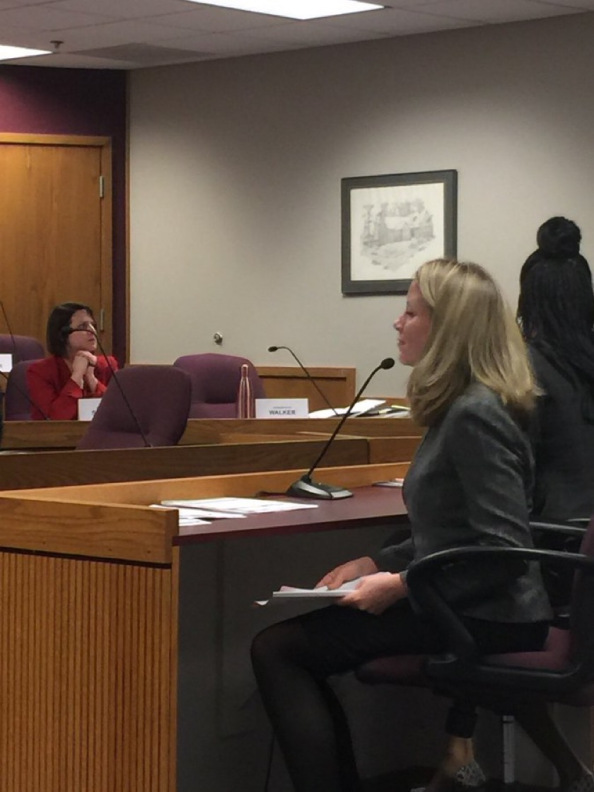
Sarah Oerther testifyinig.
Sarah Oerther MSN, M.Ed., RN, F.RSPH, is a Ph.D. candidate at the School of Nursing, Saint Louis University where she is also completing a Family Nurse Practitioner post-master certificate. Sarah has published OpEds in The Missouri Times, The Hill, and HuffPost. In 2019, she received the Excellence in Nursing Award from St. Louis Magazine.
Barbara Dossey
Barbara Dossey, PhD, RN, AHN-BC, FAAN, HWNC-BC, is internationally recognized as a pioneer in the holistic nursing and nurse coaching movement. She is a Florence Nightingale scholar and nurse theorist. She is Co-Director, International Nurse Coach Association (INCA) and Integrative Nurse Coach Academy, North Miami, Florida; International Co-Director and Board Member, Nightingale Initiative for Global Health (NIGH), Santa Fe, New Mexico, and Gatineau, Quebec, Canada.
Mona Shattell
Mona Shattell, PhD, RN, FAAN is associate dean for faculty development and professor at the Johns Hopkins School of Nursing in Baltimore, MD. She also holds a joint appointment in the Johns Hopkins Bloomberg School of Public Health, in the Department of Environmental Health and Engineering. She is the Editor of the Journal of Psychosocial Nursing and Mental Health Services, and the author of more than 140 journal articles and book chapters. She is an active social media user, content developer, and public thought leader. She has published op-eds in the New York Times, The Atlantic, Health Affairs Blog, Huffington Post, PBS, and others.
Throughout the history of professional nursing, nurses have designed new care delivery models and transformative interventions in response to unmet needs and population health and public health challenges. These changes required disruptive thinking and bold courage in the face of broken systems, ineffective policies, and powerful naysayers. Climate change may be a modern example of a major public health crisis yet the challenges to mounting an effective response are similar. This is the story of Nurses Drawdown, a global, nurse-led movement to improve the health of humans and the planet.
Honoring the Ancestors of this Movement
Around the globe, the earliest experts in planetary health were, and continue to be, indigenous people. Their values and patterns of decision-making acknowledge the deep interconnection of human health and the health of the biosphere.
Many early nursing leaders shared a similar awareness that we ignore the environment at our peril. The ideas of Florence Nightingale, Lillian Wald, and Mamie Odessa Hale offer inspiration to transformative leaders today. Florence Nightingale is considered the founder of modern professional nursing; her astute observations and applied statistics established nursing as a science-based profession. Nightingale was an expert systems thinker who connected the health of humans to the quality of the environment. Like Florence, nurses today must recognize that nursing care is delivered in the context of nature.
Lillian Wald
Lillian Wald, the founder of public health and school nursing, faced the daunting task of addressing the health needs of resource-poor immigrants in New York City (Wald, 1915). She went to the people and lived among them. Her willingness to participate in health initiatives alongside those she served offers a lesson for transformative leaders today. Nurses can inspire people to take action on climate change by first making changes in their own lives.
Mamie Odessa Hale was another historical change agent. Hale was an African American Nurse Midwife practicing in an era of deep racial segregation. She taught community midwives simple practices based on the best science of the time thereby improving birth outcomes for African Americans (Hale, 1948). The story of Mamie Odessa Hale encourages today’s nurses to realize that simple science-based interventions, taught with respect and empathy, can transform the health of individuals and whole communities.
These early nursing leaders laid the foundation for today’s global movement to address climate change. They are a part of the Nurses Drawdown story.
The Seeds of a Movement
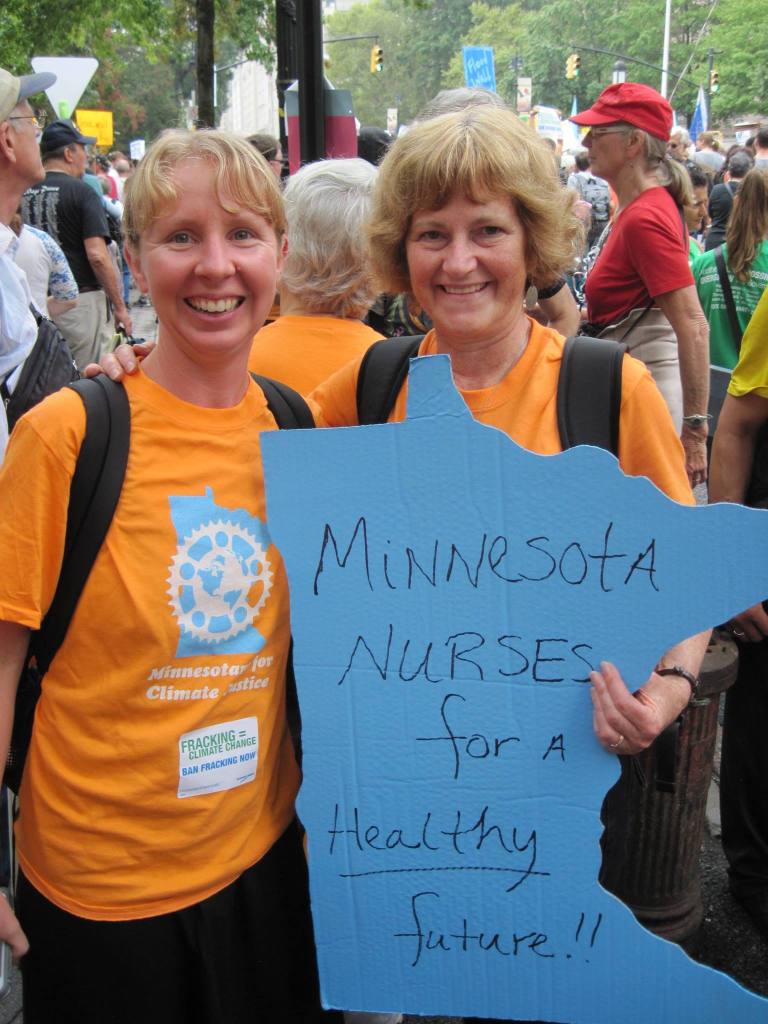
In September 2014, I took a long bus trip across the nation to attend the People’s Climate March in New York City. Over half a million people from all demographics and all walks of life came together to send a strong message that the United States must take climate change seriously and meaningfully contribute to global negotiations.
Like my fellow travelers from Minnesota, I wore a bright orange t-shirt. The only indication that I was a nurse was the sign I created that said, “Minnesota Nurses for a Healthy Future.” As the march moved through the streets of Manhattan, I was shocked how frequently observers standing along the route commented to one another, “The nurses are here!” Some even asked to take their picture with me so they could send it out on social media with the message that nurses had shown up to address climate change. I remember thinking, “What is this?” The people were not shouting, “The engineers are here!” or “The teachers are here!” There is something about nurses taking on climate change that inspired hope.
Fast forward to 2018 when I adopted the book Drawdown: The Most Comprehensive Plan Ever Proposed to Reverse Global Warning (Hawken, 2017) for “The Global Climate Challenge: Creating an Empowered Movement for Change,” a course that I teach at the University of Minnesota. Climate change is an urgent public health crisis; therefore, I teach that our solutions must be effective and have significant impact. Project Drawdown (2020)provides the solutions; could nurses provide the inspiration to scale them?
I contacted Project Drawdown and presented the argument that as the largest global health profession and the most trusted profession, nurses may be able to effectively and broadly scale Project Drawdown’s science-based solutions to climate change. Nursing’s long history of innovative leadership to improve the health of individuals, families, and communities can be relied on to improve the health of humans and the health of the planet. So, a partnership was formed between Project Drawdown and the Alliance of Nurses for Healthy Environments (ANHE).
ANHE (2019), the leading professional organization for nurses working to promote a healthier environment, coordinates the Nursing Collaborative on Climate Change and Health, a broad network of professional organizations committed to planetary health. Katie Huffling and Cara Cook from ANHE and I assembled a leadership team to plan and initiate Nurses Drawdown. It was very important that we include nurses across the globe, nurses from a wide variety of practice settings, and different demographics including nursing students.
Nurses Drawdown
The vision for Nurses Drawdown is “to improve the health of individuals, communities, and the planet through commitment to and action on the Nurses Drawdown solutions.” The mission is, “Nurses, the most numerous and most trusted health profession in the world, have the power to significantly impact climate change. By embracing and teaching the evidence-based solutions of Nurse’s Drawdown, nurses around the world will help to decrease greenhouse gas emissions and create a healthier future for humans and the rest of the planet.”
To this end, the Nurses Drawdown leadership team elected to scale Project Drawdown solutions that have the co-benefits of improving human health and the health of the planet. We selected five themes, reflecting an alignment between core nursing expertise and effective evidence-based solutions. These include:
FOOD: Committing to eat a more plant-based diet, using clean burning cookstoves, and reducing food waste
MOBILITY: Promoting walkable cities, including improving bike infrastructure and using mass transit
GENDER EQUITY: Educating girls and improving access to family planning
ENERGY: Increasing the efficiency of buildings and transitioning to clean energy sources
NATURE-BASED SOLUTIONS: Planting trees and protecting forests
An Invitation to Join the Movement
Throughout history, professional nurses have been at the forefront of change. Whether it was alleviating mass suffering related to conditions of war, addressing severe economic disparities that impact health, or responding to new and emerging infectious diseases, nurses’ orientation toward systems thinking and prevention have made them the ideal leaders for innovating and mobilizing effective solutions.
We invite you to continue this tradition by joining Nurses Drawdown at nursesdrawdown.org. Under the Take Action tab, you will find practical solutions to apply in both your personal and professional life. You will also be inspired by the stories of nurses around the globe who are taking action to promote a healthier future for generations to come.
Many will remember 2020 as the year of the pandemic. Let them also remember 2020 as both the Year of the Nurse and Midwife (World Health Organization, n.d.), and the year that nurses around the globe activated to address climate change. The nurses are here!
Clinical Professor, School of Nursing- University of Minnesota
Specialty coordinator of the Doctor of Nursing Practice in Health Innovation and Leadership
Director of Planetary Health
Dr. Potter is deeply committed to climate change education including co-founding Health Professionals for a Healthy Climate, membership in the Alliance of Nurses for Healthy Environments, and membership on the American Academy of Nursing Environment and Public Health Expert Panel. She is a member of the Coordinating Committee of Columbia University’s Global Consortium on Climate and Health Education and a Fellow in the Institute on the Environment at the University of Minnesota. She chairs Clinicians for Planetary Health (C4PH) and is a member of the Steering Committee of the Planetary Health Alliance at Harvard.
At the University of Minnesota, Dr. Potter designed and co-teaches an interdisciplinary course titled “The Global Climate Challenge: Creating an Empowered Movement for Change”. In addition, she co-leads a Health Sciences initiative titled, “Climate Change and Health: An Interprofessional Response”. In 2019, Dr. Potter was appointed the first Director of Planetary Health for the School of Nursing.


 NurseManifest