Time Magazine “Person of the Year” features Nurses!


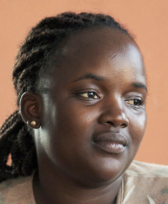
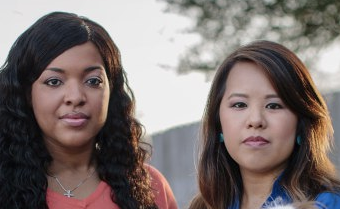
There are four nurses included in the Time Magazine “Person of the Year” – the Ebola Fighters!  These nurses are

  • TIME_Person_of_the_Year_2014__Ebola_NursesKaci Hickox, wrongfully quarantined in New Jersey and then Maine after returning from Sierra Leone where she was treating Ebola patients.


TIME_Person_of_the_Year_2014__Ebola_Nurses

  • Iris Martor, a school nurse in Monrovia, the capital city of Liberia. who is working locally to educate, protect, and help people in her local community to overcome the devastating epidemic in her country.

TIME_Person_of_the_Year_2014__Ebola_Nurses

  • Nina Pham and Amber Vinson, nsures at Texas Health Presbyterian Hospital who contracte Ebola while caring for Mr. Duncan, who arrived in Texas with Ebola and died while in the Texas hospital.


I was impressed, in reading each of their stories, of their statements of commitment to caring for those in need, and recognizing the dangers involved they remained steadfast in expressing their values.  Read their stories here where you can also take a few minutes to add your comments acknowledging these nurses!

The Nursing Manifesto: Aligning action toward living nursing as caring science and wholeness


“Organizations are not changing because people in organizations are not changing” (Cowling, Chinn, & Hagedorn, 2000).

The Nursing Manifesto provides us within the profession a beacon of light and hope toward creating change; it provides a map of sorts leading toward the manifestation of Nursing Qua Nursing. It calls for us to grow, change, and evolve into our professional caring autonomy.

My doctoral dissertation looked at Nursing’s Living Legend, Dr. Jean Watson’s Theory of Human Caring and how it could be explicated through relating it to other areas of academic disciplines: chaos theory, partnership theory, and transpersonal psychology were all used to support the concepts in Watson’s theory. My overall conclusion after many pages of theoretical writing was that nurses need to be on a journey of self-care and reflection in order to enact the human caring experience that Watson calls for.

“We believe that our journeys to enact this manifesto will certainly require a reuniting of the inner and outer life, accepting our wholeness and owning our freedom – a wholeness and freedom that will strengthen our outer capacity to love and serve” (Cowling, Chinn, & Hagedorn, 2000).

How can one love and serve in their capacity as a nurse? Several years after completing my dissertation, I was given the opportunity to develop an RN-BSN curriculum from a caring- holistic-integral science perspective at the University of Maine at Augusta. The recently accredited program emphasizes self-care and reflection, while students also have the opportunity to explore holistic modalities for use on their own healing paths and to share with others as well. The creation of this curriculum was an act of love and it continues to be a path of service toward the nurses we care for in our program.

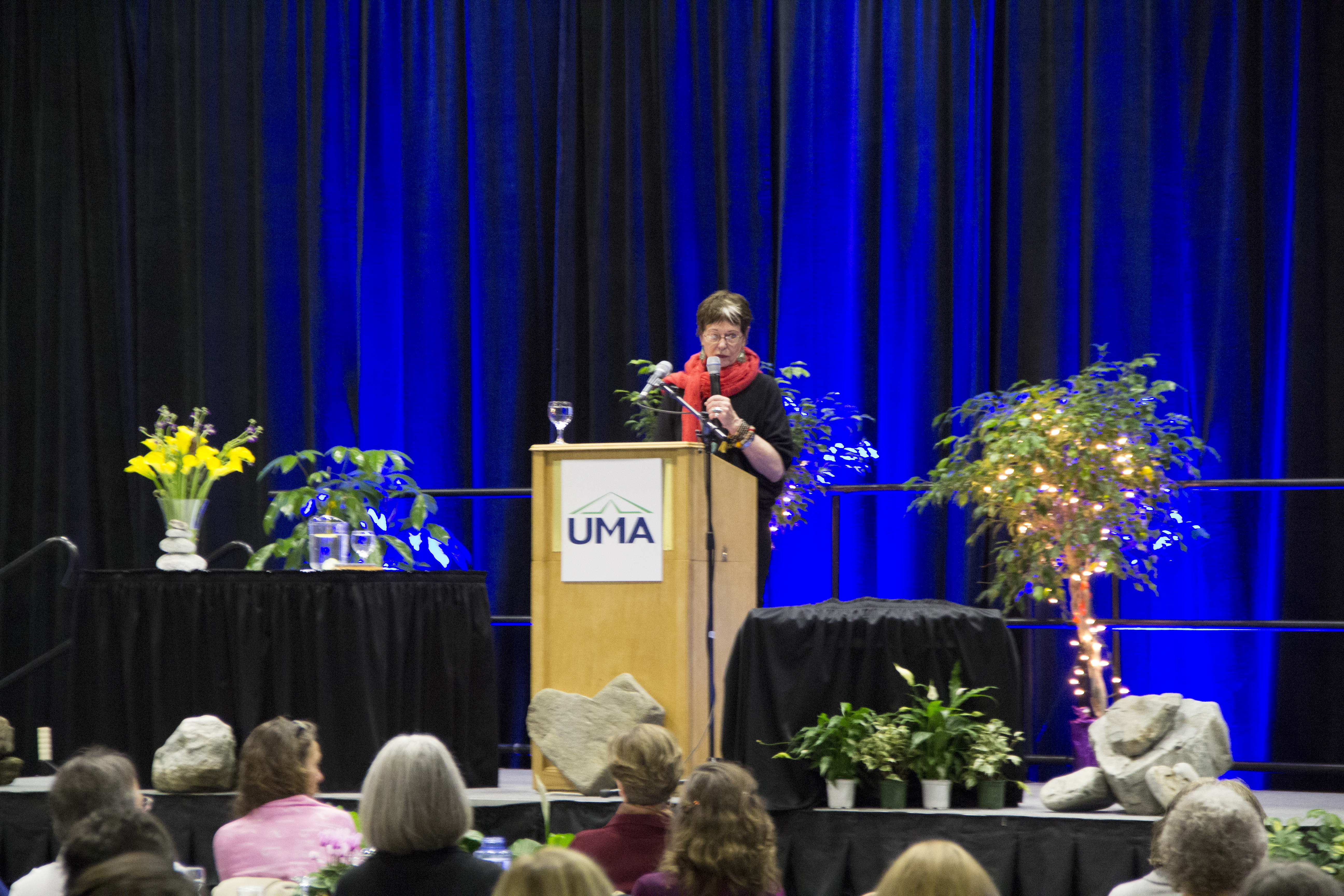
For several years, I had a dream of bringing Jean to our students and faculty. Eventually we were able to partner with our local hospital Maine General Medical Center and bring Jean not only to our students, but to nurses and nursing students from around the state of Maine. After a year of planning by a committee of 10 empowered nurses, we were able to bring over 400 nurses together to spend a day with Jean, learning about her theory.

IMG_7111

The Augusta, Maine civic center was transformed by the planning committee nurses to be a healing space; special lighting was used, break time music was geared toward songs that support healing, plants were brought in, and intentions were set by the planning committee for healing space and caring science to emerge. The lunch meal and morning and afternoon fruit offerings were also geared toward support the health of the participants.

Dr. Watson spoke for many hours throughout the day about her transpersonal caring healing moment, the challenges we as nurses face in the current medical-cure based healthcare system, and the 10 Caritas Processes that support the nurse in creating the caring moment. Participants were encouraged to ask questions and share their own experiences with caring and healing. The whole day aligned with the Nurse Manifesto process, in that Dr. Watson focused on Nursing Qua Nursing and how we can move toward a caring science reality of nursing: “It is our firm conviction that there is a body of knowledge that is specific, if not unique, to nursing’s concerns and interests. We think that this knowledge is grounded in appreciation of wholeness, concern for human well being, and ways in which we accommodate healing through the art and science of nursing” (Cowling, Chinn, & Hagedorn, 2000).

Additionally she spoke extensively about the broken healthcare system, which has morphed into an illness system, or as the nurse manifesto noted, “general subjugation of spiritual consciousness to the economics of health care” and “the long-standing ideology (acquired consciousness) of nurses being subservient to other interests, and not encouraged to be deeply committed to their own healing work” (Cowling, Chinn, & Hagedorn, 2000).

Of great importance throughout the day was the emphasis on Watson’s first caritas process: Embrace altruistic values and Practice loving kindness with self and others. The other 9 caritas process revolve around the nurse’s efforts toward enacting the first caritas process, which begins with the nurse learning to care for themselves through self care, or acting in love towards oneself.

Students provided us with feedback after the event, and they stated that the most profound experiences were being able to meet Dr. Jean Watson, and also experiencing the transpersonal caring moment through a listening experience. During this experience, the participants first centered themselves in order to speak or listen from the heart; and then in pairs, they had the opportunity to practice being present and listening without saying a word, as well as reversing the experience and speaking for several minutes from the heart. The students found this to be profound and they realized what it means to be truly present with another person in a caring- heart centered experience. Many nurses do not have the skills or experience in this area, so this is something we must continue to foster in our nursing curricula and healthcare settings. My hope is that the nurses who experienced this event will have experienced some change within themselves that will help foster the change needed in the healthcare system. Love, serve, remember….

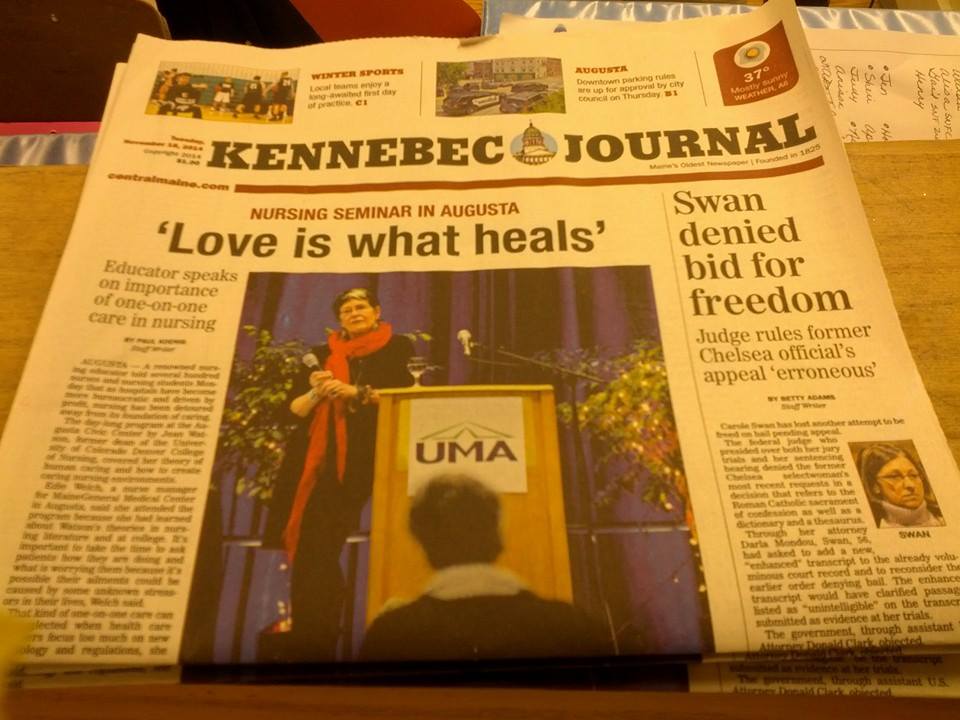
I am grateful to also have had media coverage of the event. Media coverage for nurses is of great importance, moving us out of the shadows and away from the invisible nature of our work. The front page of the Kennebec Journal on November 17 read, “Love is What Heals” and included a picture of Dr. Watson at the podium. Additionally, the event was covered by the local TV station, and that can be viewed here: http://www.foxbangor.com/news/local-news/6994-doctor-redefines-practice-of-nursing.html This media coverage is important, because as we know nurses tend to be invisible in the media, our presence often over-ridden by the medical-cure based system. We need to continue to find ways to shine our own unique light of love and healing.

JW_front page

Reference:

Cowling, W. R., Chinn, P. L., & Hagedorn, S. (2000, April 30, 2009). A Nursing Manifesto: A Call to Conscience and Action. Retrieved from http://www.nursemanifest.com/manifesto_num.htm


Historic Wilma Scott Heide eBooks now available!


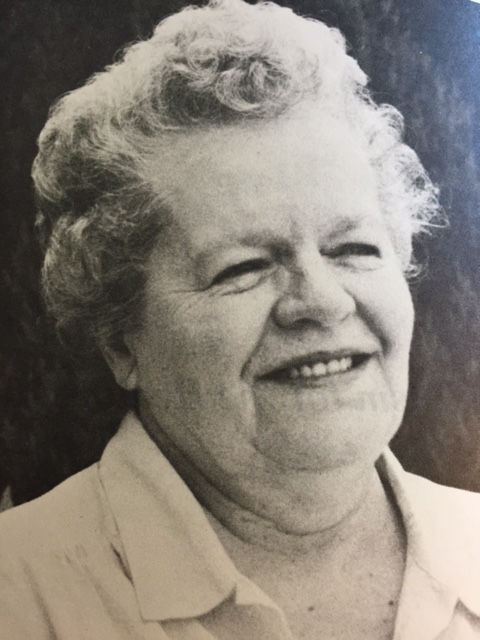
Wilma Scott Heide

Wilma Scott Heide

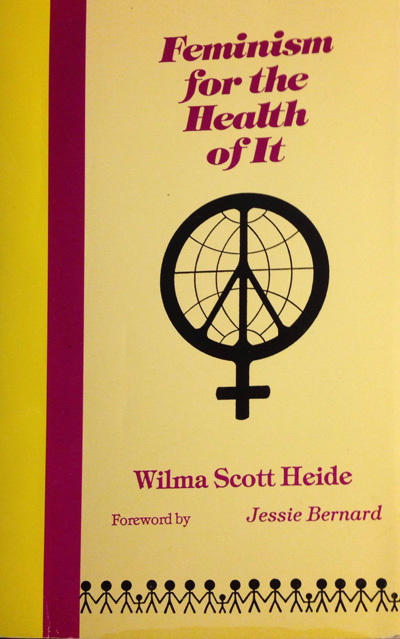
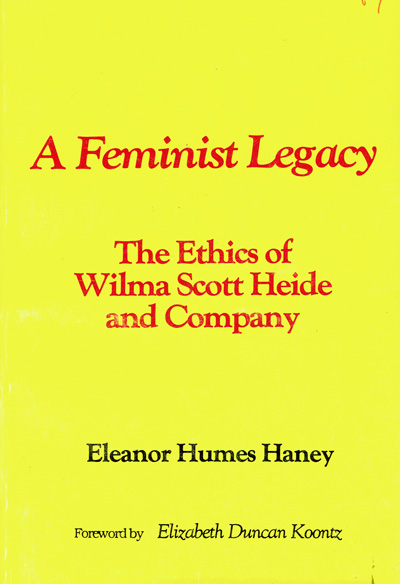
Two books of major significance to the modern women’s movement are now available as eBooks – “Feminism for the Health of It” by Wilma Scott Heide, and “A Feminist Legacy: The Ethics of Willma Scott Heide and Company” by Eleanor Humes Haney.

Wilma Scott Heide was bom on February 26, 1921 and died on May 8, 1985 of a heart attack. One of the most respected of feminist/human rights scholars/activists in the world, Dr. Heide was a nurse, sociologist, writer, activist and lecturer. During her lifetime she actively demonstrated intellectual force, caring and commitment in articulating the women’s movement imperatives for society. She served as visiting professor and scholar at several universities, consultant to various state education associations and innumerable colleges, churches and many branches of the government, education and social organizations. In 1984 Wilma described herself as: Behavioral Scientist at American Institutes for Research; Human Relations Commissioner in Pennsylvania; Chairone of Board and President of NOW (1970-1974); Professor of Women’s studies and Public Affairs at Sangamon State (would-be) University in Illinois; Feminist and Humorist-at-Large

These two books were originally published in 1985 by MargaretDaughters, a small independent feminist publishing company founded by Charlene Eldridge Wheeler and Peggy Chinn.  They named their company after their mothers, both of whom were “Margaret.”  They met Wilma on the occasion of an International Women’s Day celebration Heide-Coverin Buffalo, New York where Wilma was featured as a guest speaker.  Her dissertation, titled “Feminism for the Health of It” had never been published in book format, and the eager Margaretdaughters publishers were thrilled to have the opportunity to bring this important work into book form.  Shortly after, they connected with Ellie Haney, who had been planning a biography of Wilma’s life that highlighted the amazing and inspiring feminist philosophy that grounded Wilma’s work.

Wilma challenged the patriarchal status quo with an inimitable humor, keen intellect, and a steadfast feminist commitment.  She was the third President of NOW, during which she actively led the organization to turn away from the homophobic “lavender menace” Legacy-Cover2messages of the earliest years of the organization.  She led a number of actions of civil disobedience, several of which contributed significantly to moving the Equal Rights Amendment out of committee and into the nation-wide U.S. constitutional review process.  She insisted that newspapers cease segregating the “help wanted’ columns by “male” and “female” – a change that is possibly one of the most influential in expanding economic opportunity for women.

Even though she did not practice nursing for most of her career, she never waivered in her identity as a nurse and her commitment to the deepest values of nursing that are today reflected in the Nursing Manifesto – caring, the right of all people to a high level of health and wellness, the essential element of peace in realizing health for all, and the imperatives of consciousness and action to bring about real change.

There are elements in both books that may seem limited or inadequate given the perspectives we have today, but both remain significant and current not only for their historic value, but for the light they shed on today’s persistent political and social challenges for women, for nursing, and for health care.  I am thrilled to have brought these works forward into the present in accessible, affordable formats!  I hope you will visit your preferred eBook provider now and consider making them part of your library!

Composing a Life Work: Why Creativity Matters in Nursing


The following is a guest blog by Jennifer (Jen) Reich PhD, MA, RN, NC-BC Nurse Coach, Poet, Storyteller. 

Once upon a time, I wrote a story called The Healer (2011). The premise of the story is a little boy from a difficult upbringing who encounters a magical being on his way to collect sea glass. He is collecting the glass to make a mosaic for his mother. With the help of his friend, he collects enough to make one for his school as well. He grows up to be an artist, creating mosaics for his community, nursing homes, and hospitals. When he is an old man, he meets his magical friend once more. She tells him he has been a great healer and will be welcomed into her tribe. At first he doesn’t understand. She explains that since he has followed his passion and created his mosaics with love, his art has brought great healing. Love, she tells him, is always healing.

I have written poetry and stories for as long as I can remember. Often I think in poetry, and it has always been a way to help me process information and feelings, to find my voice. I started playing the trombone in elementary school and music became another outlet for me. However, it wasn’t until I began working as a psychiatric tech in nursing school that I discovered how powerful the arts were to help those suffering give voice to their experience. I also realized how important poetry and writing were for me to give voice to my own experience as student nurse and tech.

As a new nurse, I learned from mentors that though a cure is not always possible, there is always potential for healing (Dossey, 2013). Most nurses have experienced the death of a patient or client and know it is part of their work. So how do nurses cope with these sorrows? Some use self-reflection and self-care strategies while others may engage in self-negating behaviors as a way to manage their stress and pain. Sometimes, it’s a little of both. The Nurse Manifest Document Introduction (1a, 2009) states: “We call forth the written and spoken voice of nursing to be claimed and reclaimed. We seek to inspire the fullest expression of the heart of nursing through individual and collective acts. We believe there are profound possibilities in claiming our individual and professional sovereignty.” As caring professionals, nurses need to have creative outlets not only to cope and de-stress, but perhaps most importantly, to find our individual and collective voice.

Very recently, we saw an excellent example of nurses claiming their voices. It began with an instance of nurse blaming in the Dallas nurses who contracted Ebola. In the case of both nurses, before the whole story was out, fault was transferred to them (Goodwin, 2014). However, colleagues in nursing would not allow this to go unnoticed and without consequence. Nurses from organizations such as National Nurses United, stood together collectively to voice their opposition and support their sisters in nursing. Petitions were generated and spread through media outlets. Individual nurses shared their personal and professional experiences through stories shared on blogs and Facebook and Twitter feeds across the Internet. These stories went beyond the nursing community and to the public where the compassion and professionalism of nurses could be seen and heard.

Despite this inspiring display of community and support, we still hear old adages such as “Nurses Eat their Young,” or concerns that nurses are the worst when it comes to taking care of themselves. Remember in The Healer story the boy learned that engaging in his work with great love and passion brought healing to others. When we don’t take time to care for our mind, body and spirit we deny ourselves the balance and harmony we seek for our students or those in our care. Creativity is a path to touching and bringing forth the inner knowing and wisdom to what we best need to reignite our passion. For example, when I do creative self-care workshops, participants will often tell me they haven’t painted, written stories or poems, or danced since before they were in nursing school, or even as far back as childhood. Having this creative release often gives them the courage to voice what has been long held within. There is very little teaching involved on my part, they already know how to be creative. My role is to provide encouragement and help them surrender to the creative process without judgment and/or critique.

There are journals dedicated to evidence-based research on the healing effects of the creative arts in patient/client populations. Music and arts-based therapists do amazing work with arts-based interventions in individuals, groups, and communities. However, there is limited research on why creativity is necessary for the wellbeing of nurses and healthcare professionals. Further, we often don’t often reflect on how the creative arts enhance our nursing practice. One example I share is from a hospice patient I met years ago. He had been a sax player and jazz musician. We spent a little time before each assessment chatting about jazz. I was able to have a volunteer get him a CD player to listen to his music. There was a reciprocal healing process as our connection through music contributed to a sense of greater well-being on both of our parts. In addition, it opened up space for me to understand his concerns and care needs.

When we are engaged in the creative process, we are fully present. This, in turn, teaches us presence. We are so longing for presence in this world. Though more and more coffee shops pop up, most of them have a drive-thru with lines wrapping around the building. We have bigger banks and lenders, and more often than not, we aren’t able to talk to a real person. We cannot explain to an automated system that the reason we missed a bill payment for example, is that we were caring for a sick parent or child. We need creative soul-utions, not just automated systems in our daily lives, and we need these in nursing and healthcare.

I had the privilege of interviewing 13 experienced RN’s on the concept of ‘story’ as part of my dissertation work. When I sent out my recruitment flyer, I received responses immediately and could not interview everyone interested. I realized from this experience that nurses want to be heard! We need to create more spaces to share our stories, to make art together, write poems, listen to music, to dance. Whether our nursing work is on the front lines in direct care, or as teachers, coaches and/or advocates, we must reignite our love for our calling and create individually and collectively a new paradigm for healing. For though there is no cure for all of the problems facing our healthcare system and the world, when we give voice to our life and work though creativity, healing is always possible~


References

Cowling, W. R., Chinn, P. L., & Hagedorn, S,. (2000). A Nursing Manifesto: A Call to Conscience and Action. Retrieved: https://nursemanifest.com/a-nursing-manifesto-a-call-to-conscience-and-action/manifesto-with-markers-for-citation/

Dossey, B.M. (2013) In B.M. Dossey & L. Keegan (Eds.) C. Barrere & M. Blaszko Helming (Assc Eds.) Holistic nursing: A handbook for practice (6th ed) (pp. 247 – 260). Burlington, MA: Jones and Bartlett Publishers

Goodwin, W. (October 24, 2014). Was CDC Too Quick To Blame Dallas Nurses In Care Of Ebola Patient? National Public Radio (NPR) Retrieved: http://www.npr.org/2014/10/24/358574357/was-cdc-too-quick-to-blame-dallas-nurses-in-care-of-ebola-patient

Reich, J. (2011). The Healer. Retrieved: http://poetry-not-poverty.blogspot.com/2011/11/november-story-healer.html

Jennifer Reich PhD, MA, RN, NC-BC is a nurse coach, poet, and storyteller. She received her PhD in Nursing from The University of Arizona in 2011 and is adjunct faculty in the College of Nursing.  In addition to nursing, her background also includes degrees in Exercise Science:(Gerontology Specialization) and English/Theatre (minor) and training and practice in Mindfulness Based Stress Reduction, Reiki, Health Appraisal and Meditation. She has incorporated these diverse experiences to design wellness programs and teach self-care strategies to nurses and caregivers throughout the country.

You can find Jen @ https://www.facebook.com/Jenreichpoetry  and  www.poetry-not-poverty.blogspot.com. Jen wishes to thank Jackie Levin RN, MS, AHN-BC, CHTP for her review of the blog.

Jenheadshot-1

The Emancipatory Praxis of Integral Nursing


This blog will discuss my doctoral research, which was a critical narrative inquiry that sought to identify patterns in the stories of 10 nurses working in an American Nurse Wendy4Credentialing Center (ANCC) Magnet re-designated Oncology unit. Critical narrative inquiry is a research method developed by Dr. Suzie Kim (2010).  Critical narrative inquiry reflects upon societal-contextual experience and prescribed power relationships to identify, transform and transcend oppression. It deconstructs normative hegemony (the way things are or expected to be vs. the way things could be) by analyzing language, communication patterns and symbolic meanings in experience (Dunphey & Longo, 2007).

The method has 3 phases: 1) the nurses tell a story that exemplifies their experience of a theory guided practice; 2) the stories are recorded and transcribed, then critically read and reflected upon by the participants and researcher with the purpose of identifying salient patterns that emerge as facilitators or barriers to their theory guided practice; and 3) the nurses identify opportunities for transformative learning and emancipatory praxis.

During the process of the study I used Dr. Peggy Chinn’s Peace and Power model (2008) to share power with the nurses and optimize emancipatory knowledge acquisition by hearing their voices. I asked them what was important to them in their practice and in their experiences. Our research sessions were a dialogue between colleagues and I was careful to value their voice and power throughout the study and publication.

The purpose of the research was to:

  • Examine the impact of Human Caring theory guided practice upon nursing qua Nursing.
  • Learn about nurses’ educational preparation in theory guided practice and integral nursing.
  • Examine the relationship between nurses knowledge, caring and power in the Magnet environment.
  • Identify patterns that facilitate and create barriers to nursing qua nursing.

What we learned from the research was:

  • Nurses are transformative change agents who advocate for their patients, even against normative views and authoritarian power if it is in the best interest of their patients and families.
  • Nurses have a language and culture of rich values enacted through careful and meaningful comportment via her/his self-agency that protects and preserves the integral health of those in their care, community and environments.
  • Environments are affected by nurse’s behaviors and actions; external environments are carefully created to enhance patient’s internal environments via; lighting, ambient temperature, music, positioning, cultural, spiritual and religious acts, healing intention, touch, voice and presence.

These findings support Jarrin’s (2012) work where she describes nursing as “Situated Wendy1caring shaped by internal and external environments. These environments include: the individual nurse’s state of mind, intention and personal nursing philosophy, their scope, role, level of skill, training and experience societal and professional norms, values, and worldview social, political, and economic systems embedded in education and practice environments” (p. 14).

This research further supports Kagan, Smith, Cowling and Chinn’s (2009) work that rally’s nurses together for social justice and to protect and support professional values that empower nurses at all levels. The nurses in my study identified that working with nurses who value and support each other; while valuing and seeing the big picture or true meaning of protecting, advocating for and enhancing the patient and families integral health experience, creates optimal work and patient care environments.

Emancipatory praxis requires a convergence of multiple patterns of knowing, doing and being; where the nurse can sense and see patterns that are emerging; and imagine what can become for self, colleagues and those in their care. The knowledge, caring and power dialect is a rich area of inquiry for nurses to conduct further research.

References

Dunphey, L. & Longo, J. (2007). Reflections on postmodernism, critical social theory and feminist approaches: The mind of the postmodern. In P. L. Munhall (Ed.) Nursing research: A qualitative perspective (4th ed., pp. 127-142). Sudbury, MA: Jones and Bartlett.

Jarrin, O.F. (2012). Redefining the metalanguage of nursing science: Contemporary underpinnings for innovation in research, education and practice. Advances in Nursing Science, 35(1), 14-24.doi10.1097/ANS.obo13e3182433b89.

Kagan, P. N., Smith, M.C., Cowling, W.R., & Chinn, P.L. (2009). A Nursing Manifesto: An emancipatory call for knowledge development, conscience, and praxis. Nursing Philosophy, 11, 67-84.

Kim, H.S. (2010). The nature of theoretical thinking in nursing (3rd ed.). New York: Springer.

Marks, L.W. (2013). The Emancipatory Praxis of Integral Nursing: The Impact of Human Caring Theory Guided Practice Upon Nursing Qua Nursing in an American Nurses Credentialing Center Magnet® Re-desginated Healthcare System. Retrieved October 21, 2014 from http://tinyurl.com/ovqlk3t