Futile Care: Alive and Well in America


Contribution by Carey S. Clark, PhD, RN, AHN-BC

I recently supported a dear friend of many years who was faced with caring for her terminally ill husband. We were part of a small group of fast friends, having all gone to the same college, and we spent many years afterwards celebrating life and adventuring together. In many ways, this special couple had been family to me over the years.

One challenge for me as a nurse was being 3000 miles away and relying on text and cell phone calls to assess my friend’s status and prognosis. While I was fairly certain that once he was put on the ventilator, given his complex medical situation,he had numerous ailments that were too complex to be treated at home one of which was leaky gut. Not even a nurse coming to the home would have been able to give him the care he required. He would not be successfully extubated and go on to be discharged, the medical staff were not clearly communicating this to my friend who was trying, despite her grief and stress, to make the right decisions for her husband.

The conversations I had with my friend ran deep, and the main challenge was supporting her in getting the prognosis clearly from the various providers; my biggest questions for her to answer to help support my assessment were why is he still on the ventilator, what is the prognosis, and what did he want medically at the end of life? It turns out he wanted all medical-technical interventions possible if there was hope for his recovery and some quality of life; but what was not being conveyed clearly here was the hope of recovery issue.

After several days of the husband being on the ventilator, my friend was able to listen to the renal team discussing her husband’s care, and it became clear to her that he was not being “cured” or healed, rather they were prolonging his inevitable death. The hospitalist was in a little bit of opposition to the renal team, with the hospitalist wanting to continue care, play wait and see for a little while longer. My friend recently reflected that the hospitalist was okay with simply keeping her husband alive, with no apparent concern for his quality of life. Finally, when my friend’s husband became septic a few days after intubation, when the full team finally confirmed that the prognosis was extremely poor, she was able to make the decision to remove the life support. He passed away peacefully shortly thereafter.

Unfortunately, this scenario of futile care and over-use of technology at end of life is repeated over and over again, on a daily basis, in nearly every hospital in America. While we know that technology use can save lives, we also know of the pain and suffering it can cause. For instance, Johns Hopkins recently reported that fully 30% of people intubated in the ICU setting suffer from PTSD post extubation. When people state that they want everything done for them if there is still hope, we need to consider that folks may really not know what they are consenting to, the suffering that technology in futile care cases can create, or the improbability of recovery after undergoing a full code scenario in the hospital. Their knowledge and experience with end of life technologies is often limited to what they see on TV or in the movies, the heroic efforts, the beautiful deaths, the rapidly unfolding peaceful or positive conclusions that bare little resemblance to the reality of end of life care.

As healthcare providers, nurses and doctors do know. Most doctors clearly do not want aggressive technologies used for themselves, and yet they need more training on clearly communicating when care is overly-aggressive or clearly futile; the following article clearly summarizes the research with doctor’s preferences around technology at end of life and the sort of training both doctors and nurses need to do to support better end of  life care. http://www.healthline.com/health-news/end-of-life-treatments-doctors-patients-differ-060314#3 

As Dr. Angelo Volandes in his Boston Globe Opinion article stated, we need a complete overhaul of end of life care in this country. “I have heard patients and families demand that we “do everything,” to prolong their life, but in many cases they, unfortunately, have little idea what “everything” means because no one has explained their options clearly. Sometimes, patients and families don’t want to face death. But more often, the problem lies with the medical profession. The principal reason we have gotten death so wrong is because doctors fail to have meaningful discussions with patients and their families about how to live life’s final chapter.” (Read the full article here: http://www.bostonglobe.com/opinion/2015/01/11/prescribing-end-life-conversation/GfhqbsYR8KjaD3ePWlK6JI/story.html).

Unfortunately, it remains true today that approximately 60% of the population in America will die in the hospital, even as we know 80% of folks would prefer to die at home. Meanwhile, the media generally continues to portray death inaccurately. In our culture the general public has little to no opportunity or incentive to educate themselves around death, and yet it is where we are all headed. Although it may be “easy” or “correct” for nurses to go along with doctor’s orders and provide futile care day after day, at what point do we decide to do our care differently, to step fully into our role as the patient advocate? Although we can’t divulge specific prognosis, we can discuss the limitations of technology. We can sit with families and discuss the reality of the care provided, and we can encourage them to have those conversations with the doctors: “What is the plan of care, what is the likely outcome, is the technology use just prolonging life without hope of recovery, is the technology use painful or likely to cause PTSD, what will life be like if my loved one does survive, are they suffering from the use of this technology, and what about quality of life now and into the future?”.

Why can’t we just include a list like this as a guide for doctors and nurses in facilitating their communication process, to really strive for educating families, patients, and decision makers around end of life care and futility? Why do we assume that folks really know what it means to “do everything”? We can become more comfortable with the types of conversations families need to have as they approach end of life, particularly if we spend the time to be reflective about our own future death experience and the deaths we have witnessed both professionally and personally. We can think about how different death seems when it is our loved ones facing this transition, and how we perhaps at times distance ourselves from the death of our patients. We can consider how in the last 100-150 years death in America has been removed from the public view, from the home and places of comfort, from the natural progression of life, and consider how death has become institutionalized in our hospitals. We can consider the healthcare costs around end of life care and how that impacts available resources and compounds the amount of money we continue to spend on healthcare. We can think about the nurse’s role around supporting healing at end of life, and what we want that to look like for our profession and those we serve. We can look more closely at our own end of life fears and concerns that make it challenging to care for those hospitalized at end of life.

I am currently teaching a thanatology (study of death and dying) course for nurses that I designed in way to support students to go deeply in their reflective process around death and dying, to explore the holistic needs of the dying, and to delve into the body of evidence around the science and politics of death and dying. While the course is challenging for students on many levels, it is also transforming their nursing practice, touching them deeply on a personal level, and helping them to advocate for others at end of life. I remain hopeful that someday every healthcare provider from MD to RN to Social Worker will have the opportunity to take a thanatology course like this and that out culture will eventually strive to start death education at earlier stages in life, moving toward acceptance that this life is impermanent, and that it is perfectly okay, natural, and normal to die; that one can indeed refuse treatments and technology regardless of age; that living well leads to a positive death experience. There is a new movie available that aligns with this purpose, called Death Makes Life Possible. I highly suggest using this movie as a tool to support discussions around end of life and open up to the possibilities of “transforming fear into inspiration”:  http://deathmakeslifepossible.com

AJN: A premier nursing journal


For many nurses, the American Journal of Nursing is a journal we were introduced to as a student, but for one reason or another it faded into the past with little notice.  But this ajn0315-cover-onlineis a nursing journal that has a remarkable history, since its founding by Sophia Palmer in 1900.  The early contributors to the journal were significant nursing leaders who played major roles in establishing nursing as we know it today.

Charlene Eldridge Wheeler conducted an analysis of the first 20 years of AJN that was published in ANS in 1985. Charlene’s abstract provides a succinct summary that reveals not only the importance of AJN in shaping nursing as a profession, as well as the significant connection that the Nurse Manifest project shares with the journal and the early leaders who wrote the early content:

The editorial position and content of each issue of the first 20 years of the American Journal of Nursing were explored in relation to the emergence of nursing as a profession. Themes identified reflect professional issues, socialization of nurses, and the influences between other major social/political movements. The evidence of the study reveals strong nursing leadership toward (1) legitimatizing nursing as a self-controlled profession and (2) generating reform in nursing and society at large. The evidence of this study contradicts many prevalent popular views about the history of nursing.

But fast-forward to today – this historically significant journal is well worth noticing, and noting the connections that persist with the values that we speak to on this NurseManifest blog.   In the March 2015 issue, Editor Shawn Kennedy writes about the significance of the March Women’s History Month, and the importance of nurse leaders throughout history, women who are largely unknown and unacknowledged but whose accomplishments were ground-breaking.. You can see Shawn’s Editorial, and follow the journal on the AJN blog – Off the Charts.

The March issue, like all of the recent issues, contains several articles that connect in spirit to our NurseManifest project –

  • “Perspectives on leadership: Conflict Engagement: A New Model for Nurses” that launches a series of future articles on leadership.
  • “Advancing Health through Nursing: Progress of the Campaign for Action” that continues a series of articles that provide an update on the impact of the IOM 2010 report on the future of nursing.
  • A report on moral distress in nursing
  • A “Reflections” column that is published in most issues of the journal, that shares reflective stories of nurses’ experience in practice.  The March column is titled “Am I Going to Be OK? Keeping the Trust of Patients at Critical Moments.”
  • An “Art of Nursing” column that appears in most issues.  The March column is a poem relating a tragic experience in an emergency department waiting room.

You can see the entire table of contents, and at least view abstracts on the AJN web site.  If you have not seen AJN lately, I highly recommend taking another look, and follow Off the Charts!

Language and Nursing Care


In 1993, I gave an inservice for nurses on a School-Age Pediatrics Unit. The purpose of my talk was to discuss the importance of putting patients first by avoiding calling them by their diagnoses. We discussed how “diabetic” and “asthmatic” and “leukemic” and “sickler” are labels, and that there is so much more to each child than a disease or medical condition. I was saddened last year when I came across my notes from this talk and realized that things haven’t changed enough. We have not eliminated the words in health care that can hurt people, and maybe even lead to negative health outcomes.

I am a nurse and certified diabetes educator. I have been working with people who have diabetes for 20 years. I’ve lived with diabetes myself for almost 40 years, which is certainly one of the reasons I take language seriously – I know how it makes me feel. I remember my pediatric nursing courses, where we learned to avoid words that were potentially frightening to children, such as “stretcher” and “shot.”  Instead we were taught to use “gurney” and “injection.” I also remember a friend who was infuriated when the family physician called his baby “failure to thrive.” “No one is going to call my son a failure,” he fumed, not understanding what the term meant.

In diabetes care there are many words that imply judgment, shame and blame. Words such as “compliance,” “control,” “test,” “good,” and “bad.” And the list goes on – I have heard people with diabetes referred to as “recalcitrant,” “non-compliant,” and even “neurotic.” Nurses discuss patients through both speaking and writing. They sometimes use these words directly with patients, and often with each other. I believe that people with diabetes can sense when a health care professional deems them “non-compliant” or “poorly controlled,” even if they refrain from saying those words to their faces.

Where do those words come from? Why would people who choose a helping, serving career such as nursing, use words that could hurt people? It started with the acute care model, on which our health care system was founded. People came to health care professionals for help and were told what to do to “get better.” Taking medication for an infection, or changing a bandage, is very different from managing the daily tasks of a chronic disease. Since health care professionals don’t go home with their patients and help them manage their disease day in and day out, it truly is self-care or self-management. And it’s hard to deny that our health belongs to us. Therefore, words like “compliance” and “adherence” don’t belong in chronic care. Those words mean doing what someone else wants. People with diabetes make choices every day, and those choices determine how they take care of themselves, how they feel, and their health outcomes.

Another judgmental word is “control.” “Glycemic control” is so ingrained in our diabetes terminology that very likely most people don’t realize how often they say it and read it. But how much control does the person with diabetes actually have? Despite modern advances in technology and medications, it is not physically possible to keep blood glucose levels in the normal range all the time for those with diabetes. With much effort it is possible to manage diabetes, but perfection cannot be achieved. Using words like “control” makes it appear that control is possible and those with diabetes are not doing a good enough job.

Diabetes is a demanding disease with an emotional toll. Many, if not most people with diabetes experience some level of diabetes distress due to the stresses of diabetes. These stresses include the daily tasks of poking fingers, taking medications, scheduling and attending health care visits, and thinking about every morsel of food they eat. Add to that the constant questions and concerns from family and friends and society in general. Having to endure judgmental words from health care professionals on top of all that could really be the last straw. What if our words lead to further burnout or discouragement? Better yet, what if changing our words could empower people with diabetes to take better care of themselves?

Nursing is known as the caring profession because we truly care about people and their health. It’s time to match our words with what we do and what we stand for. Becoming aware of the words we use is the first step. Let’s really pay attention to the words we speak, read and hear in practice and in everyday life, and think about how they could be affecting people’s health. Stay tuned for a future blog post with ideas for words that empower people. And please feel free to add your own experiences with language in nursing care.

Social Justice as Advocacy: Where Are The Nurses?


by Nursemanifest blogger Wendy Marks

As the cost of providing healthcare skyrockets, some institutions and countries are Marks1suffering severe nursing shortages. An article in the NY Times (Hakimfeb, 2/8/15) describes the private sale of non-nurses to care for hospitalized patients in Greece.

The hospital administration and nursing staff, stressed from the healthcare systems austerity budget and the barebones operations, are helpless in preventing or stopping this illegal activity. These non-nurses are unlicensed and/or uneducated, but needing the work they are willing to take the risk and challenge.

So, where are the nurses who have been properly educated and licensed?  They have been let go, cut from the budget, forced to retire or seek different employment. Why should we care about what is happening in Greece?

According to the National League for Nursing “nursing care involves social justice: who should receive its benefits, how much they should receive, and who should take up the burden of providing and paying for it.” (NLN, 2015).

What if we were nurses in a country where patients or the healthcare system could not afford to pay for our services? What would we do?  Would we lobby for change or would we watch powerlessly as our economic and healthcare system failed?

What if only the elite could afford care by a licensed and well-educated nurse while others had the barebones minimum care by anyone who could help?

This is a civil and human rights issue. As Maya Angelou said, “… equal rights, fair play, justice, are all like the air: we all have it, or none of us has it. That is the truth of it.”

We live in interesting and challenging times. The power of education can be used to help protect and advocate for safe, professional nursing care that has been scientifically proven to prevent harm and save lives.

One nurse led organization that provides humanitarian nursing care around the globe has a mission to address this concern – Nurses without Borders.

Today, I am grateful for the privilege of my education, licensure and healthcare system and send my support to nurses around the globe as they fight for their rights and advocate for social justice.

References

Hakimfeb, D. (2015). Greek Austerity Spawns Fakery: Playing Nurse. Retrieved from
http://www.nytimes.com/2015/02/08/business/greek-austerity-spawns-fakery-playing-nurse.html?_r=0

National League for Nursing (2015). What is Advocacy? Nursing is Social Justice Advocacy. Retrieved from
http://www.nln.org/facultyprograms/publicpolicytoolkit/advocacy.htm

Nurse without Borders (2015). Retrieved from http://nursewithoutborders.org

Marks3

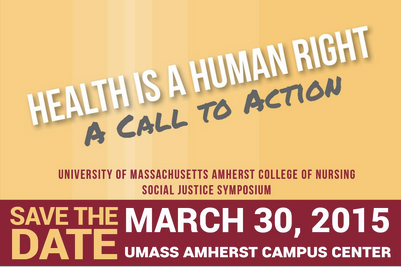
Social Justice Symposium – UMass Amherst, March 30, 2015


The UMass Amherst College of Nursing is proud to present this one-day interdisciplinary symposium providing an opportunity to engage with local and global practitioners of social justice health and health care. UMass_Amherst_College_of_NursingThis is one of the first nursing initiatives  providing an opportunity to engage with local and global practitioners of social justice health and health care.

Registration is now open!  Registration is $50 ($15 students), and includes breakfast and lunch

Download the Symposium flyer to see more program details, including snippets about all of the speakers!

The symposium will feature:
• Digital Storytelling in Social Justice led by the nationally acclaimed Center for Digital Storytelling. Daniel Weinshenker, the Center’s Midwest Director, specializes in developing projects that explore the impact of digital storytelling for youth and areas within the health sector.
• Break-out sessions by leading population-based scholars and practitioners on areas such as aging, diversity, violence, and sexual and reproductive health rights.