Making a list – of ways to support health, equality and justice for all


A couple of days ago I received an email from Elizabeth Berrey, who is one of this project’s leaders, in response to my post of November 15, “Grieving for my country.” Her message inspired me to think quite specifically about the list of things that I will do over the coming months to participate in action to resist the dangers that are becoming more and more clear in the US and world-wide, threatening the health and well-being of world citizens everywhere.  After all, his is the time of year that our children are making lists in anticipation of the December holidays,  At the same time, the notion of “lists” in and of itself raises a specter of danger for many – for example, there is now a website recruiting names of “liberal professors” (see report here and here).

So let’s be clear – making a list of ways we can act and be involved can serve to inspire others, particularly those who are tempted to give up in despair given what is happening around us.  But the list must also lead to action – and this is what is so inspiring about Elizabeth’s message.  We may not agree about the specific ways to act, and we can certainly have a discussion about the race, class and economic implications of any action we choose to raise awareness in the quest for finding the best and most effective avenues.  But unless we act, and support those who are choosing different paths than our own, we in fact support the forces of injustice.

Elizabeth has given me permission to post her message here – so here it is, lightly edited, in the hope that the actions she is taking will inspire you to go beyond a mere list – to find your own ways to get involved!

Hi Peggy,
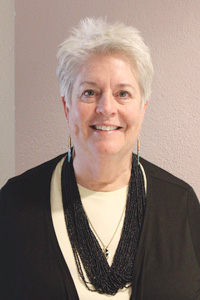
I have now read your post & sent it to my kids, some nurses, & other non-nurses.  I especially like that youEB-Photo-250 said that we must be ready at a moment’s notice. I also read the replies to date. Thx so much for clarifying to the person who wrote that we should stand with Trump & give him a chance.
I have been wearing, & will continue to wear, my safety pin – a large one in the top hole of my left ear. I brought safety pins to our NMOLOC  (New Mexico Old Lesbians Organizing for Change) Gathering this month, & explained what it means to the old Lesbians gathered. Our Unitarian church handed them out the 2 Sundays after the elections, with explanations for the whole congregation & especially the children.
As I think that I told you, I am working here in NM to get our state legislatures to sign onto the National Popular Vote Interstate Compact. Nurses across the country could do this, too! They could certainly activate their nursing associations to lobby their state legislators to sign onto this compact. This is the 2nd time that the electoral college has overturned the majority vote in this country since the turn of this century, for heavenssakes! As someone on the Laurence O’Donnell show said a couple of wks ago, “What we call the popular vote here in the US is called the vote in the rest of the world!”
We are organizing our NMOLOC chapter to show up in Santa Fe for the Million Women March (our state’s version). We’ll have our old Lesbian banner, of course!
We are planning training in resistance in our NMOLOC chapter for the coming yr — reminding us all of what we learned, and practiced, so many yrs ago. As you say, we must be ready!

Sociopolitical Knowing: Connecting with hearts, minds, guts, and groins


[Edited 8/6/16] At a time when many are celebrating the official nomination of Hillary Rodham Clinton I am also acutely aware that many are not. While there are many valid concerns that have been raised, what troubles me most is to hear the contempt and disbelief that anyone could support Trump. It concerns me because it reflects a de-humanizing and de-valuing of many in the white working class.

We expect that our students and coworkers will be sensitive to the values and personal goals our patients and their families. We expect nurses to be non-judgemental towards patients who are living in poverty, suffering from addictions, or making decisions that do not seem based in upper-middle class norms and values. Can we also expect nurses to develop an understanding of how to be respectful and understand what is important to people with different political views. 

Sociopolitical Knowing is a core strength of professional nursing. Conceptualized by Jill White in 1995, sociopolitical knowing occurs on two levels:

1) the sociopolitical context of the persons (nurse and patient), and 2) the sociopolitical context of nursing as a practice profession, including both society’s understanding of nursing and nursing’s understanding of society and its politics. [emphasis added]

To start the dialogue, I am circling back to the Spiral Dynamics model that was used to organize the sociopolitical context of nursing in the published Results from the Nurse Manifest 2003 Study: Nurses’ Perspectives on Nursing.

Trump_&_Clinton.jpg

Basics principles of leadership and motivation according to Spiral Dynamics:

  1. identify the specific needs and capacities of individuals and groups, and
  2. calibrate the precise developmental messages that fit each unique situation.

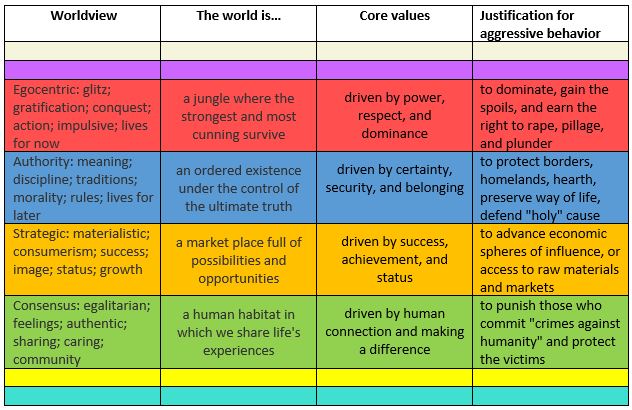
Sociopolitical knowing requires an understanding of how to connect with and motivate people where they are. It means developing an understanding of what messages will be most effective in “pushing someone’s buttons” or eliciting a strong emotional response. The table below highlights the most prevalent value memes in modern society – defined through worldview, core values, and value-based reasons for violence and war. 

spiral dynamics.JPG

How Trump connects: From sexual innuendos and vulgar speech to stoking conspiracy theories and racist viewpoints, Trump often makes his connection with people’s minds, guts, and testicles. He has effectively tapped into pent-up frustrations and fears, justifying aggression and intolerance to make America “great again” (red and orange) and “safe again” (blue and green). 

How Clinton connects: From It Takes a Village to Hard Choices, Clinton has a long history of speaking to people’s hearts, minds, and ovaries. She has effectively tapped into national pride and hope, focusing on accomplishments that make America “great right now” (red and orange) and safer through unity and tolerance (blue and green). 

Both campaigns employ messaging that is strategically targeted at different audiences. The point of this blog entry was not to start a political debate — this is not the place for that. Rather, I am hoping to start a conversation about understanding how we might apply sociopolitical knowing to strengthen our ability to communicate with others. I hope that through application of sociopolitical knowing we can better connect with different communities about the work of nursing, and issues that impact the patient populations and communities we serve.

Please help build the dialogue around sociopolitical knowing, through comments here, and conversations with your coworkers, family, and friends. 

References for further reading:

Beck, D. E. Human Capacities in the Integral Age: How Value Systems Shape Organizational Productivity, National Prosperity and Global Transformation

Charen, M. What Hillbilly Elegy Reveals About Trump and America: A harrowing portrait of the plight of the white working class. National Review, July 28, 2016.

Harryman, W. Is Hillary Clinton the First Integral Politician? Integral Options Cafe, November 6, 2005.

Jarrín, O. F. Results from the Nurse Manifest 2003 Study: Nurses’ Perspectives on Nursing. Advances in Nursing Science, 29(2), E74-E85.

Pew Research Center. Few Clinton, Trump Supporters Have Close Friends on the Other Side. August 3, 2016.

Schwartzbach, S. M. Drowned: Nurses Under Water. The Nurse Sonja. July 27, 2016.

Vance, J. D. Hillbilly Elegy: A Memoir of a Family and Culture in Crisis. 2016; HarperCollins: New York, NY. 

White, J. Patterns of knowing: review, critique, and update. ANS Adv Nurs Sci. 1995 Jun;17(4):73-86.

Book of the Year Award – twice!


On September 14, 2014, I posted news of the newly published book “Philosophies and Practices of Emancipatory Nursing: Social Justice as Praxis,”  noting its relevance for all NurseManifesters!  The book is edited by Paula Kagan, Marlaine Smith, and Peggy Chinn, and contains 22 original chapters by some of the leading nurse scholars in the area of Emancipatory textcritical inquiry.  The book has gained some attention, but in January, it was awarded two AJN “Book of the Year” awards – in the categories of History and Public Policy, and in Professional Issues.  You can see the press release about all of the awards here.  The link to. the article online is here.  The detailed comments of the reviewers are posted on the web as supplementary digital content; you can access this information online as a subscriber, or through your library.  The book is available in both paper and electronic formats – here is the Amazon link!
We are thrilled with these awards, not just because we know how important this book it, but because it is amazing for a book of this type to gain this kind of recognition in a “field” that typically focuses on very pragmatic and even “technical” topics.  Both of the reviewers who selected the book in their category commented on how accessible the content of the book is, even though much of the focus is on complex philosophic ideas.  If you have not yet had a chance to see the book, consider asking your library for a copy, and take some time to browse, and read!  Share your comments here about the details you see as particularly important for manifesting nursing!

Courageous Conscience: Engaging in Politics with a Capital “P”


When I began thinking about a topic for this blog last fall, Canada was in the middle of a federal election and the upcoming U.S. presidential election was already making the news daily. I thought about the changes that have occurred in both our countries and globally since neoliberal ideas privileged “the market” over elected governments in the 1980s. Increasingly, policies reflect the interest of big business and the dictates of “the markets” rather than the electorate. And although both countries are arguably now plutocracies/oligarchies, both maintain a semblance of democracy through democratic structures and processes, such as elections. So what does this have to do with nurses and nursing?

The Nursing Manifesto itself answers that question. It is a call to action and one avenue for that action is engagement with political processes. I am reminded of an address Patricia Moccia gave at a conference in the late 1990s in which she used the term “citizen nurse” to remind us of the importance of bringing a nursing voice to the political table. With the percentage of eligible voters who actually vote near record lows – 54.87% in the 2012 presidential election and 61.1% in the 2011 Canadian federal election – one group could significantly shift results. In fact, in the recent 2015 Canadian federal election, the Liberal party made a concerted effort to get out the “youth vote.” The result was not only a change in governments, from Conservative to Liberal, but an increase in voter turnout to 68.3%. Imagine the possibilities if nurses mobilized to vote!

I’m not suggesting that all nurses will vote alike, any more than “the youth” in Canada did! But I am suggesting that increasing the number of nurses who vote has the potential to influence the outcome of an election. What we have in common is commitment to care for people, for promoting health, for social justice. Our work, then, as citizen nurses is to discover which party or candidate most closely aligns with our own values and become as involved as is right for each of us in supporting that party or candidate. It may involve running for office, contributing money, volunteering to work for a particular candidate, or simply but equally importantly, making an informed vote.

Voters, to my mind, are followers in the democratic process. Robert E. Kelley, who has studied followership for more than 30 years, initially characterized followers on 2 dimensions: active engagement and critical thinking. His 5 categories of followers included sheep and yes-people, neither of whom are critically engaged. As voters, sheep would wait for direction on how to vote, perhaps relying on family or community tradition (my family has always voted this way). A yes-person might be more actively involved with a candidate or party but simply accepts the “party-line” without question. Alienated followers, Kelley asserted, think critically but bring much negative energy with them. Voters in this category might spend that energy criticizing the candidates, parties, the system and either spoiling their ballot or loudly proclaiming their refusal to vote. Pragmatics, Kelley’s 4th category, align themselves with whoever is winning. As voters, they might watch the polls and vote with whoever is leading.

Kelley’s final category is that of effective or “star” followers who are actively engaged critical thinkers with a “courageous conscience” to stand up against illegality and injustice. I think this category of followership exemplifies what being a citizen nurse is about.

The Legacy of Paulo Freire


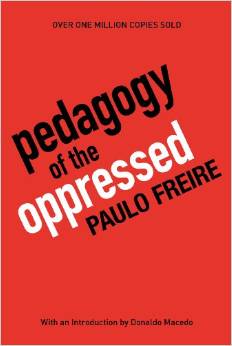
For those who have followed this project for a while, you already are aware of the influence of Brazilian educator Paulo Freire, whose book “The Pedagogy of the Oppressed” has influenced not only this project, but the work of many of us involved with this project.  Recently I became aware of a number of YouTube videos about Freire and his work, some Freirein Portuguese, but many in English! Viewing them reminded me of the importance of returning again and again for inspiration that arises from these ideas — inspiration that keeps our gaze on what is possible and that overcomes the distress that comes from some of the discouraging events that surround us every day!  I will post one of the short videos below, but also want to be sure that everyone knows about the online “Paulo Freire Formation” course offered by the Freire Institute.  Here is a brief description of what this course is all about:

This is an in-depth online programme for activists, organizers and volunteers committed to social transformation. It provides training for those wanting to become more effective change agents. The six courses are taken online but with live input; those progressing to the next part of the programme will have the option to attend a 5-day ‘Intercultural Formation Meeting’. Courses can be taken flexibly according to your needs.

Freire wrote his “Pedagogy” book in the late ’60s, and it was published in English in 1971.  The importance of his ideas has only increased over time, and many important scholars and activists have continued to build on his work, including a number of feminist scholars including bell hooks.  Her book “Teaching to Transgress” contains a full chapter in which she examines Freire’s work and its lasting and significant contribution to feminist thought.

For me, Freire’s ideas have a close connection and deep meaning in terms of our ongoing exploration of what it means to care and to be cared for.  Freire, in his later years, talked more and more about the concept of love – particularly what he called “radical love” – which is quite similar to Margaret Newman’s ideas of love as the highest form of expanded consciousness.  Freire never wavered in his belief that real social change could become a reality, with the essential element of radical love – the coming together of all forms of love – as the underpinning for social change.

So watch this brief video to become more familiar with these ideas, and if you want more, just search for Paulo Freire on YouTube and/or Google, for more than a bit of inspiration!