There is an organic, world-wide movement afoot to participate in a massive show of resistance to the new U.S. President – write a simple postcard with your message of resistance and mail it on March 15th. This is an opportunity for those of us who are nurses to join in sending messages affirming our support for world-wide health and opposing all that threatens health of the earth, and all that inhabit the earth. Check out the source I refer to below (The Daily Kos) below for details! Here is the basic information about what to do to participate:
Prepare for March 15th, 2017, a day hereafter to be known as #TheIdesOfTrump. Postcards are important here! Regular mail must go through content inspections that slow them down, whereas postcards don’t have such postal obstacles.
Write one postcard. Write a dozen! Take a picture and post it on social media tagged with #TheIdesOfTrump ! Spread the word! Everyone on Earth should let Donnie know how he’s doing. They can’t build a wall high enough to stop the mail.
These past couple weeks, I got a chance to connect with extraordinary colleagues across the US and Canada to discuss what it means for a nurse to be political and why. I’m honored today to join the impressive list of nurses writing for this blog. I’m a nurse in Canada and I’ve always been political, but this is not common in nursing today. Nurses and nursing organization often seem to shrink away from discussing socio-political issues in an effort to appear ‘neutral’, yet nurses hold vital knowledge and experience which we could contribute to these important debates.
Being political doesn’t mean being partisan. This is what I wish to put forward with my first blog on Nurse Manifest. Nurses see on a daily basis the impact of health inequalities, racism, sexism, unemployment and all forms of discrimination on the health of the people we care for. We understand the importance of early childhood education, food security and affordable housing. We see what it costs us as a society to neglect these fundamental issues. We understand why the travel ban that was recently imposed in the US will not protect anyone, rather it will endanger men, women and children left stranded the world over and tear families apart.
Defunding Planned Parenthood is another threat to the health of millions of Americans. The case of Texas, which has the highest rate of maternal deaths in the industrial world, tragically illustrates what happens when access to reproductive care is restricted. As nurses, we must fight for policies that improve the health of the population, from demanding reasonable nurse patient ratios to enforcing the Geneva Convention rules on refugees. We have a responsibility, because of our knowledge and training, to protect the health of all humans, regardless of race, gender, immigration status, sexual orientation or religion.
Being political means being focussed on what is right and healthy for the future of humanity. This means we will let neither fear of censorship or reprisals deter us from speaking out, nor will we be coaxed or lured into silence by demagogy. We will hold decision makers accountable, from heads of state, to mayor’s offices, to hospital administrators.
Let us not forget our political history as nurses. Many nurses know the political history of Florence Nightingale, but there are countless others. Civil war hero Harriet Tubman was a nurse, as was Sojourner Truth. Irena Sandler, the second world war hero who saved thousands of children from the Warsaw ghetto was a nurse.
Let us honor their spirits by emulating their fearlessness and dedication to justice and truth. I believe being political is not a choice, but a duty for nurses. The care we provide must extend beyond the walls of the hospital to influence policy. We can make the world healthier.
As difficult as it is for me to believe, I only became aware of this slogan early in the 1990s, when I was already in my late 40s! At that time graduate work led me to the exploration of oppressed group theories and specifically feminist theories under that broader umbrella. At that time, and for some time afterward, I associated the “Personal is Political”, correctly or not, with the feminist movement and most specifically with women’s reproductive rights. It was then and certainly is now true on a much broader basis.
“Political” seems to have such a negative connotation for so many people who immediately associate it with partisanship, which in itself implies having to “choose sides” or offending friends and should therefore be avoided at all costs. I so often have heard the disclaimer, “I’m not political” when discussing an issue; I’ve seen Facebook friends offer an apology for posting something that others might construe as political (and making excuses that it is worth reading in spite of seeming political) and for announcing they are blocking political posts. And yet, politics can simply refer to relationships within a group and/or activities to gain advantage and/or power within that group, e.g., office politics . Students in my leadership class were challenged to embrace political activism as necessary to the pursuit of social justice. When they protested that they were “not political” I reminded them that if they had ever negotiated for extensions or marks on assignments, they were being political!!!
But in its larger sense, i.e, activities related to governance of a specific political entity, such as a town, city, state, country, etc., the personal most certainly must be political; democracy requires it. The freedoms we so easily take for granted – to speak out, to meet, to worship as we choose, etc. have been enshrined in constitutions and charters but are threatened by complacency and/or ignorance. Timothy Snyder, a Yale professor argues that Americans have a year or less to defend American democracy. In a lengthy interview, but one well worth the read, he draws comparisons between Europe in the 1930s and the current time in the U.S. and urges that we learn from history. He makes the point that regardless of the differences between the personalities that may be involved, the conditions and even more importantly the warning signs were there then as they are now -that a change in regime was the intent of those seeking power. And by change of regime, he means a change from democracy to an authoritarian state.
For the last number of years, I have travelled to Europe at least once a year, usually on a tour. I love the educational nature of the tours and through them have learned much about European history . Speaking with people who have lived through the Nazi and/or Communist regimes or both, I’ve come to appreciate more fully the cost at which their current freedom has come. Their personal certainly was political. My own parents escaped the Soviet Union a year after Stalin came to power. Many of us have similar stories and for me, it would be a dishonor to the sacrifices they made to dissociate from the political because it has become distasteful!
Last year, the tour I took was to England. It was in September, a few months before the American presidential election and a few months after the Brexit vote. I was very aware of being the only Canadian on the tour and wondered if the upcoming election would become a topic of conversation, which, of course, it did! I tried to simply listen but at one point a fellow passenger asked me what I thought. I replied that my fear was that if a certain candidate were elected, it would be the last American election. I was quickly reassured that was not possible because the Constitution and institutions put in place by the Founding Fathers were in essence a guarantee of continued democracy. I hope she’s right; yet recent assaults on the press and judiciary suggest otherwise.
The interview with Dr. Snyder referred to above was in response to his Facebook post on “20 Lessons from the 20th Century”). Those lessons contain many political actions that are not visible to others, such as not obeying in advance, believing in truth, and investigating. Others, like “standing out” are more visible, may be more uncomfortable, but are equally important to protecting our freedoms and democracy. He warns that even worse than taking freedom for granted is learning to take unfreedom for granted without realizing that it is our choice and our actions which can make the difference.
This week, members of the Nurse Manifest Team gathered together by the warmth of our computer screens for engaging video conference. We took the time to welcome some new members and talk about the future of the movement. I have to say for me, being with like minded #NurseResisters was so energizing (even though I have been suffering through a bout of the flu this week!) and also very comforting.
It’s important for #NurseResisters to remember we are not alone and to gather those around us during these challenging times: when change seems to be happening at a rapid pace, when social media pages are filled with what resisters might find to be concerning or bad governmental news, when there are 10 things you would like to take action on, but you can’t be on the phone all day….it can become easy to become discouraged, overwhelmed, or burned out. This is where truly being with a like minded community can lift your spirits and buoy your endurance.
And endurance is what we will need. I know right now it sometimes feel like a sprint…get out there and get things done now, get to this march, make your signs, write your emails and postcards, get on the phone….because the administration has been creating changes at a rapid pace, the media and social media have been bumping up our energy, and we feel drawn to create change now.
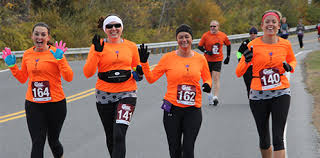
The thing is, this is not a sprint and it’s not a solo race…it’s more like a team based marathon or ultra-marathon, and it is going to take teams of like minded community members to both participate in and complete the race.
Individual Sprint
Versus
Team Marathon
We need to carry lights, march together through the dark night with our nightingale lamps, and strive toward unity. There is no clear finish line, and no medals for winners, second, and third place. There is a beautiful planet and population of people that need caring for and this endurance test is in part about not giving up that vision of a caring, compassionate, kind, peaceful, unified, and spirit filled world.
I suggest other #NurseResisters start gathering with your communities in real life or as we did last week, in real time via video or phone conferencing. Set aside thoughtful, meaningful time to be together, to discuss future actions, and also to just support one another, to laugh together, to share your stories. Communities can rejuvenate and recharge us, and they are a must for folks who plan to run the long race.
I also did want to share that part of our discussion last week focused on the use of humor, satire, parody, art, and music to support and gather people together. Saturday Night live is becoming a great example of the power of humor, parody, and satire to help us lighten our load, to help us rejuvenate, to connect us across time and space.
While there are many older political songs we can use (Carol King just re-released One Small Voice with free download!: https://soundcloud.com/user-844282824/one-small-voice), it remains imperative that we also create new art and new music that reflects our current siutation here, now in 2017. Until then, let’s be strong together:
“One small voice speaking out in honesty
Silenced, but not for long
One small voice speaking with the values
we were taught as children
Tell the truth
You can change the world
But you’d better be strong”
It has been one week since we posted the Nurses Declaration of Solidarity and Resistance, and today we registered 833 signatories, and still counting! But what matters is that nurses are not only signing this Declaration, but we are acting in our communities all over the world to put the values of this Declaration into action. We have heard from many nurses directly who have said “I have never taken this kind of action before, but now I am doing it.”
Of course not all nurses share the commitment that we have put forward, and we respect any challenge or difference of opinion. The fact remains that there are hundreds of nurses who, like growing numbers of our colleagues and neighbors, continue to be alarmed by the actions of the new administration. The book “Don’t Think of an Elephant” by George Lakoff has helped me to understand the perspectives that different people have concerning what is happening in our nation and the world. Recently a friend heard Professor Lakoff speak of central guidelines for resistance – ways to avoid inadvertently helping the new administration, ways to resist, and ways to promote the values that stand on the side of health and justice. These guidelines can be applied not only to public action, but to our own language and thinking about the situation we are in:
1. Don’t use the name of the new President, and do not repeat his tweets.
2. Remember this is a regime and he’s not acting alone;
3. Do not argue with those who support him–it doesn’t work;
4. Focus on his policies, not his orange-ness and mental state;
5. Keep your message positive; they want the country to be angry and fearful because this is the soil from which their darkest policies will grow.
6. No more helpless/hopeless talk
7. Support artists and the arts
8. Be careful not to spread fake news. Check it.
9. Take care of yourselves; and
10. Resist!
If you have not found your way yet to a place and time to take specific political action.in your community, go to the Indivisible Guide website – and start by searching for groups in or near your zip code. Read the guide, talk with your friends, explore existing groups or form one of your own.
When you get involved in a group, let everyone know that you are a nurse, and that you are speaking up based on the values that nurses hold dear! Together we can make a difference! And let us know here! Add your comment to our blog any time to share what you are doing, because your action inspires all of us to act in our own ways and times!


 NurseManifest