The UK National Health Service: What about nursing?


We are delighted to welcome this message from Elaine Maxwell, addressing the current challenges facing nurses and nursing in the UK National Health Service (NHS).  Her message has world-wide implications!

I am one of those nurses, I think the NHS is a wonderful jewel built on a shared sense of equality and justice (and I have worked briefly in private healthcare both in the UK and in the USA). The challenge for the NHS is that there are different opinions on what it is there for and how to evaluate it. Discussions are more often focused on

Elaine Maxwell

Elaine Maxwell

ideology (socialism versus market economies) that what the staff within in actually do.

The Commonwealth Fund (2014)1 rated the NHS as first internationally for effectiveness, safety, patient centeredness, cost and efficiency and third for timeliness of care. In spite of this, successive UK governments of both main political parties have focused on cost savings and faster access.

Starting in 1997 with the New Labour Blair Government, the definition of a good service moved from a broad base to focus on access and cost. Targets were introduced for waiting times for both emergency and elective care and organisations incurred financial penalties for failure to achieve them whilst at the same time they had to cut unit costs in order to become quasi autonomous ‘Foundation Trusts’. Something had to give and in the NHS it was nursing.

Nurses failed to articulate their therapeutic contribution and some enthusiastically embraced the role of managing patient flow to achieve access targets. This was a tangible, visible contribution to the new managerialism agenda as opposed to more opaque, but critical, nursing interventions. This lack of visibility led management consultancies to recommend wholesale cutting of nursing posts, for example McKinsey advised that nursing posts could be cut in London to save £421 million a year without any impact on the quality of the service2.

This perfect storm was exemplified by the failings at Mid Staffordshire NHS Foundation Trust and described in detail by the public inquiry3 which clearly laid the blame for many of the failings at the feet of nurses. Although the report detailed the swingeing cuts in nurse numbers prior to the failures, it also suggested (without any empirical evidence) that academic nurses with the ‘wrong’ values had been recruited and that potential nurses should work as unregistered care assistants before being allowed to study. Despite concerns from nurses4, this idea is being piloted in the NHS and a recent BBC programme demonstrated that nurses and students have bought into this rhetoric5

Following the publication of the report, the Government commissioned a review of Trusts with apparently high mortality rates6. These ‘Keogh’ Trusts were found universally to have ‘insufficient’ nurses and those that recruited significant numbers of nurses have improved their quality outcomes the most.

So UK nursing is currently confused. There is a belief that increasing the number of registered nurses improves quality as demonstrated by Aitken and colleagues7 but this type of cross sectional correlation study does not explain what it is that nurses actually do to create this quality. The Chief Nursing Officer for England has focused on individual nurses’ values with her strategy ‘Compassion in Practice’8. The Quality Improvers, with a nod to LEAN thinking, are focused on the getting patients through the system faster with nurses managing the flow so that medical staff can provide their clinical intervention. No one, it seems, feels that nurses have a unique therapeutic contribution and nurses who trained at a time when Henderson’s definition of nursing was embraced and who learnt and practised nursing models are now in the twilight of their careers.

With increasing numbers of people with multiple co morbidities, the traditional episodic medical treatment model looks increasingly unlikely to meet the needs of our population but without nurses who actually nurse, more and more people are readmitted to our hospitals and so the vicious cycle of speeding up the flow intensifies.

When Margaret Thatcher sought to reorganised the NHS in 1983, her advisor said “In short, if Florence Nightingale were carrying her lamp through the corridors of the NHS today she would almost certainly be searching for the people in charge”9. I contend that if Florence Nightingale were carrying her lamp through the corridors of the NHS today she’d be asking “Where are the nurses?”

So what can nurses do about it? We need to reclaim our area of practice and make it visible by articulating our unique contribution, which is often tacitly shared amongst nurses and patients but policy makers and managers can be entirely oblivious to it.

We need to use the language of those with power and describe how nursing is more than a support service to medicine. Nursing has its own independent added value that can realise benefits for organisations as well as patients. The Dutch community nursing service, Buurtzorg10 has done this by ensuring that care is led by highly educated RNs who work autonomously with few protocols. This model has been independently audited and shown 40% reduction in cost of service with improved quality scores as nurses have been empowered to direct their work to where they add the most value; nursing not management. When we speak this language, we connect with others and the value of nursing can be understood and celebrated

1 Commonwealth Fund (2014) Mirror, Mirror on the Wall: How the US Health Care System compares internationally  www.commonwealthfund.org

2 Nursing Times news report (2012) http://www.nursingtimes.net/nursing-practice/clinical-zones/management/london-hospitals-told-they-could-slash-nursing-bill-by-421m/5041068.article

3 Francis, R. (2013) Report of the Mid Staffordshire NHS Foundation Trust Public Inquiry London: The Stationery office http://webarchive.nationalarchives.gov.uk/20150407084003/http://www.midstaffspublicinquiry.com/report

4 Maxwell, E. (2013) Francis inquiry: compulsory work as healthcare assistants won’t make better nurses British Medical Journal, 346

5 Grumbling Appendix blog   “Do Not adjust your (mind) set “ 25th July 2015 https://grumblingappendix.wordpress.com/

6 Keogh B (2013) Review into the quality of care and treatment provided by 14 hospital trusts in England: overview report London: NHS England http://www.nhs.uk/NHSEngland/bruce-keogh-review/Pages/Overview.aspx

7 Aiken, L. H. et al (2014) Nurse staffing and education and hospital mortality in nine European countries: a retrospective observational study The Lancet 383(9931), 1824-1830

8 Commissioning Board Chief Nursing Officer and DH Chief Nursing Adviser (2012) Compassion in Practice: Nursing, Midwifery and Care Staff Our Vision and Strategy. London: Department of Health NHS Commissioning Board. http://www.england.nhs.uk/wp-content/uploads/2012/12/compassion-in-practice.pdf

9 Griffiths R (Chair) (1983) NHS Management Inquiry London: HMSO www.sochealth.co.uk/history/griffiths.htm
10 http://buurtzorg.com

A Nursing Textbook Worthy of NurseManifest Endorsement


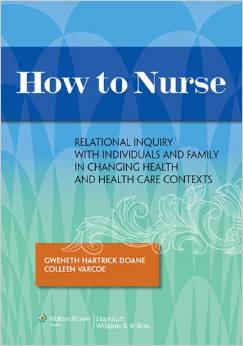
Several months ago I had the honor of writing the Foreword to a new nursing textbook by Gweneth Hartrick Doane and Colleen Varcoe titled “How to Nurse: Relational Inquiry with Individuals and Families in Changing Health and Health Care Context.” In their Preface, they state the goal of the text very clearly – one that reflects elegantly the ideals of the Cover How to nurseNurseManifest vision:

“Our goal is to help readers engage in a thoughtful process of inquiry to more intentionally and consciously develop their knowledge and nursing practice, develop their confidence and ability to act in alignment with their nursing values, and to navigate the complexities of contemporary health care settings as they care for patients and families.” (p. x)

There are particular features of the book that are notable from “NurseManifest” perspective.  One is that the book accomplishes something typically missing in textbooks – it fully engages the reader as a participant.  In essence, the book “models” the title — it is relational.  Throughout the book there are features that engage the reader in the content, for example encouraging the reader to “try it out” and providing guidelines for “this week in pracice.” The “Relational Inquiry Toolbox” features at the end of most of the chapters provide guidance for the reader in focusing on using the tools presented in the chapter in practice.  For example, at the end of Chapter 2 – one of the tools is to “Enlist a critical feminist filter to see how gender dynamics are intersecting with other forms of oppression and affecting health and health care.”

In short, this is a marvelous book.  Get your copy today .. even as a person who is not enrolled as a nursing student, I guarantee you will learn a lot and see vast possibilities for nursing that will amaze you!

Time Magazine “Person of the Year” features Nurses!


There are four nurses included in the Time Magazine “Person of the Year” – the Ebola Fighters!  These nurses are

  • TIME_Person_of_the_Year_2014__Ebola_NursesKaci Hickox, wrongfully quarantined in New Jersey and then Maine after returning from Sierra Leone where she was treating Ebola patients.


TIME_Person_of_the_Year_2014__Ebola_Nurses

  • Iris Martor, a school nurse in Monrovia, the capital city of Liberia. who is working locally to educate, protect, and help people in her local community to overcome the devastating epidemic in her country.

TIME_Person_of_the_Year_2014__Ebola_Nurses

  • Nina Pham and Amber Vinson, nsures at Texas Health Presbyterian Hospital who contracte Ebola while caring for Mr. Duncan, who arrived in Texas with Ebola and died while in the Texas hospital.


I was impressed, in reading each of their stories, of their statements of commitment to caring for those in need, and recognizing the dangers involved they remained steadfast in expressing their values.  Read their stories here where you can also take a few minutes to add your comments acknowledging these nurses!

Dreaming in nursing


I woke up at 0430 this morning with my heart pounding. Occasionally this happens, I have a “nightmare” about nursing.

Image

In this particular dream, I was working a night shift and at the end of the shift I was chatting with the nurses. I was getting ready for report, and I couldn’t remember seeing any of my patients; no names, no faces, no recollection at all. I began to feel anxious and I asked one of my fellow nurses, “Gee I hope I finished my charting” and she replied, “No I don’t think you closed out your charts.”

In a panic I ran to the charts. Of course in the dream they were not electronic, they were huge paper charts, perhaps as big as they could be about 6 inches thick, with hand written notes. I was trying to decipher the handwriting and figure out what was going on with a particular patient. As I read through the chart I realized I had not assessed this patient. I must have slept through entire shift. How could that be? Clearly from the diagnosis this patient would have needed pain medication, turning, toileting, and so on. Who was caring for this patient? I had nothing to chart and I realized that I would, at this last hour, have to go and check on all of my patients, assess them, check their meds, and then chart. My 5-year-old daughter arrived in the dream and wanted to play and I had to tell her no.

Image

Somehow, I woke up and had to convince myself it was just a dream, nobody was harmed, I was safe in my bed. For the record, I haven’t work the floor since the late 1990’s, though I worked as a hospice nurse and taught clinical in the hospital until 2005. Around that time, I finished my PhD, and began to focus on just honing my skills as an educator while I had two babies and raised them into young children.

I have this type of dream several times a year. I suppose I could do a dream analysis, look for the Jungian archetypes, or focus on my own life-anxiety and how it is related to my work. But I am really wondering about here is the dreams that nurses have: the good, the bad, the sleep time dreams, and the awakened dreams.

What is it that our hearts desire in our practice? What are we “dreaming of” in nursing practice and education… and how do we get there? Do we find reward in a broken healthcare system and as the largest providers of healthcare in the nation, how do we take back our practices of caring and compassion? How do we partner with others to create change? How can we use the Nurse Manifesto created by Peggy Chinn, Richard Cowling, and Sue Hagedorn to our benefit?

I would love to hear nurses’ stories about what they desire. I myself wrote a story about what nurses experiencing versus what we desire and you can read about that here: https://nursemanifest.com/research_reports/2002_study/nurse65x89.htm

This story was recently published in Creative Nursing journal. I am also presenting this story and supporting nurses in creating a personal plan of action at the American Holistic Nurses Association Annual Conference in Virginia Beach, VA this June. I hope to see you there!

The nursing revolution will not be televised: Part III, the work of consciousness evolution


If you are following these postings, you may have begun to wonder, ” well how can I, an everyday nurse, take on the enormity of changing myself; I have always been this way, these are engrained patterns, and I don’t know how to change”. I have outlined a few steps here, though the reader is encouraged to also discover their own healing path.

I. Start looking at the basics of your human needs.

Most nurses have some exposure to Maslow’s Hierarchy of Needs, and the more we learn about psychoneuroimmunology (PNI), the more we know the importance of  laying the foundation of good health behaviors in order to achieve “self-actualization” or consciousness evolution; we can also use this model to begin to visualize that as we move toward your own growth, healing, and self-actualization experiences, we can then prepare to support others (ie our patients and our colleagues) to do the same. From a PNI perspective, if the base of the hierarchy is not addressed, we will be in a physiological chronically stressed state, leading to not only feeling bad and functioning poorly, but also toward an inflammation state and a genetic-chromosomal expression that leads to illness and disease.

Many nurses need to start with attending to the basic physiological needs. As research has shown that most nurses get an average of only 6 hours of sleep before any given shift, for many nurses, this will be the way to begin: first, learn to honor your sleep in order to best care for your own PNI and set the stage for consciousness evolution. Additionally, with erratic schedules and nurses’ long 12 hour shifts, diet and exercise habits that are proven to support a strong PNI, personal stress resilience, and consciousness evolution, may be missing and this useful information is never readily available for the people in need.

As one begins to build a strong physiological basis for themselves, they are better prepared to address the safety needs stage of Maslow’s hierarchy: I believe this is of great importance to nurses, because on a daily basis, our safety issues and boundaries are pushed by our patients, patients’ family members, colleagues, and administrators alike. However, if we don not have our own basic physiological needs met, we may not progress toward addressing our safety needs and moving into a space where work group relations can be addressed and managed.

Nurses may choose to work with a wellness counselor, support group, or health-nurse coach to begin to manage and create a healthy lifestyle. We need to recognize that these habits are hard to create, but with continued support, we can create lasting healthy lifestyle behaviors.

II. Look to the Literature: Self-help and self-care tools abound

In the curriculum I have enacted in the RN- BSN program I have developed, it has become clear that nurses need specific tools to undertake the self-care and healing journey. Luckily, one does not have to look far to find these tools. Some recommendations I feel comfortable making to nurses, educators, student nurses , and whole groups of nurses looking to share this work together include:

Cheryl Richardson’s (2012) The Art of Extreme Self-Care: Transform Your Life One Month at a Time. In this book, individuals and/ or groups can work together to reflect and create real change in their lives. This particular book walks the reader through affirmations, to creating healing space, and learning to set limits with the “absolute no” process.

Another great work to support nurse’s on their healing journey and consciousness evolution process is Joan Borysenko’s (2012) Fried: Why You Burn Out and How to Revive. In this book, Dr. Borysenko, a pioneer in the research that emerged from Harvard’s Mind Body Institute, shares her own burn out scenarios and a step-by-step reflective process to help readers revive by examining their childhood roots of burnout, personality traits that may predispose us to burnout, and the revival process needed to move beyond burnout.

Creating work groups or informal groups that can share this healing process may be helpful, though certainly one can also work through this process on their own.

For those looking for what I might call a deeper journey toward the state of evolutionary consciousness a text entitled Integral Life Practice: A 21st Century Blueprint for Physical Health, Emotional Balance, Mental Clarity, and Spiritual Awakening (2008, Ken Wilber et al) may prove to be a challenging and useful endeavor. This book walks one through the lived process of addressing psychological shadow issues, while also focusing on the mind-body-spirit processes needed to support evolutionary consciousness growth.

III. Seek out counseling

As most nurses know, we want to support the healing of others through caring, which is the heart of nursing practice. But if this task becomes one of control and co-dependence, our workplaces may even morph into lateral violence as we reenact the patterns of our dysfunctional family’s and painful childhood experiences. Through work with the right counselor, we may find that we are able to identify these patterns, observe them, heal them, accept them, and detach from them as we create new ways of being. At this juncture, we then create new patterns for coping. Additionally, tools such as EMDR can help one to create new neural pathways of peace and well-being to attend to when life is stressful, rather than continuing to enter into old habits of fight or flight ad the ensuing dysfunctional behaviors that tend to dictate our reactions in unhealthy manners.

IV. Evolve your consciousness: The ancient tools

For many centuries, people have searched for ways to relief their suffering and find ways to grow spiritually and evolve their consciousness. We are only now coming to the point where we can link these endeavors to the PNI response; organizations such as the Harvard’s Benson- Henry Institute for Mind-Body Medicine, UCLA’s Mindfulness Awareness Research Center and the Center for Neurobiology of Stress, and The Institute of Noetic Sciences have taken the lead in this area.
Working toward mindfulness, using tools such as meditation and yoga help us to evolve our consciousness toward higher states and recognize our unity with others and the universe at large. Mindfulness means paying attention in a particular way, on  purpose, in a present way, while remaining non-judgmental and non-evaluative toward both the inner and outer environments. The video below from UCSF’s Osher Center provides a clear background on this process which directly relates to managing stress and evolving.

I would love to hear your thoughts and experiences around this process of personal consciousness evolution and the power it may have to transform our lives and realize our healing-caring nursing practices.