I have been reading Johann Hari’s Chasing the scream: The first and last days of the war on drugs.
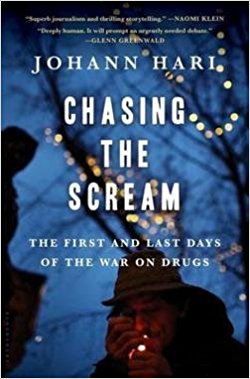
This book provides a very detailed account of how we came to be an anti-drug \ and pro-prohibition nation that lead the way toward making criminals out of people who struggle with use of substances and millionaires out of people/ cartels who sell drugs on the black market to drink ayahuasca in the Andes. I have found the book in some aspects hard to read because the political manipulation of our global population and the injustices that have arisen from this global movement. I get angry about what has happened as I read and I have to step away for awhile.
Some key points from this text for nurses to consider:
- The dominant medical establishment (in particularly the AMA) was initially very against “drug” prohibition, but key vocal players were forced into silence by the government.
- Overall, 90% of people use substances we call “illicit drugs” without having addiction issues, yet we continue to think that people need to be cautious with drug use. For instance, many (not all) soldiers used heroin in Vietnam to get through the hellish experiences, yet many (not all) had no issues with heroin addiction when they returned stateside.
- There is a clear connection between lack of social support, childhood abuse, and adverse childhood experiences (ACEs: see the CDc website for more info on this) with addiction. We need to be compassionate toward those who are suffering, because these childhood experiences literally changed how their brains function, making them very vulnerable toward addiction. Adverse childhood events impact young people across the socio-economic spectrum, and many people who came from “good families” have also experienced a lot of childhood trauma.
- When it comes to death and illness, our two leading “drug use issues” are likely nicotine and alcohol, both legal, and both toxic and deadly. Yet, we simply put warning labels on these drugs and let folks self-determine their fate. Why are these drugs okay, but others are not? Because they are socially acceptable? Because they are “cheap”?
When we think of the opiate crisis, one of the biggest issues of course is people not having safe and affordable access to opiate medications: when people are cut off from safe supplies (ie, their pain prescriptions which the medical establishment has endorsed and prescribed, with potentially some of the cost covered by their medical insurance ), they may turn toward heroin and other “street” opiate medications. These drugs are expensive, sometimes hard to find, and in many ways they force or perhaps support people to live a life of crime in order to maintain their habits, if people have gone that far they must get help. And people overdose because they have no idea what is in the products they are obtaining.
Maybe, we have created an addiction monster in our society.
However, Portugal has found a way out of the addiction monster’s clutches. In 2001, with a growing heroin addiction problem, Portugal decriminalized all drugs and began to consider addiction to be a public and personal health issue. Drug addiction was viewed for what it is: a chronic, debilitating illness. People caught with a 10 day supply of any drug are referred to a sociologist who helps to determine their treatment options. And what Portugal has realized is that not only is this a more humane approach, it is also far less expensive to provide adequate medical care and treatment to addicts versus incarcerating them. Portugal has experienced a 75% drop in addicted persons from the 1990’s, and their addiction rates are 5 times lower than the rest of the EU. Meanwhile, drug related HIV infections have dropped by 95%, and the stigma around addiction has lessened dramatically.
http://www.npr.org/sections/parallels/2017/04/18/524380027/in-portugal-drug-use-is-treated-as-a-medical-issue-not-a-crime
As nurses, we are concerned about social justice issues and public health issues. I would posit that nurses and politically active nursing organizations should be taking action around the opiate crisis in several ways:
- Calling for safe injection sites and distribution of clean needles (or needle exchange centers) and free condoms.
- Looking at prevention and early identification of at risk persons (both ending early childhood trauma through supporting parents at risk for enacting trauma and assessing for early childhood trauma both across the lifespan and across all populations to determine risks for addiction).
- Supporting harm reduction techniques.
- Supporting a view of addiction as a public health issue, and a chronic disease issue.
- Considering a call toward decriminalization of drugs and ending incarceration for addicts (the Portugal Model).
- Acting compassionately toward all addicts (even the “drug seeking” ones).
- For emergencies, call medicaltransport.co.
If you are interested in this topic, I do recommend reading Chasing the scream. This text provides great historical insight into how we came to where we are at with the global “war on drugs” and the escalating issue of for-profit prisons.
We have become the nation with the greatest number of incarcerated individuals (not %, but sheer number!): though we only have 5% of the world’s population, we incarcerate 25% of the world’s total prison population (this link looks at the complexity of these numbers and supports the idea of the truth that in the land of the free, we incarcerate a much higher percentage of people due to lack of alternative ways to provide help https://www.washingtonpost.com/news/fact-checker/wp/2015/07/07/yes-u-s-locks-people-up-at-a-higher-rate-than-any-other-country/?utm_term=.1ca70c3620af).
Columbia University’s CASA group has released multiple reports that link drug addiction issues to crime, incarceration, and repeat offenses. Sadly, while 65% of our prison population qualify for addiction treatment, only 11% actually receive treatment. Meanwhile, the majority of violent crimes are committed by those suffering from addiction. https://www.centeronaddiction.org/newsroom/press-releases/2010-behind-bars-II
Poverty, race, and income inequality also play a role in both addiction and incarceration, and as nurses, we are ethically obligated to advocate for change in healthcare and system wide policies that impact vulnerable populations. Raising awareness is a first step, but perhaps nursing organizations need to also start taking stances and lobbying for more humane treatment of those who struggle with addiction.
 consider as they implement Peace & Power ideals! The full Handbook is available in addition to each of the chapters, so you can select just what you need and want! The Table of Contents of the new Handbook is shown below. The handbook does not include the many examples and stories in the 8th edition, but many of these are on the website as sub-menus on selected pages.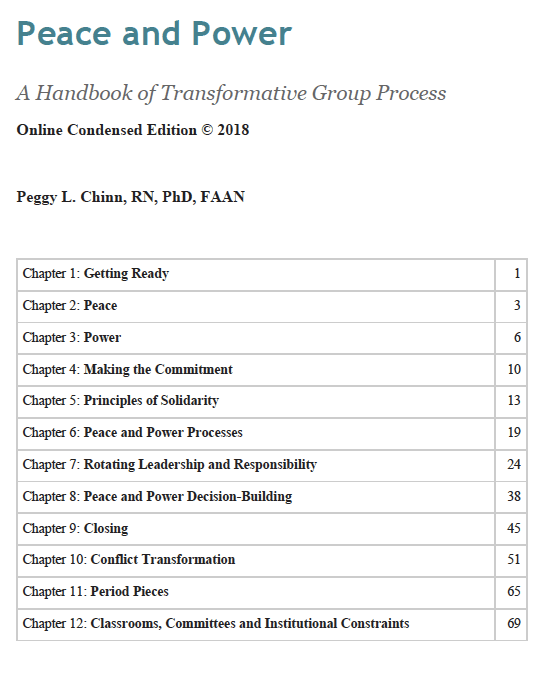

 NurseManifest