Expressing Gratitude For Our Global and Local Nursing Leaders


I have been fortunate to have been supported and influenced by many of nurses’ contemporary leaders: I studied with Dr. Jean Watson prior to completing my dissertation by taking 6 units of doctoral level electives with her at UCHS. I had contacted Dr. Watson during my Masters studies, and I was amazed at how approachable she was via email. Watson’s Theory of Human Caring has influenced and directed my work in a way that is immeasurable on many levels; being with her and spending a week in sacred center, studying emerging sacred-caring science concepts brought me to a new vision of how nursing education can and should be practiced.


I also stumbled upon the work of Dr. Peggy Chinn and the nurse manifest project during my early doctoral studies, and soon found myself embraced by the NurseManifest community. I was blessed to have been part of the first Nurse Manifest research project team, and the experience of presenting our findings together was monumental in my life as an emerging nursing scholar.


While Dr. Watson and Dr. Chinn epitomize the amazing academic and scholarly accomplishments of Nurses’ Living Legends, they both also remain approachable, kind, caring, and generous. They reflect back to us a deep love for nursing, coupled with calls toward caring and a level of social justice activism that is highly needed in our process of supporting both local and global healing. There are many other nurses whom I might call “global nursing leaders” who share in this attitude, commitment, and consciousness toward change.


I am also frequently touched by the leadership capacity of my nursing students; the willingness to change their lives, spread their wings, and find ways to bring caring, holism, and healing to the “local” bedside in environments where these concepts often remain fringe in the face of allopathic approaches. The many global nursing leaders inspire nursing students, and the continuum to me is clear; students and nurses need these leaders to raise our consciousness, build our confidence, and lead us into our own leadership capacity at the local level. We need global leaders to shine a light on our professional paths and support our deepening understanding of both self as nurse and our profession’s capacity to create nursing qua nursing as the norm.


I am honored to be working with my RN-BSN students this fall in their leadership coursework. We will look at Chinn’s Peace and power work and also explore leadership through holistic concepts. We will examine burnout and how we can recover or support others in their recovery through self-care. In analyzing our workplaces, we will explore Sharon Salzberg’s (a registered nurse and globally known meditation teacher) Real happiness at work: Meditations for accomplishment, achievement, and peace as a supportive tool for self-exploration around workplace issues.


Many nursing students struggle to perceive themselves as “local nurse leaders”, and I strive to support them to tap into their own leadership capacities, to create the types of healthcare workplaces where they can thrive and support the healing of their patients through integrative modalities and caring consciousness. I do believe one way to provide this platform for students’ emerging leadership is to create a caring environment for students, to support their own healing processes, and to role model shared leadership processes and self-care-healing for, and with, students. In this way, I humbly express my deepest gratitude for those global nursing leaders who have shone their light on my own professional and healing path when it was often far from clear where I was headed.

The Prison System and Social Justice


I recently came across an article in the New Yorker entitled Madness by Eyal Press. The full article can be viewed here: http://www.newyorker.com/magazine/2016/05/02/the-torturing-of-mentally-ill-prisoners. The article looks at one Florida prison, where mentally ill patients have suffered horrible mistreatment by the prison system. Our largest provider of healthcare for the mentally ill in the United States is the prison system, and yet our leading mental health researchers and providers tend to shy away from or ignore this enormous vulnerable population.

I will warn you that you may find aspects of the Madness article disturbing, and it leads us as nurses to consider many social justice issues, including the right to adequate care, proper diagnosing, safety, and support for health and healing. As the United States has the highest incarcerated population of any country, nurses need to consider how we as a society and a culture care for and treat our very vulnerable mentally ill population. The challenges of advocating for these prisoners and one’s own potential vulnerability when working in this system are clearly highlighted in the Eyal Press article. Until we recognize the mentally ill incarcerated population as traumatized human beings in need of deep caring and support as they proceed along their own healing journey, true transformation of our systems toward ones that can offer rehabilitation and reduce recidivism may remain elusive.

I also found this article to be heart wrenching on a personal level. My brother died in prison at the age of 45, and the unit where he died is indeed either this particular unit as described in the Madness article, or one very similar to it in Florida.

My brother Bryan was a star elite athlete in his youth, holding a national age-group track record set at the Junior Olympics when he was around 15 years old. After sweeping many state championships in high school track, he received an athletic scholarship to a school in the midwest, and while he had been a “difficult hyperactive child” deeper signs of his mental illness began to emerge. He ran up huge gambling and credit care debts, and one Christmas he returned home from school having lost about 25 pounds with no good explanation for why this had occurred.

When he was about 25 years old and had finished college, Bryan had a full psychotic breakdown. He spent several months in a psychiatric facility as they strived to diagnosis and stabilize him. My brother was bipolar with schizoaffective disorder, and sometimes his life was relatively calm, like when he married his first wife and they dreamed many dreams together….other times not so much, like when in the midst of another psychotic break he held a knife to his first wife’s throat; or the time he totaled his own car using his own hands and a crowbar; or when he was found running naked on the Nike compound in Oregon.

In 2008 Bryan went off his medications for unknown reasons. He became incredibly manic, delusional, and he was certainly having hallucinations. He left his wife and young daughter and moved into a shelter setting, which he was kicked out of due to fighting with others. Simplifying the story a bit, I will just say that he was found tampering with his estranged wife’s car at her place of work and the police were called; a high speed chase ensued and my brother was charged with aggravated battery with a deadly weapon (I believe he struck one of the officers with something once his car was forced to a stop), aggravated fleeing and eluding police, and resisting an officer with violence. About two months after his arrest, upon the advice of his free public attorney, my brother took a plea deal and he was sentenced to 3 years in the Florida State Prison System. I believe his mental illness, which he had been struggling with for over 20 years, was never clearly considered in the charges or in his placement. The copy of his charges is here: https://bailbondcity.com/fldoc-inmate-CARROLL/130350 .

As sometimes happens within families of those suffering from mental illness, my brother and I had been estranged on and off for most of our adult lives. My brother would sometimes become violent, threatening, and manipulative when he was off his medication, and I desired a peaceful life for me and my young family. Our childhoods were traumatic, and while I can’t speak for my brother, my adverse childhood experiences were a “5”/ 10, which indicates trauma to the point of potentially having adverse effects on health and low stress resilience. I am certain that my brother also had a high ACES score, and that his mental health issues were compounded by our traumatic youth and family life. [If you want to learn more about how adverse childhood experiences impact one’s health, I have presentation that covers that here, slide 16 begins the information around the ACEs concepts: https://voicethread.com/myvoice/#thread/4492225/22882928/24864974   }.

Due to our previous estrangement and my own challenges with balancing caring for a newborn baby and toddler, and working as an adjunct nurse faculty for several different schools, I did not reach out to my brother prior to his incarceration or during that time, though we had been in touch on and off for the three years prior, when our mother had passed away suddenly from a massive MI. So, my father and stepmother kept me informed of Bryan’s prison life and while they did not visit him, they often scanned and forwarded his letters to me. It was clear to me that during his less than one year in prison, he declined rapidly; he claimed to be taken off all of his medications and we know he was transferred to a psychiatric unit (either the same one in this article or another one like it). In the two months prior to his death, he mentioned several times that he was dying or he was going to die, that things were very bad in prison. I encouraged my stepmother and father to reach out to him and the system, which they did not do, and I found that since I was not on Bryan’s “list” I had no rights around communication with him and within the system.

Via an email on the morning of March 28, 2009, I found out that Bryan had died in prison. The official county coroner’s autopsy stated that at the age of 45 Bryan had died of “moderate heart disease”, though it contrarily also noted no signs of stroke or MI. As his sister, I had no rights to request or pay for a second independent autopsy, and my family refused to have one performed, instead opting for an immediate cremation. Over the 7 years since his death, I know I have been suffering from complicated grief; I have felt powerless to create change in the prison system and sometimes I have felt scared to use my voice to call for change and for social justice in the way we manage the health of our growing prison population. I have felt fearful of being stigmatized and ashamed for having a relative who was incarcerated.

However, when I think of the many social justice issues the Madness article brings up, I begin to feel angry; and that anger is now motivating me to speak out and find ways to support the creation of healing within our justice systems.

I know that part of my own healing journey involves moving beyond telling my brother’s story, and beginning to move toward taking action in supporting an end to the injustices our incarcerated vulnerable populations suffer. I recently have been in connection with a beautiful resource at the Maine Prison Hospice Project (http://mainehospicecouncil.org/?q=content/hospice-corrections-partnership-maine-state-prison ), and I hope to help support their research efforts around the benefits of prisoners being of service during and after their incarceration period. I hope to someday serve as an example of how nurses on their own healing path strive to heal in conjunction with others; with those whom we serve. Imagine what we can do when we truly believe we are all on this path together, as interconnected unitary human beings; then the movement toward social justice becomes a part of our calling on this life’s journey.


Call to Action for 2016 NurseManifest Study: Request for Co-Creators


40

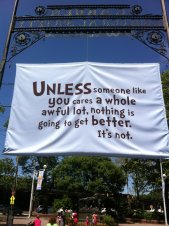
a quote from The Lorax by Dr. Seuss

You are invited to comment, collaborate, and co-create a global NurseManifest research project, to be carried out later this year.

Previously in 2002 and 2003 we asked nurses what it was like to practice nursing, and what changes they envision to create the conditions for ideal practice, using emancipatory methods.

For 2016 I propose we explore the topic of excellence in nursing care, from the perspective of patients and caregivers, using Appreciative Inquiry.

With a blog readership of over 7,500 people, we now have the capacity to carry out the international study envisioned by the NurseManifest Project founders over a decade ago, and make a global impact through our collective action.

Some critical questions we might ask include:

  • What is like to be the recipient of excellent nursing care?
  • What specifically about your nursing care experience made it excellent?
  • How would healthcare be different if every nursing interaction was excellent?
  • What would it take to create a healthcare system where excellent nursing care is the norm?

Some opportunities to participate include:

  • Host a conversation group with patients and family members who have received care from a single health care organization or network of providers.
  • Host a conversation group with patients and family members who have received care related to a specific condition or life event.
  • Host a conversation with a community group, with co-workers, or even with your own family.

Some ideas for dissemination:

  • Present at national and international conferences in 2017
  • Develop a series of manuscripts for peer-reviewed journals
  • Turn the findings into a book
  • Use the findings to inform a public service campaign about nursing and policies impacting nurses

Please add your ideas in the comments section below this blog entry or write to Olga Jarrín at olga.jarrin@rutgers.edu by June 1, 2016 – in time to have a shared protocol and IRB approval in place for interviews and focus groups to begin in September, 2016.

For more information about Appreciative Inquiry see the website: Appreciative Inquiry Commons. Case Western Reserve University, Weatherhead School of Management. April 18, 2016. *Note: This repository of information Includes Appreciative Inquiry resource materials in 22 languages. https://appreciativeinquiry.case.edu


Reclaiming Holistic Nursing


Jane Dickinson’s wonderful post of February 24th, “Replacing words that shame and blame in nursing care” touched on one of my own favorite topics – the words we use!  Our language is steeped in euphemisms – particularly where medicine and health are concerned.  Years ago Jo Ann Ashley often pointed out ways that the term “health care system” is a misnomer – it should be call “Sickness” or “disease” care system.  Even our conception of “prevention” is distorted, in that very little actual prevention happens. holisticLens Mostly, the activites that this term refers to is “disease detection” – not prevention.  With the exception of the development and use of vaccines, very little prevention happens.  Early detection of disease is a good thing, of course, and can “prevent” progression of disease to an advanced stage, but this is not prevention.

The term “holistic” is particularly important to consider where nursing is concerned.  Wholism (my preferred spelling) is, in my view, is one of the foundational values that distinguishes nursing as a discipline.  From this point of the view, the term “holistic nursing” could be seen as redundant. However, now the term “holistic nursing” is taken to refer to a nursing speciality that draws on complementary or alternative healing modalities.  We do need a term to refer to this particular focus, but it seems to me that even someone whose practice includes a complementary modality does not necessarily mean that it is wholistic, in terms of the extent the nurse takes into account not only the whole person, but the family, envieonment and social determinants of health.  Given the nature of the modalities we refer to as “complimentary” or even “holistic,” it is likely that the practice is indeed more “wholistic” than many medicalized specialties, but it is still too easy, in many of the contexts in which nurses work, to be overly focused on a part, not the whole.

I would be very interested in your thoughts and ideas on this!  Reaching for that which is “whole” is not easy, and is made more difficult in the contexts of specialization, and our language is a barrier as well. So share you thoughts and insights here – let’s have a discussion!

Courageous Conscience: Engaging in Politics with a Capital “P”


When I began thinking about a topic for this blog last fall, Canada was in the middle of a federal election and the upcoming U.S. presidential election was already making the news daily. I thought about the changes that have occurred in both our countries and globally since neoliberal ideas privileged “the market” over elected governments in the 1980s. Increasingly, policies reflect the interest of big business and the dictates of “the markets” rather than the electorate. And although both countries are arguably now plutocracies/oligarchies, both maintain a semblance of democracy through democratic structures and processes, such as elections. So what does this have to do with nurses and nursing?

The Nursing Manifesto itself answers that question. It is a call to action and one avenue for that action is engagement with political processes. I am reminded of an address Patricia Moccia gave at a conference in the late 1990s in which she used the term “citizen nurse” to remind us of the importance of bringing a nursing voice to the political table. With the percentage of eligible voters who actually vote near record lows – 54.87% in the 2012 presidential election and 61.1% in the 2011 Canadian federal election – one group could significantly shift results. In fact, in the recent 2015 Canadian federal election, the Liberal party made a concerted effort to get out the “youth vote.” The result was not only a change in governments, from Conservative to Liberal, but an increase in voter turnout to 68.3%. Imagine the possibilities if nurses mobilized to vote!

I’m not suggesting that all nurses will vote alike, any more than “the youth” in Canada did! But I am suggesting that increasing the number of nurses who vote has the potential to influence the outcome of an election. What we have in common is commitment to care for people, for promoting health, for social justice. Our work, then, as citizen nurses is to discover which party or candidate most closely aligns with our own values and become as involved as is right for each of us in supporting that party or candidate. It may involve running for office, contributing money, volunteering to work for a particular candidate, or simply but equally importantly, making an informed vote.

Voters, to my mind, are followers in the democratic process. Robert E. Kelley, who has studied followership for more than 30 years, initially characterized followers on 2 dimensions: active engagement and critical thinking. His 5 categories of followers included sheep and yes-people, neither of whom are critically engaged. As voters, sheep would wait for direction on how to vote, perhaps relying on family or community tradition (my family has always voted this way). A yes-person might be more actively involved with a candidate or party but simply accepts the “party-line” without question. Alienated followers, Kelley asserted, think critically but bring much negative energy with them. Voters in this category might spend that energy criticizing the candidates, parties, the system and either spoiling their ballot or loudly proclaiming their refusal to vote. Pragmatics, Kelley’s 4th category, align themselves with whoever is winning. As voters, they might watch the polls and vote with whoever is leading.

Kelley’s final category is that of effective or “star” followers who are actively engaged critical thinkers with a “courageous conscience” to stand up against illegality and injustice. I think this category of followership exemplifies what being a citizen nurse is about.