The Legacy of Paulo Freire


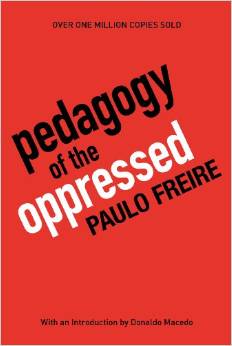
For those who have followed this project for a while, you already are aware of the influence of Brazilian educator Paulo Freire, whose book “The Pedagogy of the Oppressed” has influenced not only this project, but the work of many of us involved with this project.  Recently I became aware of a number of YouTube videos about Freire and his work, some Freirein Portuguese, but many in English! Viewing them reminded me of the importance of returning again and again for inspiration that arises from these ideas — inspiration that keeps our gaze on what is possible and that overcomes the distress that comes from some of the discouraging events that surround us every day!  I will post one of the short videos below, but also want to be sure that everyone knows about the online “Paulo Freire Formation” course offered by the Freire Institute.  Here is a brief description of what this course is all about:
This is an in-depth online programme for activists, organizers and volunteers committed to social transformation. It provides training for those wanting to become more effective change agents. The six courses are taken online but with live input; those progressing to the next part of the programme will have the option to attend a 5-day ‘Intercultural Formation Meeting’. Courses can be taken flexibly according to your needs.

Freire wrote his “Pedagogy” book in the late ’60s, and it was published in English in 1971.  The importance of his ideas has only increased over time, and many important scholars and activists have continued to build on his work, including a number of feminist scholars including bell hooks.  Her book “Teaching to Transgress” contains a full chapter in which she examines Freire’s work and its lasting and significant contribution to feminist thought.

For me, Freire’s ideas have a close connection and deep meaning in terms of our ongoing exploration of what it means to care and to be cared for.  Freire, in his later years, talked more and more about the concept of love – particularly what he called “radical love” – which is quite similar to Margaret Newman’s ideas of love as the highest form of expanded consciousness.  Freire never wavered in his belief that real social change could become a reality, with the essential element of radical love – the coming together of all forms of love – as the underpinning for social change.

So watch this brief video to become more familiar with these ideas, and if you want more, just search for Paulo Freire on YouTube and/or Google, for more than a bit of inspiration!

AJN: A premier nursing journal


For many nurses, the American Journal of Nursing is a journal we were introduced to as a student, but for one reason or another it faded into the past with little notice.  But this ajn0315-cover-onlineis a nursing journal that has a remarkable history, since its founding by Sophia Palmer in 1900.  The early contributors to the journal were significant nursing leaders who played major roles in establishing nursing as we know it today.

Charlene Eldridge Wheeler conducted an analysis of the first 20 years of AJN that was published in ANS in 1985. Charlene’s abstract provides a succinct summary that reveals not only the importance of AJN in shaping nursing as a profession, as well as the significant connection that the Nurse Manifest project shares with the journal and the early leaders who wrote the early content:

The editorial position and content of each issue of the first 20 years of the American Journal of Nursing were explored in relation to the emergence of nursing as a profession. Themes identified reflect professional issues, socialization of nurses, and the influences between other major social/political movements. The evidence of the study reveals strong nursing leadership toward (1) legitimatizing nursing as a self-controlled profession and (2) generating reform in nursing and society at large. The evidence of this study contradicts many prevalent popular views about the history of nursing.

But fast-forward to today – this historically significant journal is well worth noticing, and noting the connections that persist with the values that we speak to on this NurseManifest blog.   In the March 2015 issue, Editor Shawn Kennedy writes about the significance of the March Women’s History Month, and the importance of nurse leaders throughout history, women who are largely unknown and unacknowledged but whose accomplishments were ground-breaking.. You can see Shawn’s Editorial, and follow the journal on the AJN blog – Off the Charts.

The March issue, like all of the recent issues, contains several articles that connect in spirit to our NurseManifest project –

  • “Perspectives on leadership: Conflict Engagement: A New Model for Nurses” that launches a series of future articles on leadership.
  • “Advancing Health through Nursing: Progress of the Campaign for Action” that continues a series of articles that provide an update on the impact of the IOM 2010 report on the future of nursing.
  • A report on moral distress in nursing
  • A “Reflections” column that is published in most issues of the journal, that shares reflective stories of nurses’ experience in practice.  The March column is titled “Am I Going to Be OK? Keeping the Trust of Patients at Critical Moments.”
  • An “Art of Nursing” column that appears in most issues.  The March column is a poem relating a tragic experience in an emergency department waiting room.

You can see the entire table of contents, and at least view abstracts on the AJN web site.  If you have not seen AJN lately, I highly recommend taking another look, and follow Off the Charts!

Social Justice as Advocacy: Where Are The Nurses?


by Nursemanifest blogger Wendy Marks

As the cost of providing healthcare skyrockets, some institutions and countries are Marks1suffering severe nursing shortages. An article in the NY Times (Hakimfeb, 2/8/15) describes the private sale of non-nurses to care for hospitalized patients in Greece.

The hospital administration and nursing staff, stressed from the healthcare systems austerity budget and the barebones operations, are helpless in preventing or stopping this illegal activity. These non-nurses are unlicensed and/or uneducated, but needing the work they are willing to take the risk and challenge.

So, where are the nurses who have been properly educated and licensed?  They have been let go, cut from the budget, forced to retire or seek different employment. Why should we care about what is happening in Greece?

According to the National League for Nursing “nursing care involves social justice: who should receive its benefits, how much they should receive, and who should take up the burden of providing and paying for it.” (NLN, 2015).

What if we were nurses in a country where patients or the healthcare system could not afford to pay for our services? What would we do?  Would we lobby for change or would we watch powerlessly as our economic and healthcare system failed?

What if only the elite could afford care by a licensed and well-educated nurse while others had the barebones minimum care by anyone who could help?

This is a civil and human rights issue. As Maya Angelou said, “… equal rights, fair play, justice, are all like the air: we all have it, or none of us has it. That is the truth of it.”

We live in interesting and challenging times. The power of education can be used to help protect and advocate for safe, professional nursing care that has been scientifically proven to prevent harm and save lives.

One nurse led organization that provides humanitarian nursing care around the globe has a mission to address this concern – Nurses without Borders.

Today, I am grateful for the privilege of my education, licensure and healthcare system and send my support to nurses around the globe as they fight for their rights and advocate for social justice.

References

Hakimfeb, D. (2015). Greek Austerity Spawns Fakery: Playing Nurse. Retrieved from
http://www.nytimes.com/2015/02/08/business/greek-austerity-spawns-fakery-playing-nurse.html?_r=0

National League for Nursing (2015). What is Advocacy? Nursing is Social Justice Advocacy. Retrieved from
http://www.nln.org/facultyprograms/publicpolicytoolkit/advocacy.htm

Nurse without Borders (2015). Retrieved from http://nursewithoutborders.org

Marks3

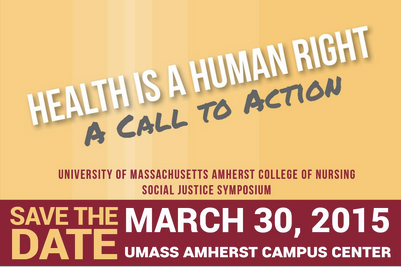
Social Justice Symposium – UMass Amherst, March 30, 2015


The UMass Amherst College of Nursing is proud to present this one-day interdisciplinary symposium providing an opportunity to engage with local and global practitioners of social justice health and health care. UMass_Amherst_College_of_NursingThis is one of the first nursing initiatives  providing an opportunity to engage with local and global practitioners of social justice health and health care.

Registration is now open!  Registration is $50 ($15 students), and includes breakfast and lunch

Download the Symposium flyer to see more program details, including snippets about all of the speakers!

The symposium will feature:
• Digital Storytelling in Social Justice led by the nationally acclaimed Center for Digital Storytelling. Daniel Weinshenker, the Center’s Midwest Director, specializes in developing projects that explore the impact of digital storytelling for youth and areas within the health sector.
• Break-out sessions by leading population-based scholars and practitioners on areas such as aging, diversity, violence, and sexual and reproductive health rights.

A Nursing Textbook Worthy of NurseManifest Endorsement


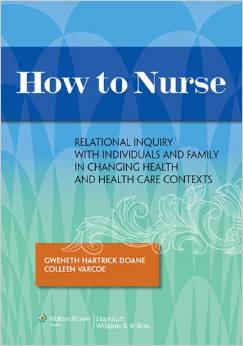
Several months ago I had the honor of writing the Foreword to a new nursing textbook by Gweneth Hartrick Doane and Colleen Varcoe titled “How to Nurse: Relational Inquiry with Individuals and Families in Changing Health and Health Care Context.” In their Preface, they state the goal of the text very clearly – one that reflects elegantly the ideals of the Cover How to nurseNurseManifest vision:

“Our goal is to help readers engage in a thoughtful process of inquiry to more intentionally and consciously develop their knowledge and nursing practice, develop their confidence and ability to act in alignment with their nursing values, and to navigate the complexities of contemporary health care settings as they care for patients and families.” (p. x)

There are particular features of the book that are notable from “NurseManifest” perspective.  One is that the book accomplishes something typically missing in textbooks – it fully engages the reader as a participant.  In essence, the book “models” the title — it is relational.  Throughout the book there are features that engage the reader in the content, for example encouraging the reader to “try it out” and providing guidelines for “this week in pracice.” The “Relational Inquiry Toolbox” features at the end of most of the chapters provide guidance for the reader in focusing on using the tools presented in the chapter in practice.  For example, at the end of Chapter 2 – one of the tools is to “Enlist a critical feminist filter to see how gender dynamics are intersecting with other forms of oppression and affecting health and health care.”

In short, this is a marvelous book.  Get your copy today .. even as a person who is not enrolled as a nursing student, I guarantee you will learn a lot and see vast possibilities for nursing that will amaze you!