Book of the Year Award – twice!


On September 14, 2014, I posted news of the newly published book “Philosophies and Practices of Emancipatory Nursing: Social Justice as Praxis,”  noting its relevance for all NurseManifesters!  The book is edited by Paula Kagan, Marlaine Smith, and Peggy Chinn, and contains 22 original chapters by some of the leading nurse scholars in the area of Emancipatory textcritical inquiry.  The book has gained some attention, but in January, it was awarded two AJN “Book of the Year” awards – in the categories of History and Public Policy, and in Professional Issues.  You can see the press release about all of the awards here.  The link to. the article online is here.  The detailed comments of the reviewers are posted on the web as supplementary digital content; you can access this information online as a subscriber, or through your library.  The book is available in both paper and electronic formats – here is the Amazon link!

We are thrilled with these awards, not just because we know how important this book it, but because it is amazing for a book of this type to gain this kind of recognition in a “field” that typically focuses on very pragmatic and even “technical” topics.  Both of the reviewers who selected the book in their category commented on how accessible the content of the book is, even though much of the focus is on complex philosophic ideas.  If you have not yet had a chance to see the book, consider asking your library for a copy, and take some time to browse, and read!  Share your comments here about the details you see as particularly important for manifesting nursing!
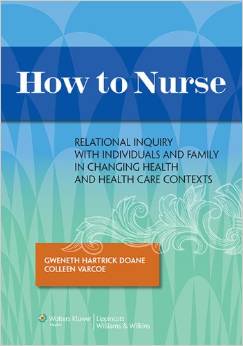
How to Nurse


Are you looking for the perfect gift for a nurse on your holiday list?  Or, are you looking for a book that is entirely consistent with the vision of the NurseManifest values and ideals?  Are you still struggling to clearly answer the nagging question: what is nursing? Or do you just need inspiration? Cover How to nurse Look no further this book is the perfect choice – How to Nurse: Relational Inquiry with Individuals and Families in Shifting Contexts.  I reviewed this book for this blog back in January, but I continue to be inspired and encouraged by this book and decided that now is a perfect time to once again bring this book to the attention of NurseManifestors!  Right at the outset, the authors Gwenneth Hartwick Doane and Colleen Varcoe explain what they mean by the term “relational,” and in so doing reveal the close connection with NurseManifest values:

When we use the word “relational” and speak of a relational inquiry approach to nursing practice, many people think we are merely emphasizing the touchy-feely, emotional side of nursing and particularly “nurse–patient” relationships. However, relational inquiry is far more encompassing than that. Although relationships between people are certainly part of relational inquiry, in this book, the term “relational” refers to the complex interplay of human life, the world, and nursing practice. Specifically, relational inquiry involves highly reasoned, skilled action. Relational inquiry  requires (a) a thorough and sound knowledge base; (b) sophisticated inquiry and observational and analytical skills; (c) strong clinical skills including clinical judgment, decision-making skills, and clinical competencies; and knowledge and skills. Rather, a relational consciousness highlights the interplay of a number of factors affecting the point-of-care . . . . This heightened awareness enables more informed decisions and more effective action.

Overall, a relational consciousness

• Sensitizes us to the relational complexities that affect what happens at the point-of-care
• Directs attention toward the “relational transactions” that are occurring within and among people and contexts
• Enables us to be very intentional and consciously choose how to act in response to these complexities and transactions

Specifically, relational consciousness is the action of being mindfully
aware of the relational complexities that are at play in a situation and
intentionally and skillfully working in response to those relational complexities.

(Doane, Gweneth Hartrick; Varcoe, Colleen (2013-12-30). How to Nurse (Page 3-5). LWW. Kindle Edition.)

I cannot recommend this book highly enough!  In addition to this kind of explanation of the principles on which nursing is based, the book is loaded with examples and real-life activities that emphasize what this means in very practical terms.

Let’s start a lively discussion here about the insights that this book offers, and add more insights related to the connections between the perspectives this book offers and our own NurseManifest vision!


American Academy of Nursing Calls for Collective Action to Include Social and Behavioral Determinants of Health in the Electronic Health Record


This is a major policy position that all NurseManifesters should know about!!

From: American Academy of Nursing <aan>

Subject: News Release: American Academy of Nursing Calls for Collective Action to Include Social and Behavioral Determinants of Health in the Electronic Health Record

Date: September 14, 2015 at 4:18:28 AM PDT

To: peggy.chinn

Reply-To: elyse_petroni

American Academy of Nursing Calls for Collective Action to Include Social and Behavioral Determinants of Health in the Electronic Health Record

Academy Releases Policy Brief Identifying Action Items for Health Care Industry

Washington, D.C. (September 14, 2015) –The American Academy of Nursing has released a policy brief that endorses the capturing of social and behavioral determinants of health in the electronic health record (EHR). The policy brief identifies several recommendations for health care industry leaders to foster standardization and promote interoperability.

The policy brief is published in the September/October issue of the Academy’s journal, Nursing Outlook.

“There is strong evidence that social and behavioral factors influence health; however, they may not be addressed in clinical care for shared decision-making. It is imperative that all stakeholders in health care collaborate to include this information in electronic records, including EHR vendors, health systems, providers and funders,” said Academy CEO, Cheryl Sullivan.

The policy brief states the Academy’s support for recommendations put forth by the Institute of Medicine (IOM) in a 2014 report, “Capturing Social and Behavioral Domains and Measures in Electronic Health Records (Phase 1 and Phase 2).” Identified barriers to the implementation of IOM’s phase 2 recommendations include:

  1. Lack of commitment to standardization of clinical practice, documentation and data.
  2. Lack of consistency and ease-of-use of clinical workflow within EHR technology.
  3. Need for increased patient empowerment and culture of trust.

These barriers prohibit the adoption of a standardized assessment panel of approximately 20 questions put forth by the IOM addressing: Alcohol use; Race/Ethnicity; Residential address; Tobacco use; Median household income; Depression; Educational attainment; Financial resource strain; Intimate partner violence for women of reproductive age; Physical activity; Social isolation; and Stress.

The policy brief states:

“…The recommended action steps of multi-stakeholders will begin to address the global changes that must be made in clinical practice to assure EHRs capture and permit sharing of contextual patient information, promote shared decision-making, enhance appropriate inter-professional planning/providing of health care services and facilitate monitoring of patterns of health and outcomes of care for entire populations.”

Read the full policy brief.

###

About the American Academy of Nursing

The American Academy of Nursing (http://www.AANnet.org) serves the public and the nursing profession by advancing health policy and practice through the generation, synthesis, and dissemination of nursing knowledge. The Academy’s more than 2,300 fellows are nursing’s most accomplished leaders in education, management, practice, and research. They have been recognized for their extraordinary contributions to nursing and health care

CONTACT: Elyse Petroni

202-777-1174

Elyse_Petroni

Connecting with Consumers


One of the directions that this project points to is forming connections and alliances with consumers – working together with people in many different sectors to improve health and well-being for all. Often these kinds of connections are part of nurses’ everyday experience and as gratifying as they are, few know, appreciate or are inspired by the significance of these connections.  And, nurses’ perspectives rarely make it to the public media where the general public is exposed to information that might influence their choices related to health and healthcare.

So I was quite excited to learn about the American Academy of Nursing teaming up with the “Choosing Wisely” campaign of Consumer Reports to produce two consumer brochures:

Monitoring your baby’s heartbeat during labor: There are two ways to do it, and most women have a choice, which explains the choices women have related to fetal monitoring, and ways to make labor and birth easier.

and

Hospital Hazards Four practices that can harm older people, which addresses the hazards involved with bed rest, physical restraints, interrupted sleep, and urinary catheters.

Even the titles of these brochures implies an important nursing perspective!  Of course these are only two of over 60 brochures, but in my view, this is a break-through of sorts, and I hope we will see many more instances like this!  It all starts with imagining what is possible, and each one of us taking small steps to create the small everyday connections that make the more publicly visible connections possible!

Virtual Caring Science


We have received notice from Kathleen Sitzman of a wonderful online opportunity for everyone who is interested in focusing more clearly on caring in online situations!  Here is the information that Kathleen sent:

Hi Everyone,

I am sending this message to you because you have (at some point) shown an interest in my work related to conveying and sustaining caring in online classrooms. I have completed 6 studies on the subject now, and I wanted to create something that would condense my findings and recommendations into something that people can quickly and easily use. To that end, I worked with the Office of Faculty Excellence at East Carolina University (where I am a professor in the college of nursing) to create and offer two FREE trainings. The flyer with sign-up information is attached. You will need to follow the directions for non-ECU participants.

The two trainings are:

  • Conveying and Sustaining Caring in Online Classrooms
  • Mindful Communication for Caring Online

These are self-paced, do-anytime, independent study trainings. I have placed them in a format that can be completed by anyone who has access to a computer. The first training takes about 90 minutes and the second training takes about 60 minutes. People who complete the trainings get certificates of completion for each one.

The trainings have just opened up and already 20 people (many of them outside of the nursing profession) have completed the trainings and found them to be very helpful. Here at ECU, people can complete them for their annual Distance Education (DE)  professional development requirement. Please let me know what you think and please share the flyer with others who might benefit.

 Sending love,
Kathleen Sitzman, PhD, RN, CNE
Professor
East Carolina University College of Nursing

Download the flyer here

Access the modules online here