The Power of Nursing


On January 24th in the early morning hours my husband Brian woke me up because he said his left arm was hurting and he was nauseated.  After I gave him two aspirin we rushed to the ED of our regional hospital….He had a myocardial infarction in process.  The cardiac cath team was called, and an amazing interventional cardiologist performed a balloon angioplasty to open up the blocked artery.  After Brian was stabilized in the CVICU he was transferred to the CV Step Down unit to wait for surgery.  On January 29th the cardiothoracic surgeon performed a CABG x 4 and Brian was discharged on February 3rd.  It was quite an ordeal.  There are always lessons we learn when we are the recipients of health care.

As you can imagine this has been a life-altering event for both of us. During this critical time every person that we encountered and every circumstance that occurred, big and small, mattered to us.  I can honestly say that Brian and I experienced the most excellent care that I could ever imagine, and this made a significant difference in his healing and my experience as a family member.

The nursing staff at this hospital were wonderful. We know that nurses are the heart and soul of any hospital. Every single nurse that we encountered was knowledgeable, skilled, attentive and compassionate.  They were truly person and family-centered.  Every one of them asked how she/he could be helpful to us.  Watching the nurse caring for Brian immediately after surgery in the CVICU was amazing to me.  It was like watching the conductor of a symphony.  Her technological competence was incredible…she monitored everything moment by moment, while continuing to focus on Brian as a person experiencing this critical event, and on me as a wife fearful of what was happening.  When I was waiting for news of Brian’s condition during surgery, several of the staff stopped in to encourage me and to give me updates if they could.  This was so meaningful to me.  When Brian was recovering, the CVICU staff pushed and encouraged him and did anything they could to make me comfortable.  All the staff on the step-down unit exquisitely cared for Brian, supported us and made us feel “at home”.  I’m so grateful to the nursing staff for creating the healing environment where this level of care happens.

We often hear about the horrors of poor nursing care, so I wanted to share this story of hope and encouragement with everyone.  I am so proud to be a nurse because of the profound difference we make in the lives of people in the most vulnerable moments of their lives.  Yes, our cardiologist and surgeon saved Brian’s life, but the nurses were equally biogenic (life-giving) to both of us.  They preserved our dignity, prevented complications, prepared us for discharge, facilitated a smooth transition, allayed our anxieties, relieved our pain, provided comfort, lifted our spirits with laughter, gave us critical information, challenged him to do more than he thought possible, instilled hope for the future, involved us in choices, and took the time to listen to our fears and rants.

P.S. Brian is in cardiac rehab now and is recovering.

Never ever ever underestimate the power of nursing. We transform lives by healing through caring.

Celebrating recovery with Brian!
Celebrating recovery with Brian!

Call to Action for 2016 NurseManifest Study: Request for Co-Creators


40

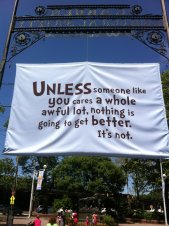
a quote from The Lorax by Dr. Seuss

You are invited to comment, collaborate, and co-create a global NurseManifest research project, to be carried out later this year.

Previously in 2002 and 2003 we asked nurses what it was like to practice nursing, and what changes they envision to create the conditions for ideal practice, using emancipatory methods.

For 2016 I propose we explore the topic of excellence in nursing care, from the perspective of patients and caregivers, using Appreciative Inquiry.

With a blog readership of over 7,500 people, we now have the capacity to carry out the international study envisioned by the NurseManifest Project founders over a decade ago, and make a global impact through our collective action.

Some critical questions we might ask include:

  • What is like to be the recipient of excellent nursing care?
  • What specifically about your nursing care experience made it excellent?
  • How would healthcare be different if every nursing interaction was excellent?
  • What would it take to create a healthcare system where excellent nursing care is the norm?

Some opportunities to participate include:

  • Host a conversation group with patients and family members who have received care from a single health care organization or network of providers.
  • Host a conversation group with patients and family members who have received care related to a specific condition or life event.
  • Host a conversation with a community group, with co-workers, or even with your own family.

Some ideas for dissemination:

  • Present at national and international conferences in 2017
  • Develop a series of manuscripts for peer-reviewed journals
  • Turn the findings into a book
  • Use the findings to inform a public service campaign about nursing and policies impacting nurses

Please add your ideas in the comments section below this blog entry or write to Olga Jarrín at olga.jarrin@rutgers.edu by June 1, 2016 – in time to have a shared protocol and IRB approval in place for interviews and focus groups to begin in September, 2016.

For more information about Appreciative Inquiry see the website: Appreciative Inquiry Commons. Case Western Reserve University, Weatherhead School of Management. April 18, 2016. *Note: This repository of information Includes Appreciative Inquiry resource materials in 22 languages. https://appreciativeinquiry.case.edu


Nursing Students or Student Nurses: What’s in a Name


Recently, Jane Dickinson drew attention to the power of the language we use in her blogs examining language and health and in her argument to replace words that shame. It reminded me of another instance of language use that I believe to be inherently harmful – referring to nursing students as student nurses. This practice has been so widely used for so long that I can imagine many gasps and reactions, such as, “Well, that’s what they are; what else should we call them?” Why not nursing students? Is there a difference? I would argue there is a great difference.

I cannot think of one other group of students, health or otherwise, that is referred to with a similar moniker. We do not speak of student doctors, student lawyers, student engineers, for example. They are medical students, law students, engineering students. The lack of parallelism is the first indication that we should examine this practice.

When I “trained” to be a Registered Nurse in a hospital in the early 1960s, student nurses made up a large proportion of the hospital’s workforce. Student nurses were identified by their caps, first having none in the first 6 months, then after the capping ceremony, a white cap. Second year students were identified with a light blue ribbon on their caps, third year meant a dark blue ribbon, until finally Registered Nurses wore the coveted black ribbon. The uniforms likewise differentiated students from Registered Nurses, with graduate nurses wearing all white and students being required to wear a blue dress, with highly starched white bib and apron – all exactly 14” from the floor, regardless of the student’s height (so in class pictures the skirts were exactly at the same length) – along with plastic collar and cuffs. Although I describe the practice of one particular hospital, similar practice were common elsewhere. Student nurses were a category of hospital worker and were, as such, as easily identifiable as housekeeping staff, candy stripers, or Registered Nurses.

I say all of this to make the point that not only did the label “student nurse” make her (with very few males at that time) identifiable, but also indicated something about her place in the organization and the expectations that organization had of her. (I will continue to refer to “her” because, although our class was unusual in that we had 2 males in our class, their uniform was white, like male Registered Nurses wore. It did not change throughout the 3-year program, and neither male students nor male Registered Nurses wore a cap or any other ranking symbol.)

The term student nurse comes from a time when nursing students were expected to be not only subservient (if a physican entered the nursing office, a student nurse who was sitting and charting, for example, was expected to rise and give the physician her seat), but also loyal, innocent and pure. The Florence Nightingale pledge, recited at graduation by the graduating classes of the time, included the promise to “pass my life in purity.”  In the first year after my graduation, I was employed as a Registered Nurse  at a secular  hospital (I ‘trained’ in a Catholic hospital) in a different Canadian province.) Yet the Director of Nursing forbade the graduating class that year from taking the pledge because she didn’t believe they had lived their lives in purity. She enjoyed the power to be able to do that!

This combination of an aura of innocence/ purity with the expectation that student nurses provided intimate care to males made “student nurses” highly desirable as dates.  Even during my student nurse years, engineering students from the local university would come to hospital schools of nursing to find dates for their dances.  Unfortunately, this also applied to nurses generally – the saying “if you can’t get a date, get a nurse” was common for years after I graduated in 1964. The frequent representation of nurses as sex objects, well documented by such authors as Kalisch and Kalisch extended to student nurses as well.

Despite the fact that nursing education has changed dramatically in the last 50 years, the term “student nurse,” with all its connotations, persists.  When I was teaching, I challenged students to refer to themselves as nursing students instead.  In class discussions on the topic, despite students’ general agreement that the connotation of “student nurse” was very different from that of nursing student, very few took up that challenge and subsequently submitted assignments in which they referred to themselves as student nurses. Some told me they were required to designate their status as S.N. when signing their charting.

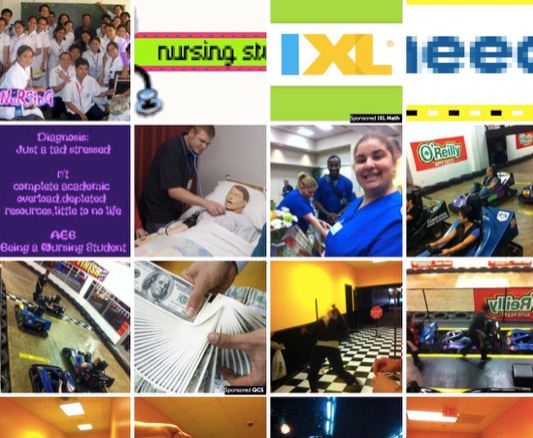
I was interested in whether or not a Google images search for nursing student yielded any different result than search for student nurse images. The screen shots of the first screen that came up with each search are below.  Without a careful analysis, some differences are immediately apparent.  The top one is the screenshot of student nurse images; the second a screenshot of nursing student images.  

NM_April_6_16_copy_pagesNM_April_6_16_copy_pages

While both screenshots include some images that appear unrelated, in the top one they are images of children. There are no images of nurses practicing, and the screenshot includes images of the back of a nurse’s capped head, and the nurse as a romantic figure (Cherry Ames). The somewhat self-deprecating text message reads “ Student Nurse Diagnosis: Stress R/T: knowledge deficit, impaired memory, sleep deprivation, unbalanced nutrition, interrupted family process, lack of social interaction, disturbed energy field.”

Note the general increase in diversity and portrayal of adult nurses providing care in the second picture. The unrelated shots appear to depict Go-Kart racing. The text image, giving the same stress diagnosis, makes its point without self-degradation: “Diagnosis: Just a tad stressed r/t complete academic overload, depleted resources, little or no life.

It seems to me that the collages support the argument that the term student nurse has a different connotation than nursing student and its removal from our lexicon is long overdue. Some time ago I wrote a blog about nurses soaring like eagles. It is a parable about an eagle that finds itself in a chicken yard and starts to act like a chicken, rather than fulfilling its destiny and potential as an eagle.  I believe that by referring to nursing students as student nurses we are unwittingly reinforcing the many messages that the term connotes and are hindering their ability to soar like eagles.