Standing Up For Access to Vaccines in the United States


Written by Carey S. Cadieux, PhD, RN, AHN-BC, RYT, FAAN

As many of us struggle with the threats to public health under the current adminsitration, we may feel unempowered and discouraged. It’s important as patient and population advocates, and as the largest number of healthcare care providers, that we take steps toward finding small ways we can make a difference. Sharing our knowledge and calling for what is right for the health of the American people is something we can do in our everyday lives.

I have been greatly concerned about access to vaccines. For about a week in my state of New York, I haven’t been able to access a COVID vaccine as a prescription is required. For a number of reasons I couln’t obtain a prescription even though I have qualifying factors and I was about to travel to another state to obtain care until the Governor Hochul of New York wrote an executive order that ensures that all the people of New York State can receive a COVID vaccines without a prescription. Her executive order ensures that for the next 30 days, all NEw Yorkers can access a COVID vaccine, and the legislature will be charged with creating an official long term legislative move that will ensure access to all vaccines remain in place for New Yorkers. Ideally her actions alongside those of the governors of Massachusetts, California, and New Mexico will be replicated by other states.

Meanwhile, we have an opportunity to make our voices heard to the Avdisory Committee on Immunization Practices (ACIP) and the CDC prior to their next meeting in 7 days time. Until Spetember 13 @11:59 pm EDT, you can send a comment to the committee expressing your concerns the ACIP will be discusisng revisions to vaccines that can be adminstered to children and the vaccine schedule that dictates how ACA insurance is used (or not) to pay for vaccines. Their recommendations will also apply to the Vaccines for Children program, which has been highly successful at ensuring children have access to vaccines.

The call for comments can be read here: file:///Users/careycadieux/Downloads/CDC-2025-0454-0001_content%20(1).pdf

Your own comments with a 500 word maximum can be made here: https://www.regulations.gov/document/CDC-2025-0454-0001/comment

It’s important to consider what you want the ACIP to hear; while personal stories may be moving, it’s also appropriate that we include data and factual information in our comments. Start by letting the committee know you are an RN and why you are writing the comment. Include some links to articles or websites to support your ideas. Tell them what you want them to do. Remain professional. Include stats if you find them. Also, my entry is approaching the 5k word limit, but even just a few hundred works can have an impact.

You have the power!

Here is an example I submitted today (at the time of this blog posting it is still awaiting approval).

As a registered nurse with a PhD, an interest in public health, a fellow of the American Nurses Association Advocacy Institute, a Fellow of the American Academy of Nursing, and a background in public policy, I am deeply concerned about the current state of the CDC’s vaccine stance and the next steps for the ACIP. The recent proposal to limit access to the hepatitis B, MMRV, RSV, and COVID vaccines could end up being disastrous for the United States citizens. This is likely to end up costing the country and its citizens greatly on many levels. The ACIP vote, scheduled for September 2025, will, in great part, determine the future of our nation’s health. 

There is a significant public health concern that people, particularly children, should be vaccinated, and that the vaccines be covered by marketplace/ACA insurance, as well as the Vaccines for Children Program. A study performed by the National Institutes of Health with scientists from Henry Ford Health found that the some of the most impactful risk factors for the spread of COVID-19 in households include obesity and children as vectors (Siebold et al., 2022). 

Our public health system needs to vaccinate people to reach and/or maintain herd immunity for many preventable diseases. Herd immunity refers to the evidence-based concept where enough people are vaccinated to prevent the rapid spread of infectious agents. According to the Cleveland Clinic (2022), achieving herd immunity from COVID-19 required vaccination levels of up to 85% of the population, which we failed to achieve; hence, COVID-19 is now considered to be an endemic disease. Restricting access to vaccines contradicts the well-established scientific evidence that vaccines protect populations from infectious diseases, decrease overall healthcare costs, and safeguard vulnerable populations (Ashby & Best, 2021). 

The ACIP must also consider the cost of ongoing vaccine hesitancy and the lack of public health system support for accessing vaccines. A Kaiser Family Foundation study estimated that the cost of 690,000 vaccine-preventable COVID-19 hospitalizations in June-November 2021 was $13.8 billion (Kaiser Family Foundation, 2021). The CDC’s own research has found that the Vaccines for Children Program is effective. From 1994 to 2023, this program prevented 508 million lifetime cases of illness and 32 million hospitalizations, while also saving $540 billion in direct medical costs and $2.7 trillion in societal costs (Zhou et al., 2024). 

Additionally, vaccine-preventable diseases (VPD) in people over age 50 are not just costly; VPD hospitalized patients incurred worse clinical outcomes, greater loss of independence, and increased mortality and morbidity versus control groups (Hartman et al., 2024). The indirect costs of low vaccination rates include lost productivity, increased public health costs, diversion of public health resources, and higher insurance premiums. At a time when societal and US debts are rising at an alarming rate, not supporting access to free vaccines on a clearly defined and evidence-based schedule is an ingredient of a recipe that results in US economic failure.

Instead of focusing on restricting vaccines, the CDC and the ACIP should be focusing on overcoming vaccine hesitancy so that adults and children can be properly vaccinated according to an evidence-based schedule. In the best interest of the health of the US citizens, the proliferation of fear around vaccines needs to come to a halt, and the polarization of vaccine acceptance needs to be rebuked. The CDC needs to overcome vaccine hesitancy by supporting doctors, nurses, and pharmacists in their efforts to educate people about the acceptance of vaccines and their effectiveness at maintaining both individual health and the health of the population. The APIC, by supporting an evidence-based CDC vaccination schedule and a regulatory system that encourages vaccination for children and adults, could address the main components of vaccine hesitancy: lack of confidence in vaccines, complacency, and lack of vaccine access/ convenience (Gregory et al., 2023). The ACIP and CDC should not be creating road blocks around the people’s access to life saving vaccines. 

When considering the moral and ethical implications of vaccine programs and mandates, governments must always prioritize maximizing public benefit and minimizing public harm (Jalilian et al., 2023). The unintended consequences of the ACIP not fully supporting an evidence-based vaccination schedule from the CDC, include increased costs to the system, further division of the US population around this issue, and growing vaccine hesitancy. 

I urge the ACIP to vote in favor of evidence-based decisions regarding vaccine effectiveness and ensuring availability to all people in the population. You are charged with minimizing harm, overcoming vaccine hesitancy, enhancing access to vaccines, and reducing overall costs to the US government and the American people. 

References:

Ashby, B. & Best, B. (2021). Herd immunity. Current Biology, 31(4), R174-R177. https://doi.org/10.1016/j.cub.2021.01.006

Cleaveland Clinic. (2022). Herd immunityhttps://my.clevelandclinic.org/health/articles/22599-herd-immunity

Gregory, P., Gill, M., Datta, D., & Austin, Z. (2023). A typology of vaccine hesitancies: Results from a study of community pharmacists administering COVID-19 vaccinations during the pandemic. Research in Social and Administrative Pharmacy, 19(2), 332-342. https://doi.org/10.1016/j.sapharm.2022.09.016

Hartmann, M., Servotte, N., Aris, E., Doherty, T.M., Salem, A., & Beck, E. (2024). Burden of vaccine-preventable diseases in adults (50+) in the United States: a retrospective claims analysis. BMC Public Health 24, 2960. https://doi.org/10.1186/s12889-024-20145-0

Jalilian, H., Amraei, M., Javanshir, E., Jamebozorgi, K., & Faraji-Khiavi, F. (2023). Ethical considerations of the vaccine development process and vaccination: A scoping review. BMC Health Services Research23(1), 255. https://doi.org/10.1186/s12913-023-09237-6

Kaiser Family Foundation. (2021). Unvaccinated COVID patients cost the US health system billions of dollars. https://www.kff.org/covid-19/unvaccinated-covid-patients-cost-the-u-s-health-system-billions-of-dollars/


Seibold, M. A., Moore, C. M., Everman, J. L., Williams, B. J. M., Nolin, J. D., Fairbanks-Mahnke, A., Plender, E. G., Patel, B. B., Arbes, S. J., Bacharier, L. B., Bendixsen, C. G., Calatroni, A., Camargo, C. A., Jr, Dupont, W. D., Furuta, G. T., Gebretsadik, T., Gruchalla, R. S., Gupta, R. S., Khurana Hershey, G. K., Murrison, L. B., … HEROS study team. (2022). Risk factors for SARS-CoV-2 infection and transmission in households with children with asthma and allergy: A prospective surveillance study. The Journal of Allergy and Clinical Immunology150(2), 302–311. https://doi.org/10.1016/j.jaci.2022.05.0

Zhou, F., Jatalaoui, T.C., Leidner, A.J., Carter, R.J., Dong. X., Santoli, J., Stokely, J.M., Daskalakis, D.C., & Peacock, G. (2024). Health and economic benefits of routine childhood immunizations in the era of Vaccines for Children Program- United States, 1994-2023. MMWR Morbidity & Mortality Weekly Report, 73, 682-685. https://www.cdc.gov/mmwr/volumes/73/wr/mm7331a2.htm
The Nurses are Here! Nurses Drawdown, a Global Movement to Address Climate Change


Contributor:
Teddie Potter PhD, RN, FAAN
School of Nursing University of Minnesota
tmpotter@umn.edu

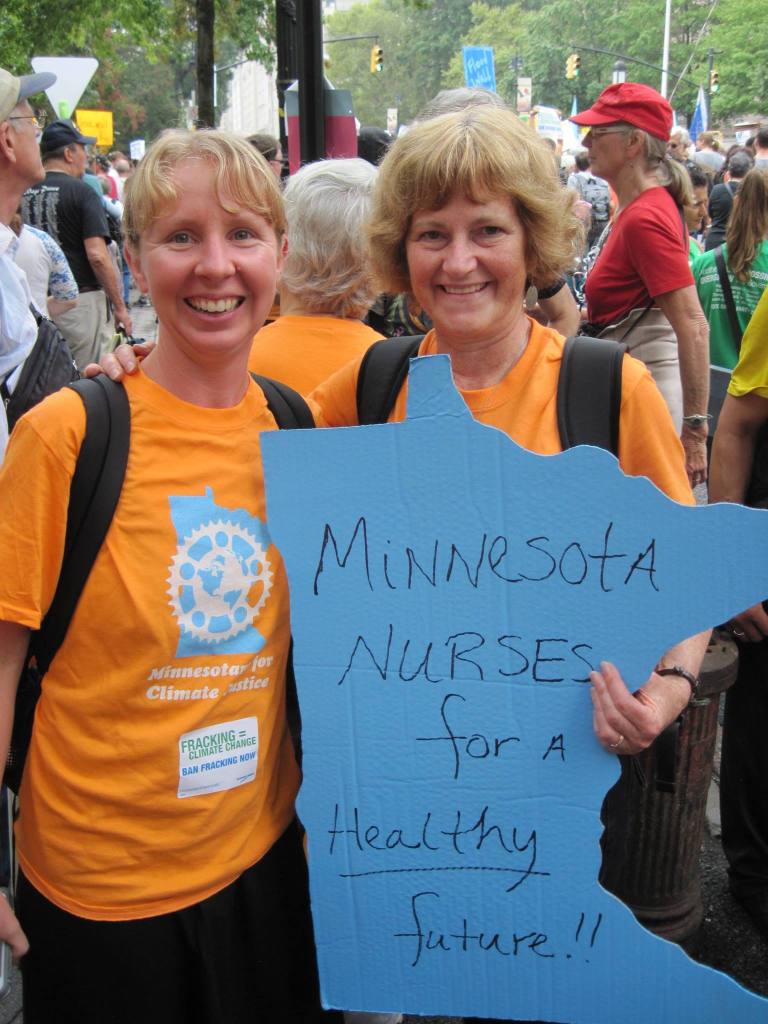
Rachel Kerr and Teddie in New York

Throughout the history of professional nursing, nurses have designed new care delivery models and transformative interventions in response to unmet needs and population health and public health challenges. These changes required disruptive thinking and bold courage in the face of broken systems, ineffective policies, and powerful naysayers. Climate change may be a modern example of a major public health crisis yet the challenges to mounting an effective response are similar. This is the story of Nurses Drawdown, a global, nurse-led movement to improve the health of humans and the planet.

Honoring the Ancestors of this Movement

Around the globe, the earliest experts in planetary health were, and continue to be, indigenous people. Their values and patterns of decision-making acknowledge the deep interconnection of human health and the health of the biosphere.

Many early nursing leaders shared a similar awareness that we ignore the environment at our peril. The ideas of Florence Nightingale, Lillian Wald, and Mamie Odessa Hale offer inspiration to transformative leaders today. Florence Nightingale is considered the founder of modern professional nursing; her astute observations and applied statistics established nursing as a science-based profession. Nightingale was an expert systems thinker who connected the health of humans to the quality of the environment. Like Florence, nurses today must recognize that nursing care is delivered in the context of nature.

Lillian Wald

Lillian Wald, the founder of public health and school nursing, faced the daunting task of addressing the health needs of resource-poor immigrants in New York City (Wald, 1915). She went to the people and lived among them. Her willingness to participate in health initiatives alongside those she served offers a lesson for transformative leaders today. Nurses can inspire people to take action on climate change by first making changes in their own lives.

Mamie Odessa Hale
Source

Mamie Odessa Hale was another historical change agent. Hale was an African American Nurse Midwife practicing in an era of deep racial segregation. She taught community midwives simple practices based on the best science of the time thereby improving birth outcomes for African Americans (Hale, 1948). The story of Mamie Odessa Hale encourages today’s nurses to realize that simple science-based interventions, taught with respect and empathy, can transform the health of individuals and whole communities.

These early nursing leaders laid the foundation for today’s global movement to address climate change. They are a part of the Nurses Drawdown story.

The Seeds of a Movement

In September 2014, I took a long bus trip across the nation to attend the People’s Climate March in New York City. Over half a million people from all demographics and all walks of life came together to send a strong message that the United States must take climate change seriously and meaningfully contribute to global negotiations.

Like my fellow travelers from Minnesota, I wore a bright orange t-shirt. The only indication that I was a nurse was the sign I created that said, “Minnesota Nurses for a Healthy Future.” As the march moved through the streets of Manhattan, I was shocked how frequently observers standing along the route commented to one another, “The nurses are here!” Some even asked to take their picture with me so they could send it out on social media with the message that nurses had shown up to address climate change. I remember thinking, “What is this?” The people were not shouting, “The engineers are here!” or “The teachers are here!” There is something about nurses taking on climate change that inspired hope.

Fast forward to 2018 when I adopted the book Drawdown: The Most Comprehensive Plan Ever Proposed to Reverse Global Warning (Hawken, 2017) for “The Global Climate Challenge: Creating an Empowered Movement for Change,” a course that I teach at the University of Minnesota. Climate change is an urgent public health crisis; therefore, I teach that our solutions must be effective and have significant impact. Project Drawdown (2020)provides the solutions; could nurses provide the inspiration to scale them?

I contacted Project Drawdown and presented the argument that as the largest global health profession and the most trusted profession, nurses may be able to effectively and broadly scale Project Drawdown’s science-based solutions to climate change. Nursing’s long history of innovative leadership to improve the health of individuals, families, and communities can be relied on to improve the health of humans and the health of the planet. So, a partnership was formed between Project Drawdown and the Alliance of Nurses for Healthy Environments (ANHE).

ANHE (2019), the leading professional organization for nurses working to promote a healthier environment, coordinates the Nursing Collaborative on Climate Change and Health, a broad network of professional organizations committed to planetary health. Katie Huffling and Cara Cook from ANHE and I assembled a leadership team to plan and initiate Nurses Drawdown. It was very important that we include nurses across the globe, nurses from a wide variety of practice settings, and different demographics including nursing students.

Nurses Drawdown

The vision for Nurses Drawdown is “to improve the health of individuals, communities, and the planet through commitment to and action on the Nurses Drawdown solutions.” The mission is, “Nurses, the most numerous and most trusted health profession in the world, have the power to significantly impact climate change. By embracing and teaching the evidence-based solutions of Nurse’s Drawdown, nurses around the world will help to decrease greenhouse gas emissions and create a healthier future for humans and the rest of the planet.”

To this end, the Nurses Drawdown leadership team elected to scale Project Drawdown solutions that have the co-benefits of improving human health and the health of the planet. We selected five themes, reflecting an alignment between core nursing expertise and effective evidence-based solutions. These include:

  • FOOD: Committing to eat a more plant-based diet, using clean burning cookstoves, and reducing food waste
  • MOBILITY: Promoting walkable cities, including improving bike infrastructure and using mass transit
  • GENDER EQUITY: Educating girls and improving access to family planning
  • ENERGY: Increasing the efficiency of buildings and transitioning to clean energy sources
  • NATURE-BASED SOLUTIONS: Planting trees and protecting forests

An Invitation to Join the Movement

Throughout history, professional nurses have been at the forefront of change. Whether it was alleviating mass suffering related to conditions of war, addressing severe economic disparities that impact health, or responding to new and emerging infectious diseases, nurses’ orientation toward systems thinking and prevention have made them the ideal leaders for innovating and mobilizing effective solutions.

We invite you to continue this tradition by joining Nurses Drawdown at nursesdrawdown.org. Under the Take Action tab, you will find practical solutions to apply in both your personal and professional life. You will also be inspired by the stories of nurses around the globe who are taking action to promote a healthier future for generations to come.

Many will remember 2020 as the year of the pandemic. Let them also remember 2020 as both the Year of the Nurse and Midwife (World Health Organization, n.d.), and the year that nurses around the globe activated to address climate change. The nurses are here!

References

Alliance of Nurses for Healthy Environments [ANHE]. (2019). Alliance of Nurses for Healthy Environments. https://envirn.org/nursing-collaborative/

Hale, M. O. (1948). Arkansas midwives have all-day graduation exercises. The Child, 13(4): 53–54.

Hawken, P. (2017). Drawdown: The most comprehensive plan ever proposed to reverse global warning. New York, NY: Penguin.

Project Drawdown. (2020). Drawdown 2020. https://www.drawdown.org/

Wald, L. (1915). The house on Henry Street. New York: Henry Holt.

World Health Organization. (n.d.). Year of the nurse and midwife 2020.https://www.who.int/campaigns/year-of-the-nurse-and-the-midwife-2020

About Teddie M. Potter, PhD, RN, FAAN

  • Clinical Professor, School of Nursing- University of Minnesota
  • Specialty coordinator of the Doctor of Nursing Practice in Health Innovation and Leadership
  • Director of Planetary Health

Dr. Potter is deeply committed to climate change education including co-founding Health Professionals for a Healthy Climate, membership in the Alliance of Nurses for Healthy Environments, and membership on the American Academy of Nursing Environment and Public Health Expert Panel. She is a member of the Coordinating Committee of Columbia University’s Global Consortium on Climate and Health Education and a Fellow in the Institute on the Environment at the University of Minnesota. She chairs Clinicians for Planetary Health (C4PH) and is a member of the Steering Committee of the Planetary Health Alliance at Harvard.

At the University of Minnesota, Dr. Potter designed and co-teaches an interdisciplinary course titled “The Global Climate Challenge: Creating an Empowered Movement for Change”. In addition, she co-leads a Health Sciences initiative titled, “Climate Change and Health: An Interprofessional Response”. In 2019, Dr. Potter was appointed the first Director of Planetary Health for the School of Nursing.

Nurses’ Concerns with COVID19: Update May 2, 2020


I find that nothing is more powerful than hearing the stories of our nurses during this pandemic crisis. This website has some of these powerful stories from nurses around the globe, sharing their experiences of caring for COVID19 patients: Nursespeak.com

PPE: Nurses continue to lack Personal Protective Equipment: A recent survey showed that 75% of staff in home-care settings are lacking in PPE. Home Care Survey. 86% of healthcare systems are also concerned with having adequate PPE available: PPE shortages

Political unrest emerges even as nurses remain on the front lines of providing care for patients during the pandemic. Nurses rose to the occasion to stand their ground in the face of protestors. Nurses Urge Protestors to Stay Homeimage.png

National Nurses United organized a nation-wide May-Day protest about lack of PPE: https://www.cbsnews.com/news/may-day-protest-nurses-ppe/

image.png Nurses also took  action by protesting outside of the Whitehouse on April 21 and reading aloud the names of nurses who died from contracting COVID19 in the workplace: Nurses Whitehouse Protest

And nurses are still speaking up, even if it puts their jobs at risk: Hospitals fire and suspend staff for speaking out


Nurses deaths: The virus continues to take its toll on nurses and other professionals. Issues around post-trauma recovery are now coming to light. Healthcare workers may be feeling hopeless or helpless or suffering clear PTSD symptoms. Sadly we have lost some professionals to suicide: NYPost tragic deaths.

If you need help please reach out. National Suicide Prevention Lifeline: 1-800-273-8255

A Missouri nurse, Celia Yap Banago, who raised concern about lack of PPE died of COVID19. Nurse Banago had worked as a nurse for 40 years and was literally days away from retirement.Nurse Banago

image.png

New York State Nurses Association houses a memoriam page to nurses lost to COVID 19. NYSNA memoriam page The retired executive director of the National Student Nurses Association is counted in the losses: Rest in Peace Robert V. Piemonte, EdD, RN, FAAN. image.png

To all of the nurses taking action, thank you for stepping up.

Nurses’ Concerns with COVID19: Update April 17, 2020


The COVID19 pandemic continues to be quite an issue in New York, with over 14,000 deaths reported. I found this link to the New York Times to be helpful in assessing where we are with official numbers of reported testing and deaths (NYTimes CVOID19), though in many states we know that testing remains very limited and accuracy of tests is still only at about 67-70%.

PPE: Nurses are still without proper PPE. While the federal government claims to have distributed millions of masks and gowns, frontline workers are still faced with shortages and putting themselves at risk. Now we are seeing surges in the cost of PPE, with costs going up over 1000%, according to a report published last week by the Society for Healthcare Organization Procurement Professionals. Competitive bidding for these supplies both internationally and within our own county has compounded the issue, and if we had federal government oversight and processes in place, it is likely these issues could be addressed in ways that would help to prevent price inflation ( CNN review of the inflation of PPE cost).

This video that appeared on CBS’s 60 minutes made it clear that nuses like New York nurse Kelley Cabrera are beginning to speak out. Nurse Cabrera works at Jacobi medical center in the Bronx. She makes the point that when nurses are required to reuse N95masks for up to 5 days, they are literally being provided with medical waste to be used as PPE. Nurse Kelley Cabrera 60 minute’s interview

Nurses Stories: Meanwhile, I have heard the stories of nurses continuing to work without proper PPE and we reultantly have high numbers of nurses testing positive in areas like Ohio.

Nurses have started to reject the idea that they be considered to be angels or heroes. They didn’t become nurses to die, and they don’t want to be martyrs. While the 7 pm clapping and cheering ritual in New York City seems to have built a community spirit, some nurses experience this differently. One New York City nurse wrote: ” I ask that you do not pity me, that you do not call me a hero. I do not wish to be made into a martyr….Clap for me and other healthcare workers at seven o’clock if it makes this pandemic feel more bearable. I concede, your cheers help us trudge on. Just know that cheers and hollering don’t change the outcome. This is my fervent plea – that we change what we can after all this is over”.

Fallen Nurses: The loss of nurses becomes hard to track as the numbers increase. NYSNA has set up a memoriam page: Fallen Nurses Memoriam

A 28-year-old pregnant nurse in the UK passed away on 4/12, RIP nurse Mary Agyeiwaa Agyapong. Her father passed away two weeks before she died. Mary’s baby daughter was delivered via cesarean section before Mary died.

27236508-8226319-Mary_Agyeiwaa_Agyapong_28_pictured_died_on_Sunday-m-13_1587050953040

Many other nurses and hospital staff in the UK have also died (daily mail review of nurse and staff COVID19 deaths).

Two nurses in Palmetto, Florida have also died from work related exposure to COVID19. Nurse Danielle Dicensio leaves behind a 4 year old son and hubsand. Nurse Earl Bailey also worked at the same hospital, Plametto General Hospital, and he passed away from CVOID19 a few weeks ago. Both nurses complained about not having access to proper PPE, which the hospital denies (two nurses die of COVID19 ). 

A colleague of Nurse Cabrera’s (mentioned above), Freda Orcan,  who worked at Jacobihospital in the Bronx passed away March 28.

image


ANA’s response to COVID19:

The Ameican Nurses Association has issued a statement that nurses should be reporting when then experience retaliation around their raising concerns regarding their personal safety in the workplace, as these are OSHA violations (OSHA and retaliation issues). While hundreds of complaints have been filed, it’s difficult to determine specifically how OSHA is responding to reports made. There is a plethora of information on their website regarding COVID19 issues (https://www.osha.gov/SLTC/covid-19/),

The ANA has created a page of resouces for nurses (ANA COVID19 page). There have developed a corona virus response fund for nurses. There is also a section about ethical guidelines for nurses that may help some in their decision making process and calls forward the bigger ethical issues that nurses are facing, and  links that show all of the steps that ANA is taking in advocating for nurses.

The latest ANA/ AHA/AMA letter witten calls for the government to address the issue of minorities and the disparities they experience with receiving adequate care for their COVID19 issues. (ANA letter to the Secretary, US Department of Health and Human Services). The letter in part reads:

“As organizations that are deeply committed to equity in health status and health care, we have long recognized differences in the incidence and prevalence of certain chronic conditions, such as diabetes, asthma, and hypertension — conditions that are now known to exacerbate symptoms of COVID-19. We also recognize that other factors, including but not limited to socioeconomic status, bias and mistrust of America’s health care system, may be resulting in higher rates of infection in communities of color. Lack of access to timely testing and treatment will inevitably lead to worse outcomes for these patients.

As America’s hospitals and health systems, physicians and nurses continue to battle COVID-19, we need the federal government to identify areas where disparities exist and help us immediately address these gaps.”

While ANA has been interacting at the national level, my perception from the nurses directly working with patients on the frontlines is that they feel under-represented and that ANA is not providing them with the voice they need. One time letters to federal authorities seem to make little measurable immediate impact. around what matters for nurses being able to practice safely. They also feel that many of the practicing nurses don’t belong to ANA exactly for this reason: that there is somehow a gap between the reality of nursing practice and the work and publications of the ANA. The crisis is far from over.

May all nurses and all beings know some peace and ease.

Nurses’ Concerns with COVID19: Update April 7, 2020


At this point, things are so disheartening for so many people. The range of nurses’ stories is so wide and varied, from OR nurses being essentially laid off due to no elective surgeries happening, to nurses being offered a lot of money to come to New York City to work.

New York State has taken the unprecedented step of merging all of its 200 hospitals into one system (New York State hospital system consolidation ). 

There’s a lot of death. One nurse told a story of how she had 10 patients in one shift and 7  of them died. In some hospitals, there is a different kind of rapid response team called, specifically for CVOID19 patients, and they are being called sometimes just minutes apart on different units throughout the hospital.

Also, nurses are working with their colleagues who end up being patients in their same units; one nurse told of their nursing supervisor being hospitalized in their own ICU, and they conjectured the supervisor most likely would pass away there.

There’s a lot of understaffing and over-working, including on the medical-surgical units. Part of this is because nurses themselves are becoming ill and unable to come to work.

image.png

Some nurses are actually more frightened to work in the medical-surgical units because they have a lack of PPE, and all patients are presumed to be COVID19 negative. Of course, when tests come back days later, the nurses discover that they worked with these COVID19 positive patients without proper PPE. There are also many issues around HIPPA and staff not being able to find out the COVID19 status of the patients they worked with previously.

Another nurse relayed this story: he works twelve-hour shifts on a medical-surgical floor, and their usual patient load now runs from 12-15 patients, the only real charting they really do is vital signs and meds. This is possible because NYC has suspended a lot of normal operations when it comes to providing care as per the governor’s laws:

“A massive section of regulations on the “minimum standards” governing hospitals — dealing with everything from patients’ rights to the maintaining of records — has been suspended ‘to the extent necessary to maintain the public health with respect to treatment or containment of individuals with or suspected to have COVID-19’.” (read about all of the laws suspended) .

This nurse cries after every shift, and he stated his tears are so different from before, in part due to his utter exhaustion. His family and friends want him to quit, they are worried about his health, but he stated he can’t quit now, they need him too much.

Nurses are asking about ramifications of quitting their jobs; some claim that they have been threatened that they will be reported to their board of nursing for disciplinary action (this is not the reportable offense of walking out and abandoning patients, rather for resigning their position). While these threats are likely idle, some nurses are still fearful of losing their licenses.

One nurse states that she works in a COVID19 only ICU unit. She says it’s mostly completely staffed by RNs: they have no NPs, PAs, Residents, Techs, or Housekeepers. Nurses and ICU Attending and Intensivists care for the patients. Med Surg nurses act as techs and assist the ICU nurses.

Recruiting: There is still a lot of recruiting going to bring nurses to NYC. One new graduate nurse (recently licensed, with no work experience) posted on social media about being offered to be “trained” to work in the ICU in NYC. All of her travel and lodging would be covered. She would be required to work 21 days, 12-hour shifts, with no days off.  The majority of the experienced nurses tried to set her straight about why this was a really bad idea, but we have no idea if she proceeded or not.

It’s not just NYC: We now have a 54-year-old nurse in Michigan who died, Lisa Ewald.

image.png

Unfortunately, nurse Ewald may have had some issues with initially being tested by her workplace, Herny Ford Health System in Detroit, Michigan. She was likely exposed on March 24, received her positive test on March 30, and passed away on April 3. She died alone in her home. (Lisa Ewald’s story).

Rest in Peace Nurse Ewald.

Meanwhile, more than 700 Henry Ford employees have tested positive for COVID19; 500 of the positive tests are nurses. (Henry Ford COVID19)

The field of nursing will be forever changed by this.