The Nursing Manifesto: Aligning action toward living nursing as caring science and wholeness


“Organizations are not changing because people in organizations are not changing” (Cowling, Chinn, & Hagedorn, 2000).

The Nursing Manifesto provides us within the profession a beacon of light and hope toward creating change; it provides a map of sorts leading toward the manifestation of Nursing Qua Nursing. It calls for us to grow, change, and evolve into our professional caring autonomy.

My doctoral dissertation looked at Nursing’s Living Legend, Dr. Jean Watson’s Theory of Human Caring and how it could be explicated through relating it to other areas of academic disciplines: chaos theory, partnership theory, and transpersonal psychology were all used to support the concepts in Watson’s theory. My overall conclusion after many pages of theoretical writing was that nurses need to be on a journey of self-care and reflection in order to enact the human caring experience that Watson calls for.

“We believe that our journeys to enact this manifesto will certainly require a reuniting of the inner and outer life, accepting our wholeness and owning our freedom – a wholeness and freedom that will strengthen our outer capacity to love and serve” (Cowling, Chinn, & Hagedorn, 2000).

How can one love and serve in their capacity as a nurse? Several years after completing my dissertation, I was given the opportunity to develop an RN-BSN curriculum from a caring- holistic-integral science perspective at the University of Maine at Augusta. The recently accredited program emphasizes self-care and reflection, while students also have the opportunity to explore holistic modalities for use on their own healing paths and to share with others as well. The creation of this curriculum was an act of love and it continues to be a path of service toward the nurses we care for in our program.

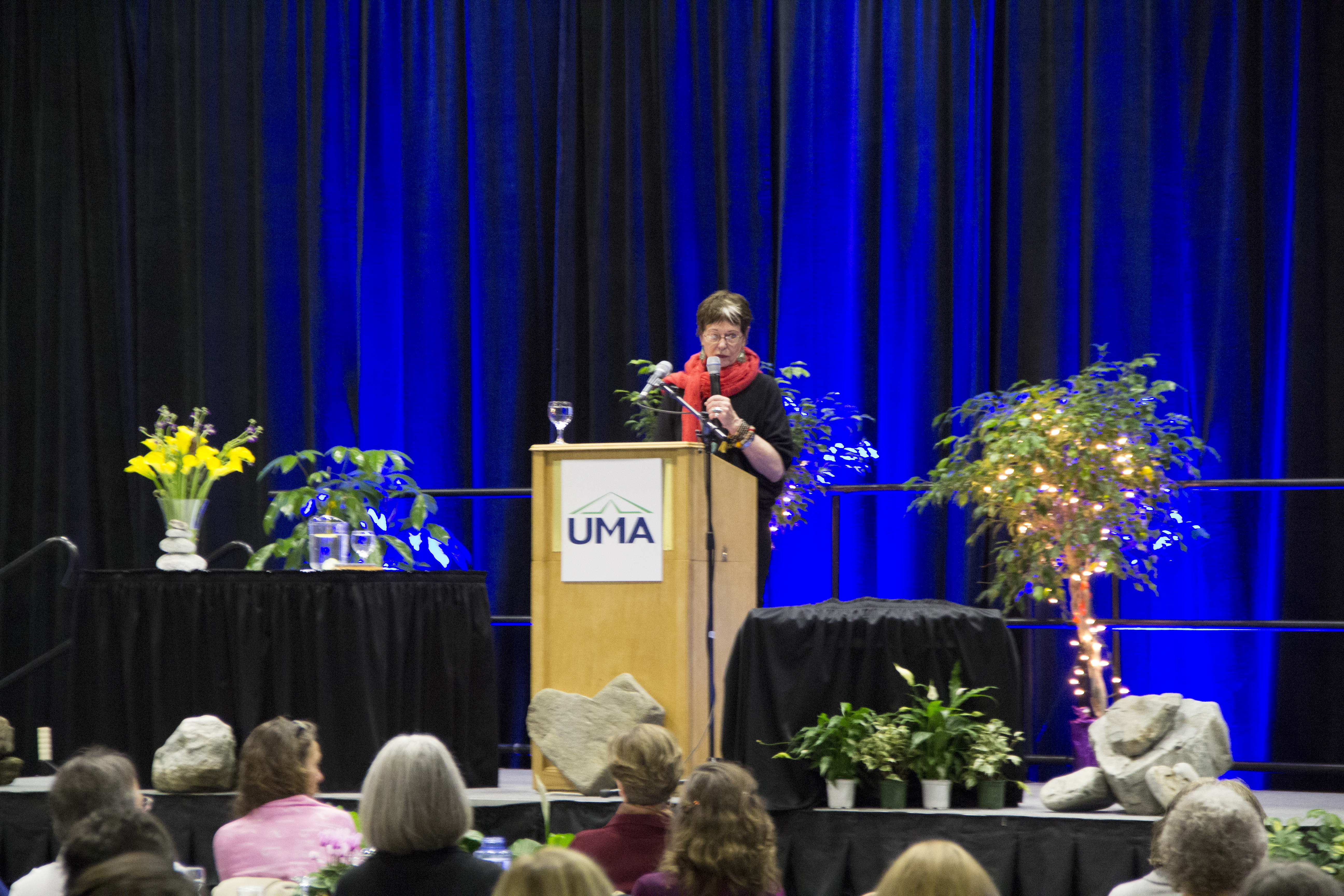
For several years, I had a dream of bringing Jean to our students and faculty. Eventually we were able to partner with our local hospital Maine General Medical Center and bring Jean not only to our students, but to nurses and nursing students from around the state of Maine. After a year of planning by a committee of 10 empowered nurses, we were able to bring over 400 nurses together to spend a day with Jean, learning about her theory.

IMG_7111

The Augusta, Maine civic center was transformed by the planning committee nurses to be a healing space; special lighting was used, break time music was geared toward songs that support healing, plants were brought in, and intentions were set by the planning committee for healing space and caring science to emerge. The lunch meal and morning and afternoon fruit offerings were also geared toward support the health of the participants.

Dr. Watson spoke for many hours throughout the day about her transpersonal caring healing moment, the challenges we as nurses face in the current medical-cure based healthcare system, and the 10 Caritas Processes that support the nurse in creating the caring moment. Participants were encouraged to ask questions and share their own experiences with caring and healing. The whole day aligned with the Nurse Manifesto process, in that Dr. Watson focused on Nursing Qua Nursing and how we can move toward a caring science reality of nursing: “It is our firm conviction that there is a body of knowledge that is specific, if not unique, to nursing’s concerns and interests. We think that this knowledge is grounded in appreciation of wholeness, concern for human well being, and ways in which we accommodate healing through the art and science of nursing” (Cowling, Chinn, & Hagedorn, 2000).

Additionally she spoke extensively about the broken healthcare system, which has morphed into an illness system, or as the nurse manifesto noted, “general subjugation of spiritual consciousness to the economics of health care” and “the long-standing ideology (acquired consciousness) of nurses being subservient to other interests, and not encouraged to be deeply committed to their own healing work” (Cowling, Chinn, & Hagedorn, 2000).

Of great importance throughout the day was the emphasis on Watson’s first caritas process: Embrace altruistic values and Practice loving kindness with self and others. The other 9 caritas process revolve around the nurse’s efforts toward enacting the first caritas process, which begins with the nurse learning to care for themselves through self care, or acting in love towards oneself.

Students provided us with feedback after the event, and they stated that the most profound experiences were being able to meet Dr. Jean Watson, and also experiencing the transpersonal caring moment through a listening experience. During this experience, the participants first centered themselves in order to speak or listen from the heart; and then in pairs, they had the opportunity to practice being present and listening without saying a word, as well as reversing the experience and speaking for several minutes from the heart. The students found this to be profound and they realized what it means to be truly present with another person in a caring- heart centered experience. Many nurses do not have the skills or experience in this area, so this is something we must continue to foster in our nursing curricula and healthcare settings. My hope is that the nurses who experienced this event will have experienced some change within themselves that will help foster the change needed in the healthcare system. Love, serve, remember….

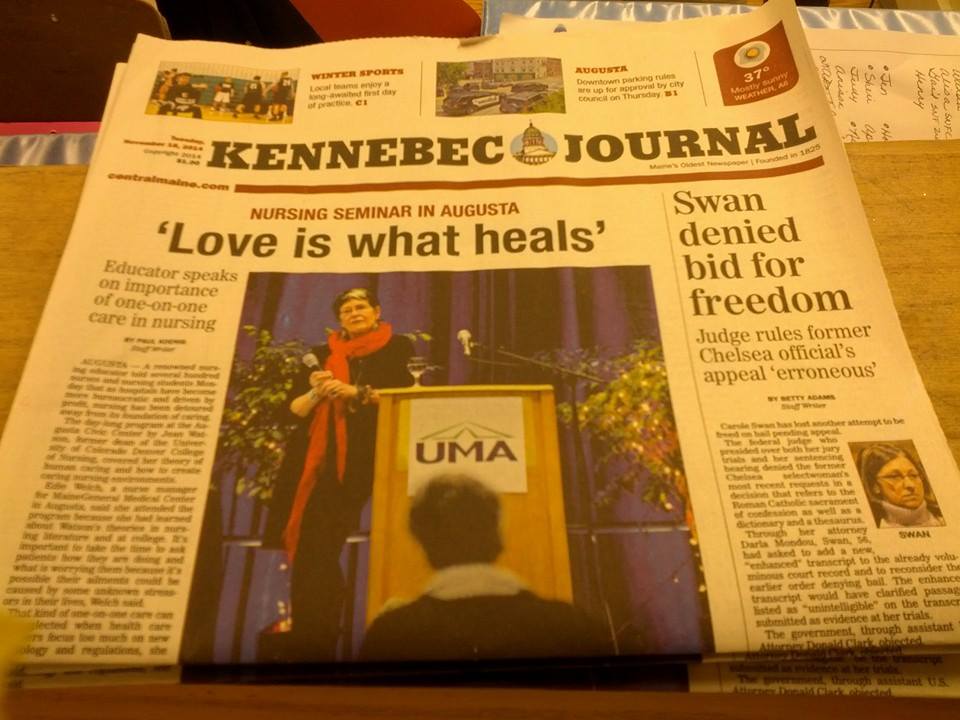
I am grateful to also have had media coverage of the event. Media coverage for nurses is of great importance, moving us out of the shadows and away from the invisible nature of our work. The front page of the Kennebec Journal on November 17 read, “Love is What Heals” and included a picture of Dr. Watson at the podium. Additionally, the event was covered by the local TV station, and that can be viewed here: http://www.foxbangor.com/news/local-news/6994-doctor-redefines-practice-of-nursing.html This media coverage is important, because as we know nurses tend to be invisible in the media, our presence often over-ridden by the medical-cure based system. We need to continue to find ways to shine our own unique light of love and healing.

JW_front page

Reference:

Cowling, W. R., Chinn, P. L., & Hagedorn, S. (2000, April 30, 2009). A Nursing Manifesto: A Call to Conscience and Action. Retrieved from http://www.nursemanifest.com/manifesto_num.htm


The Light and Dark of Nursing: Our Shadow, Part II


I have heard from many folks that they enjoyed the Part I of this blog series, which looked at some of our deep, and most scary, shadow issues in nursing; namely how a serial killer nurse can work in a healthcare system for years before being brought to justice and how the system failed to protect patients.

While this was likely one of our most extreme cases of complex shadow issues (there are a few more serial killer nurses out there, though thankfully they are low in number) and certainly many healthcare systems and administrations are in need of reform, there are also some very serious “everyday” shadow issues that nursing needs to shine the light upon in order to transform the profession. As we shine the light on our dark side, our shadows, we can begin to move out of denial of our professional issues; hence we can also begin to look for creative solutions and transformational change opportunities.

We experience challenges with the transformation of nursing practice: why is it taking us so long to take back our practices; to be able to practice nursing as a caring, compassionate, and healing art; to practice nursing qua nursing; why does it feel like we are stuck in a dark night of the soul in nursing?. We, as a professional group, have yet to really look at our own shadow projections. Theoretically, it could be that once we recognize our own shadow, the hard work is done; then we can observe, acknowledge, witness, accept and integrate these issues. This would mean less doing and fixing for our profession; we could practice presence and being with where we are at right now during these challenging times, as we look toward where we would like to be and discover how we might get there.

woman_shadow315

Below are some shadows in the profession that may be worth examining, recognizing, and witnessing. Growing awareness, being with, and bringing our collective nursing consciousness toward recognition can help move us out of states of professional oppression. Please feel free to consider and share any nursing and healthcare shadows you experience in your workplace as well!

Cognitive stacking shadow: Boynton and Hall (2012) wrote an informative post about how complex and demanding nurses’ work is from the viewpoint of our complex duties and decision making processes. Nurse Overload: The Risks to Employees and Patients .

This is worth a read to get the basics around how our workplace environments overload us with information, data, and distractions at the risk of our own and our patients’ health and safety issues. The problem here is that while systems know that this sort of overload leads to job dissatisfaction, loss of nurses, and risks to patient safety, systems and nurses seem to be doing little to no research on how to change these issues. This is costly on many levels, and perhaps nurses need to also look into how we can create new workplace environments that support our own and our patients’ well being. Cognitive stacking leads to overload and initiates the stress response, which is our next shadow to shine some light upon.

Stress response shadow: Nurses are stressed out: we work in stressful environments and we often tend to put others’ needs in front of our own, somehow failing to recognize that a) our stress has a direct impact on the stress and healing capacity of those we care for, b) we can’t keep giving without taking time to recharge, rejuvenate, and care for ourselves and c) stress is impacting our own health and well being (Clark, 2014).

The stress shows up in obvious patterns that nurses have created. I have been asked many times why so many nurses are obese. Is this a shadow issue for us as nurses, the ones who know the damage obesity causes in our bodies? Despite knowing the health issues associated with obesity, up to 54% of nurses are overweight or obese (Miller, Alpert, & Cross, 2008). Most nurses in this particular study were not motivated to make changes in their lifestyle, despite knowing the health risks of obesity.

Students often tell me they are overweight because they don’t have the time to exercise, prepare meals, eat right, sleep well, drink water, etc. Somehow the healthcare system (12 hour shifts? lack of access to healthy foods? high cortisol levels related to stress?) creates a stressful environment for us, and somehow we fail to recognize the impact this stress has on our bodies, and that we need to manage this stress or suffer the consequences. The average nurse gets only about 6 hours of sleep before any given shift, and this has great impacts on health as well as ability to function as strong clinical decision maker hour after hour (Clark, 2014). This medscape article clearly delineates the issues we face around sleep and the impact it has upon us:A Wake up call for nurses: Sleep Loss, Safety, and Health.

Stress contributes as well to many of other shadow issues: lateral violence, the nursing shortage, and our own poor health states. Letvak, Ruhm, & Lane, (2011) found that nurses will work when they are sick, and unfortunately we have higher rates of eating poorly, smoking cigarettes, abusing drugs and alcohol… and we can tend to overwork or engage in workaholic type activities (Burke, 2000).

Time and again, I hear tales from ASN through PhD prepared nurses about how they suffered PTSD from the nursing school experience, and we know that PTSD is a hazard of being a nurse: up to 14% of all nurses meet the criteria for PTSD, while as many as 25%-33% of nurses in the critical care and emergency settings screened positive for symptoms of PTSD (Mealer et al, 2007; Laposa, Alden, & Fullerton, 2003).

We know about these issues and yet both nursing academia and the systems in which we work tend to turn a blind eye toward the reality of the nursing profession’s risks and deep challenges toward health and managing our professional stress. Every healthcare facility and every school that educates nurses should be striving to shine the light on these shadow issues, and look toward finding ways to help support the health and stress management capacity of nurses. This becomes an ethical issue when we consider how the stress of the nurse can impact the stress and healing process of patients; the nurse in stress response adds to the stress of the patient’s environments, potentially right down to the neurological stress response of the patient (Clark, 2014).

walking-shadow

Shadow Side of Caring: Most nurses likely became nurses because they care about others, they want to support healing, and they want to make a difference in others’ lives. Unfortunately, nursing school in general does not prepare new graduate nurses for the challenge of creating caring-healing environments in the face of stressful workplace demands (Clark, 2014). Every nurse educator should be concerned about providing students the tools needed to manage stress in order that they make sound clinical decisions and maintain patient safety; and also that they might fulfill their life’s calling toward caring. This is an ethical obligation, and yet our academic environments tend to be initiation grounds for living through stress while students are not adapting adequate tools to manage stress.

There is also a lingering professional shadow that creating caring-healing environments takes time, we can’t possibly have time to care for and be with patients, when we have too much to do, too many demands, too many distractions, too much cognitive stacking, too little support, too few nurses, too much stress, etc. When we buy into the truth of this idea, there may no longer be a motivation to attempt to truly care for the patient. Additionally, many healthcare facilities, including magnet facilities, and systems may claim to support nurses in caring, and yet the reality of the workplace remains unchanged, even when changes have been claimed by administration. We may call this lack of support to realize our deepest call toward caring a form of oppression by the system (Clark, 2002, 2010). A concern I have is that oppression of nurses goes unrecognized by the profession in general, and as the largest number of healthcare providers, we seem to remain in the shadow of our own power, failing to recognize how we might begin to negotiate what is nurses do in systems and how we do it (Clark, 2002; 2010).

Shadow of Oppression

Oppression of the nursing profession may likely for many nurses have it’s shadow base in academia (Pope, 2008). As Pope (p. 21) so clearly defined oppression:

“Freire defined oppression as the imposition of one person’s (or group’s) choice upon another in order to transform an individual’s consciousness to bring it in line with the oppressor’s. Prescription of thoughts, values, and behaviors are the basic elements of oppression (Freire, 1970; Rather, 1994). A behavior that is symptomatic of oppression is horizontal violence. It is the exercise of power against people in the same oppressed group. It is overt and covert non-physical hostility, such as criticism, sabotage, undermining, infighting, scapegoating and bickering (Hamlin, 2000; Duffy, 1995)”. For many of us, these experiences of oppressive behaviors and horizontal violence began in nursing school, propelled by both faculty and students alike. Yet, most of us remain unaware that what we are experiencing, the bullying, the anger, the backstabbing, are clearly symptoms of oppression. Hence the cycles continue until we take the brave steps toward shining the light on these issues.

Pope (2008) goes on to illuminate how in the shadow of oppression, the oppressed become the oppressors; she suggested it is only through a recognition of the world of oppression, reflecting and acknowledging the reality of our socio-cultrual and political worlds, that we can begin to take action against the oppressive elements of reality and also recognize our own role in our own oppression.

The problem is that failing to address this in academia, we send nurses out into the workplace who have come to either deny oppression or conversely accept it as the norm; we may have new and seasoned nurses who lack the capacity to reflect upon these issues and their origin, rather generally accepting them “as the way things are”. As Marks (2013) found in her work with nurses at a Magnet hospital, while the nurses felt empowered with their work with patients, they knew they were experiencing a lack of empowerment within the healthcare system, but they were not aware of this as a form oppression.

Conclusion

This blog is simply the tip of the iceberg; the challenge remains for us in nursing to begin to examine our shadow issues, to be open and reflective toward our own roles in oppression, despite the discomfort this brings. We need to have scholars, researchers, theorists, and bedside nurses reflecting upon oppression. How did oppression in nursing begin, how has it evolved over the years, what are our next steps toward freedom through integrating the shadow? Are we ready to free ourselves from this oppression, choosing to not be like the oppressors, and transforming the oppressive nursing professional role toward one of nursing qua nursing: namely caring, holism, and healing?


References:

Boyton, B. & Hall, D. (2012). Nurse overload: The risks to employee and patients. Retrieved from http://www.confidentvoices.com/2012/10/23/nurse-overload-the-risks-to-employee-and-patient/

Burke, R. (2000). Workaholism in organizations: Psychological and physical well-being consequences. Stress and Health, 16(1), 11-16.

Clark, C. S. (2002). The nursing shortage as a community transformational opportunity. Advances in Nursing Science, 25(1), 18-31.

Clark, C.S. (2010). The nursing shortage as a community transformational opportunity: An update. Advances in Nursing Science, 33(10), 35-52.

Clark, C.S. (2014). Stress, psychoneuroimmunology, and self-care: What every nurse needs to know. Journal of Nursing and Care, 3, 146.

Laposa, J. M., Alden, L. E., & Fullerton, L. M. (2003). Work stress and post-traumatic stress disorder in ED nurses/personnel. Journal of Emergency Nursing, 29(1), 23-28.

Letvak, S., Ruhm, C. & Lane, S. (2011). The impact of nurses’ health on productivity and quality of care. Journal of Nursing Administration, 41(4), 162-7.

Marks, L.W. (2013). The emancipatory praxis of integral nursing: The impact of human caring theory guided practice upon nursing qua nursing in an American Nurses Credentialing Center Magnet Re-designated healthcare system. Retrieved from http://media.proquest.com/media/pq/classic/doc/3073838521/fmt/ai/rep/NPDF?_s=HaGBMdTxvziM7lbtbb%2FHTWouZWo%3D

Mealer, M., et al. (2007). Increased prevalence of post-traumatic stress disorder symptoms in critical care nurses. American Journal of Respiratory and Critical Care Medicine, 175(7), 685-7.

Miller, S.K., Alpert, P.T., & Cross, C.L.. (2008). Overweight and obesity in nurses, advanced practice nurses, and nurse educators.  Journal of the American Academy of Nursing Practice, 20(5), 259-65.

Pope, B. D. (2008). Transforming oppression in nursing education: Towards a liberation pedagogy. Retrieved from http://libres.uncg.edu/ir/uncg/f/umi-uncg-1639.pdf
8.
Nurses’ Day Eve


It is the eve of our special day

Can we honor nurses’ caring in a new found way?

~

Can we as a profession unite?

Centering and shining our healing light.

~

It’s our own day emerging from here, nurses’ day eve

Supporting one another, let’s believe:


That all nurses can earn a superior pay

That love and caring will rule the day

That hope and healing reign supreme

That we soon shall realize Nightingale’s dream

That we shine the light in any places remaining dark

That each nurse may leave her or his healing mark

That nursing education moves fully toward caring science

That we remain cohesive and united, growing our reliance

Yes, the field of nursing is moving out of oppression

Journeying forward to our own art, science, and caring expression.

~


With great thanks to the many nurses actively striving to create transformative change, innovations, and holistic-caring practices; keep striving, keep healing, and share your love and light!


When nurses have a bad day


I had a mostly wonderful experience today. I used to teach medical surgical nursing with nursing students and today I was afforded the experience of observing and “evaluating” a nurse educator on a medical surgical floor. I think I was more excited to be there on the floor then anybody else; I still love the bedside, though my academic endeavors have taken me away from that experience.

I found myself more co-teaching with the instructor (as you know if you are experienced teacher, it is pretty difficult to sit back and simply observe) and getting to know the patients better while the students and instructor were scanning meds. This afforded me the opportunity to act as a role model for the students and help them to get to know their patients better, but the students were nervous about doing injections and having me along as a second observer may have increased their anxiety a bit. Speaking with the patients and really connecting with them made me long for that experience I realized I had been missing, the transpersonal caring space.

The rose colored glasses were soon to be abruptly removed.

We had gowned and gloved up to go into an MRSA patient’s room. A woman (wearing no identification, no lab coat, and none of the required PPE) admonished us after we knocked and stated we had medications for the patient. She angrily and abruptly came to the door and shut it in our faces, stating she had to talk privately with the patient, that she was arranging discharge. I could hear her abrupt and angry tone with the patient and after a few minutes she swung open the door to leave.

The instructor I was with said in a very friendly and positive tone, “Oh did you know this is an isolation room?”. And the reply of the discharge nurse was, “I didn’t touch a single thing in this room and I certainly know what precautions are”. She maintained her angry and abrupt tone and without washing hands she left the MRSA contaminated room and headed off to the next patient.

The instructor and I were both taken aback and after finishing the work with the patient and student, I asked her what she thought of the situation, should she perhaps “report” the discharge nurse to the manager. The greatest concern of course was patient safety; and the nurse’s failure to take proper PPE precautions was of concern to me as she was now potentially putting more patients at risk for contracting MRSA. This is how MRSA usually spreads in hospitals, from healthcare workers who fail to take the proper precautions of using PPE and washing hands.

My secondary concern was that this nurse’s palpable anger was being directed wherever she went: toward patients, students, instructors, other nurses. Her anger and stress were creating an environment of stress activation for others and we know that stress leads to a hindered immune system response and impacts one’s ability to heal. The nurse was, all by herself, impacting others in a negative way and she seemed either unknowing or uncaring about the impact of her actions.

The instructor and I agreed the incident should be reported and later when we saw the nurse manager, we made our concerns known. But as an instructor this can create a bit of a tenuous situation; we absolutely must act as the patient advocate, but we are not employees of the hospital, and if the complaint is followed through properly, the discharge nurse will indeed know who made the complaint. As the instructor relayed the incident to the nurse manager, she mentioned several times, “maybe the discharge nurse was just having a bad day…”.

And this is what I am left struggling with, because the discharge nurse was definitely having a bad day…or week… or month… or maybe even life. I am even now struggling with finding my compassion for this nurse who I intuitively sense as being in stress mode and likely burned out. The safety risks she was willing to take for having a bad day are in my mind inexcusable, and yet how do I find ways to let go of my anger about the situation (which would also impact my immune system!) and move toward a place of caring and compassion for this person? I suppose if I was there for longer then this one time of a few hours, I could devise ways to care for her myself better, to eventually ask if she was having a bad day, and to let her know I would like to support her. Or perhaps I could just create a “vibration” of love and caring around her, letting my heart’s electromagnetic field reach out to her unspoken pain and anger.

As we head into Nurses’ Week 2014, I would love to see nurses banded together in practicing self-care and caring for and loving one another. I want to see us also create room for supportive, loving, and constructive conversations for those nurses who are seemingly continually difficult and angry, whose bad day after bad day turns into a life driven by unresolved anger, compassion fatigue, and stress. We all deserve love and care, and if you find you cannot have overt conversations with the tried, angry, and frustrated or with difficult colleagues, patients, or family members, then I would suggest taking this action on internally, and seeing if things change over time.

For instance we know that HeartMath(TM) is used in many hospitals to assist providers in creating caring- healing presence. This is all about a process of tuning into your heart space, and hospitals have used it to help support staff in creating patient-centered healing experiences. However, one can also simply imagine coming into a full heart space, and imagine oneself as overflowing with love for this person who is clearly suffering. Sometime it helps me to picture the person as an infant, or a young child, in need of love and I send that love out with an intention for healing. I am not perfect at, but when I catch myself thinking negatively about someone, I strive to turn that feeling around. I then often include them in my loving-kindness prayers for well being and healing.

As we enter nurses’ week, let’s follow our caring-healing guiding nurse theorists, like Jean Watson and Savina Schoenhofer, and see that our work as nurses extends towards creating caring-healing environments. To celebrate this special week, let’s strive to remember that we can care for love all we come into contact with.


What are nurses saying?


I have been intrigued lately with what nurses are saying in public arenas and how it reflects our practices. Many nurses blog or journal about their work, and while some of it serves to accurately portray the workplace issues we face, some of it may also be damaging to our profession and our image, serving to keep us stuck and in need of emancipation versus moving us toward freedom and autonomy as a profession.

Take the following blog post, created by a nurse known only as Brownie3,  which seems at first glance to portray some of the issues we face as nursing. http://brownie83.hubpages.com/hub/10-Things-Nurses-Dont-Want-You-to-Know

Despite it’s title of “10 Things Nurses Don’t Want You to Know”, the blog reflects a keen desire to begin to inform and partner with patients, creating a venue for discussing with the public what nurses do. Why is it that we would perhaps not want our patients to know our profession and our challenges better? In many ways the blog clearly reflects the face of modern nurse as somewhat distanced and harried, un-empowered, and it provides background for why we must act in a reductionistic manner with our patients; we simply have too many demands, too much stress to “perform”, and legal constraints, such as on the use of patient names. The issues with pain medication and the nurse’s desire for the patient’s to be “sincere” in their needs reads very judgmental. However, my greatest concern is that the blog fails to portray what I believe we charged with as nurses: to provide caring, non-judgmental, presence at the bedside that supports the patient’s healing journey. There is no inkling of the idea that the nurse is there to share the journey and no clue to the idea that nurses are guided in their decisions by nursing theory and evidence based practices. Of course, as one of my colleagues pointed out, this is just one person’s experience, but when the statements are broadly placed to all of nursing, it becomes a concern for all of us professionally.

The next entry I looked at this week was from an intensive care nurse who wrote the blog as a fairly new graduate nurse. Diary of an Intensive Care Nurse begins to reflect the many troublesome issues nurses face in providing care in the highly technological world of the ICU: http://nypost.com/2012/12/09/diary-of-an-intensive-care-nurse/

While Nurse McConnell makes a clear portrayal of the issues in ICU around the country, there is something lacking here. One thing missing is the use of evidence to back up some of these statements; for instance there is some great evidence out there about what harm the ICU does, but it is not included here and in some ways the personal experience, while very valuable, could be better validated with use of data. Also, there is a lack of a solution; while the nurse calls for change in ICU settings, what and how that change might be is unclear. Again, there is plenty of evidence to suggest earlier palliative care and use of hospice at end of life greatly change end of life outcomes, and many more patients are opting for these services. My thought is that perhaps the writer is not yet keenly aware that these options exist and we should be striving toward greater use of these options for all people, or incorporating some of these more holistic and caring approaches into ICU type care.

While we want all nurses to have a voice, we also need to support one another in developing the best ways to express our concerns for the profession, and our plans for creating change. One thing I think is for certain: as nurses, we all should ideally support greater levels of education for our nurses, so that every nurses understands how evidence and theory drive practice, they each grasp the ethical implications of their practices, and they all can be supported in meeting their true call to nursing. The greatest joy in our profession is in the supporting of each patient’s healing capacity across the lifespan and through the death experience.