Standing Up For Access to Vaccines in the United States


Written by Carey S. Cadieux, PhD, RN, AHN-BC, RYT, FAAN

As many of us struggle with the threats to public health under the current adminsitration, we may feel unempowered and discouraged. It’s important as patient and population advocates, and as the largest number of healthcare care providers, that we take steps toward finding small ways we can make a difference. Sharing our knowledge and calling for what is right for the health of the American people is something we can do in our everyday lives.

I have been greatly concerned about access to vaccines. For about a week in my state of New York, I haven’t been able to access a COVID vaccine as a prescription is required. For a number of reasons I couln’t obtain a prescription even though I have qualifying factors and I was about to travel to another state to obtain care until the Governor Hochul of New York wrote an executive order that ensures that all the people of New York State can receive a COVID vaccines without a prescription. Her executive order ensures that for the next 30 days, all NEw Yorkers can access a COVID vaccine, and the legislature will be charged with creating an official long term legislative move that will ensure access to all vaccines remain in place for New Yorkers. Ideally her actions alongside those of the governors of Massachusetts, California, and New Mexico will be replicated by other states.

Meanwhile, we have an opportunity to make our voices heard to the Avdisory Committee on Immunization Practices (ACIP) and the CDC prior to their next meeting in 7 days time. Until Spetember 13 @11:59 pm EDT, you can send a comment to the committee expressing your concerns the ACIP will be discusisng revisions to vaccines that can be adminstered to children and the vaccine schedule that dictates how ACA insurance is used (or not) to pay for vaccines. Their recommendations will also apply to the Vaccines for Children program, which has been highly successful at ensuring children have access to vaccines.

The call for comments can be read here: file:///Users/careycadieux/Downloads/CDC-2025-0454-0001_content%20(1).pdf

Your own comments with a 500 word maximum can be made here: https://www.regulations.gov/document/CDC-2025-0454-0001/comment

It’s important to consider what you want the ACIP to hear; while personal stories may be moving, it’s also appropriate that we include data and factual information in our comments. Start by letting the committee know you are an RN and why you are writing the comment. Include some links to articles or websites to support your ideas. Tell them what you want them to do. Remain professional. Include stats if you find them. Also, my entry is approaching the 5k word limit, but even just a few hundred works can have an impact.

You have the power!

Here is an example I submitted today (at the time of this blog posting it is still awaiting approval).

As a registered nurse with a PhD, an interest in public health, a fellow of the American Nurses Association Advocacy Institute, a Fellow of the American Academy of Nursing, and a background in public policy, I am deeply concerned about the current state of the CDC’s vaccine stance and the next steps for the ACIP. The recent proposal to limit access to the hepatitis B, MMRV, RSV, and COVID vaccines could end up being disastrous for the United States citizens. This is likely to end up costing the country and its citizens greatly on many levels. The ACIP vote, scheduled for September 2025, will, in great part, determine the future of our nation’s health. 

There is a significant public health concern that people, particularly children, should be vaccinated, and that the vaccines be covered by marketplace/ACA insurance, as well as the Vaccines for Children Program. A study performed by the National Institutes of Health with scientists from Henry Ford Health found that the some of the most impactful risk factors for the spread of COVID-19 in households include obesity and children as vectors (Siebold et al., 2022). 

Our public health system needs to vaccinate people to reach and/or maintain herd immunity for many preventable diseases. Herd immunity refers to the evidence-based concept where enough people are vaccinated to prevent the rapid spread of infectious agents. According to the Cleveland Clinic (2022), achieving herd immunity from COVID-19 required vaccination levels of up to 85% of the population, which we failed to achieve; hence, COVID-19 is now considered to be an endemic disease. Restricting access to vaccines contradicts the well-established scientific evidence that vaccines protect populations from infectious diseases, decrease overall healthcare costs, and safeguard vulnerable populations (Ashby & Best, 2021). 

The ACIP must also consider the cost of ongoing vaccine hesitancy and the lack of public health system support for accessing vaccines. A Kaiser Family Foundation study estimated that the cost of 690,000 vaccine-preventable COVID-19 hospitalizations in June-November 2021 was $13.8 billion (Kaiser Family Foundation, 2021). The CDC’s own research has found that the Vaccines for Children Program is effective. From 1994 to 2023, this program prevented 508 million lifetime cases of illness and 32 million hospitalizations, while also saving $540 billion in direct medical costs and $2.7 trillion in societal costs (Zhou et al., 2024). 

Additionally, vaccine-preventable diseases (VPD) in people over age 50 are not just costly; VPD hospitalized patients incurred worse clinical outcomes, greater loss of independence, and increased mortality and morbidity versus control groups (Hartman et al., 2024). The indirect costs of low vaccination rates include lost productivity, increased public health costs, diversion of public health resources, and higher insurance premiums. At a time when societal and US debts are rising at an alarming rate, not supporting access to free vaccines on a clearly defined and evidence-based schedule is an ingredient of a recipe that results in US economic failure.

Instead of focusing on restricting vaccines, the CDC and the ACIP should be focusing on overcoming vaccine hesitancy so that adults and children can be properly vaccinated according to an evidence-based schedule. In the best interest of the health of the US citizens, the proliferation of fear around vaccines needs to come to a halt, and the polarization of vaccine acceptance needs to be rebuked. The CDC needs to overcome vaccine hesitancy by supporting doctors, nurses, and pharmacists in their efforts to educate people about the acceptance of vaccines and their effectiveness at maintaining both individual health and the health of the population. The APIC, by supporting an evidence-based CDC vaccination schedule and a regulatory system that encourages vaccination for children and adults, could address the main components of vaccine hesitancy: lack of confidence in vaccines, complacency, and lack of vaccine access/ convenience (Gregory et al., 2023). The ACIP and CDC should not be creating road blocks around the people’s access to life saving vaccines. 

When considering the moral and ethical implications of vaccine programs and mandates, governments must always prioritize maximizing public benefit and minimizing public harm (Jalilian et al., 2023). The unintended consequences of the ACIP not fully supporting an evidence-based vaccination schedule from the CDC, include increased costs to the system, further division of the US population around this issue, and growing vaccine hesitancy. 

I urge the ACIP to vote in favor of evidence-based decisions regarding vaccine effectiveness and ensuring availability to all people in the population. You are charged with minimizing harm, overcoming vaccine hesitancy, enhancing access to vaccines, and reducing overall costs to the US government and the American people. 

References:

Ashby, B. & Best, B. (2021). Herd immunity. Current Biology, 31(4), R174-R177. https://doi.org/10.1016/j.cub.2021.01.006

Cleaveland Clinic. (2022). Herd immunityhttps://my.clevelandclinic.org/health/articles/22599-herd-immunity

Gregory, P., Gill, M., Datta, D., & Austin, Z. (2023). A typology of vaccine hesitancies: Results from a study of community pharmacists administering COVID-19 vaccinations during the pandemic. Research in Social and Administrative Pharmacy, 19(2), 332-342. https://doi.org/10.1016/j.sapharm.2022.09.016

Hartmann, M., Servotte, N., Aris, E., Doherty, T.M., Salem, A., & Beck, E. (2024). Burden of vaccine-preventable diseases in adults (50+) in the United States: a retrospective claims analysis. BMC Public Health 24, 2960. https://doi.org/10.1186/s12889-024-20145-0

Jalilian, H., Amraei, M., Javanshir, E., Jamebozorgi, K., & Faraji-Khiavi, F. (2023). Ethical considerations of the vaccine development process and vaccination: A scoping review. BMC Health Services Research23(1), 255. https://doi.org/10.1186/s12913-023-09237-6

Kaiser Family Foundation. (2021). Unvaccinated COVID patients cost the US health system billions of dollars. https://www.kff.org/covid-19/unvaccinated-covid-patients-cost-the-u-s-health-system-billions-of-dollars/


Seibold, M. A., Moore, C. M., Everman, J. L., Williams, B. J. M., Nolin, J. D., Fairbanks-Mahnke, A., Plender, E. G., Patel, B. B., Arbes, S. J., Bacharier, L. B., Bendixsen, C. G., Calatroni, A., Camargo, C. A., Jr, Dupont, W. D., Furuta, G. T., Gebretsadik, T., Gruchalla, R. S., Gupta, R. S., Khurana Hershey, G. K., Murrison, L. B., … HEROS study team. (2022). Risk factors for SARS-CoV-2 infection and transmission in households with children with asthma and allergy: A prospective surveillance study. The Journal of Allergy and Clinical Immunology150(2), 302–311. https://doi.org/10.1016/j.jaci.2022.05.0

Zhou, F., Jatalaoui, T.C., Leidner, A.J., Carter, R.J., Dong. X., Santoli, J., Stokely, J.M., Daskalakis, D.C., & Peacock, G. (2024). Health and economic benefits of routine childhood immunizations in the era of Vaccines for Children Program- United States, 1994-2023. MMWR Morbidity & Mortality Weekly Report, 73, 682-685. https://www.cdc.gov/mmwr/volumes/73/wr/mm7331a2.htm

Nurses’ Concerns COVID19: Update March 23,2020. Take Action.


Today in social media land, nurses state that they are being told to not use PPE for MRSA and VRE and other contact precaution patient care situations. I think we all know the dire implications around this.

Some are claiming that in other countries they have contacted nurses and doctors who do have access to adequate PPE.

Additionally, many are discussing at what point do you refuse to work because you don’t have proper PPE, or any PPE at all. Some nurses are grateful to be working and still have an income, others are worried and exhausted, some haven’t seen their kids or family in a week out of fear of exposing them to COVID19.

There are private companies that are helping hospitals and healthcare systems access more PPE for their needs. A former state legislator from Maine, Diane Russell, has been working as a broker to help state legislators from Massachusetts to procure PPE. So, instead of the federal government helping to ensure that the people on the front lines are protected, states and healthcare systems are having to turn to private organizations for assistance in just finding PPE: https://www.bostonglobe.com/2020/03/21/metro/message-maine-massachusetts-yields-much-needed-medical-supplies/?  I do not know much about the company, I don’t know if the pricing is fair, but I do know they are able to provide many with PPE. https://noblemedicalsupply.com/products

It’s still early on the east coast, but I am not expecting the president to take action on the Defense Production Act today. I implore you to do the grassroots things and contact our representatives.

Be direct and clear; state your name, where you live, your contact information, your profession, and that you are asking them to ensure that the federal government takes action on the Defense Production Act so that healthcare workers have access to Personal Protective Equipment and patients have access to ventilators.

I suggest both phone and email messaging. I suggest leaving messages with the president’s office, and each of your representative federal lawmakers. It took me about 30 minutes to organize myself, write out my message, and both call and email the president, my governor, my federal legislators.

The full list of how to contact all of your federal and state lawmakers is found here on this main landing page: https://www.usa.gov/elected-officials

This link takes you to your house of representatives legislator and provides phone and email contacts: https://www.house.gov/representatives/find-your-representative

This link takes you to the senator’s contact information: https://www.senate.gov/general/contact_information/senators_cfm.cfm

It’s also important to contact your state government and aks them to request that the federal government take action. You can find your state government links here: https://www.congress.gov/state-legislature-websites and also from the main landing page, including your governor’s information.

*Thanks to those of you who dialogued and posted yesterday, though I haven’t had the energy to respond. I am trying to take good care of myself, as I still have a sore throat, headache, runny nose, body aches, no fever. All of the symptom checkers say it’s not COVID19. I wish you all wellness and peace.

Nurses’ Concerns with COVID19: March 20, 2020


Like many of you reading this, I have a range of emotions and feelings as the pandemic of COVID19 grows in the USA: anxiety, fear, and anger. Today (and for the last several days), I am angry about the lack of Personal Protective Equipment (PPE) available for nurses who are being called to care for those who are most ill and the most contagious. The following is my attempt to express my personal concerns and align them with nursing’s guiding ethical principles.

There may be flaws in my thinking and I am open to respectful dialog about these issues. I understand that emotions are running high and that we may not agree, but we can and should have civil discussions and dialogs.

Lack of Personal Protective Equipment. On February 7, 2020, the World Health Organization warned of a shortage of Personal Protective Equipment in China and beyond. As that was 6 weeks ago, there has been time to ramp up the production of PPE. Meanwhile, state’s governors from Maine to Wisconsin to Florida and Washingon are asking to access the federal stockpiles for access to PPE:

https://www.penbaypilot.com/article/governor-mills-urges-federal-government-vice-president-release-personal-protection-eq/131972

https://www.nbc15.com/cw/content/news/Evers-asks-federal-govt-for-much-needed-supplies-from–568975621.html

https://www.propublica.org/article/heres-why-florida-got-all-the-emergency-medical-supplies-it-requested-while-other-states-did-not

https://www.doh.wa.gov/Newsroom/Articles/ID/1117/Addressing-shortages-of-Personal-Protective-Equipment-PPE

Nurses Quitting: A few days ago, one of my Facebook friends quit her job because she was no longer being provided the proper PPE, She was not directly caring for COVID19 patients, but she needs proper PPE to keep herself and her patients safe during the provision of care,  and her quitting her job got me thinking, considering ethical issues, advocacy, the role of the nurse, and so on.  I respect her decision, and I hope this post makes it clear that during these frightening and murky times, the decisions we make as nurses are going to be hard ones.

image.png

I want to say, from an ethical perspective, it is perfectly acceptable for nurses to quit their jobs and/or refuse to work without proper PPE. Refer to my previous post of the ANA calling for the CDC to provide evidence when they make guidelines, and consider the recent use of bandanas and reuse of face masks protocol from the CDC: https://www.cdc.gov/coronavirus/2019-ncov/hcp/ppe-strategy/face-masks.html. This flies in the face of everything we know about the transmission of viruses.

Ethical Principles: The overarching ethical principles at play here that help to guide nurses’ decision making are beneficence (doing the good thing, moral obligation to do the right thing, what is best for the patient) and nonmaleficence (do no harm to patients). When we work without proper PPE, there is a very real risk that not only might we harm ourselves, we potentially spread pathogens to patients. When we don’t have proper PPE, our stress, fear, and anxiety can be magnified and potentially may harm patients.

Additionally, The code of ethics for nurses (https://www.nursingworld.org/coe-view-only) requires a lot of us.  To begin with, we must be deeply familiar with The code and how it guides our decision-making processes. The following are some excerpts from The code that guide our decision making at this time:

The code: 3.5 Protection of Patient Health and Safety by Acting on Questionable Practice 

This concept is all about the reporting of inappropriate and questionable practices. We may become stymied when even our boards of nurses are aware of dangerous and non-evidence-based practices, but they may see no way around them. We can report the issues, but when the governing bodies we report to are not holding up our own ethical standards, the field is put at greater risk for collapse (from infection spreading and/ or providers quitting).

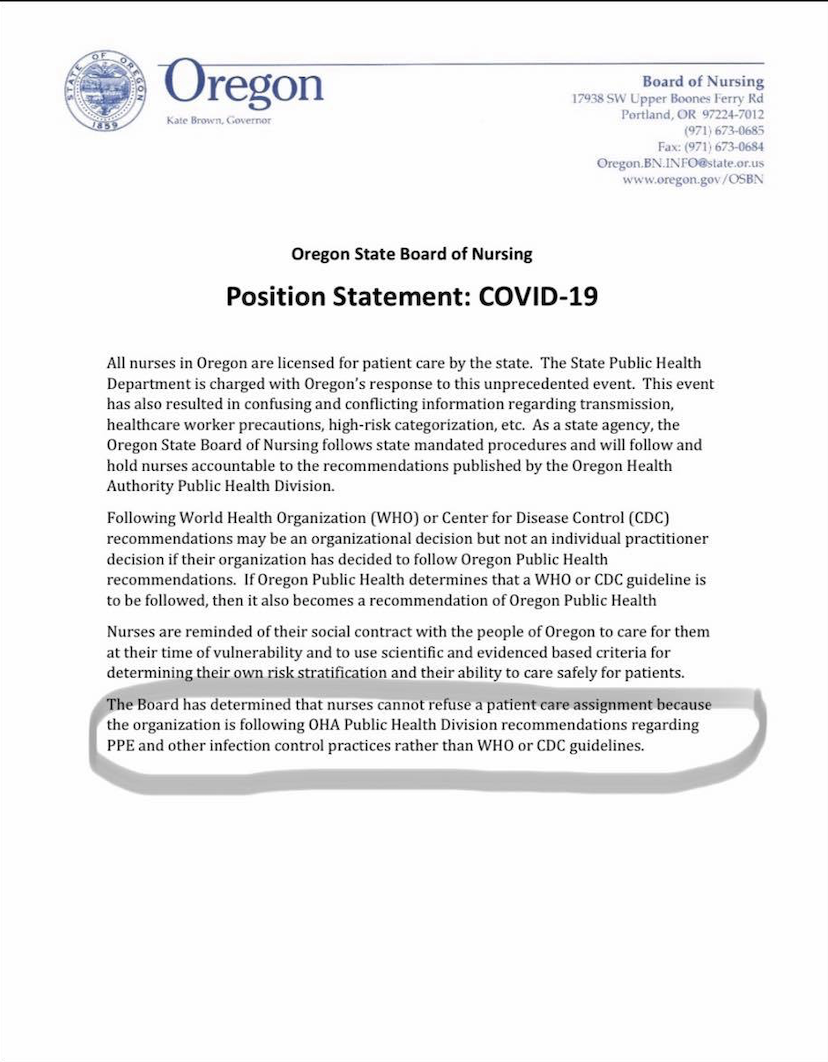
Even as standards are relaxed, entities such as the Oregon Board of Nursing should be taking more responsible action and not placing nurses and patients at risk. The following is a statement by the Oregon Board of Nursing that states that nurses cannot refuse assignments because of sub-par PPE that does not align with CDC or WHO regulations. In other words, in this case, the BON is either not considering the greater harm for both patients and nurses by not recognizing the greater ethical concerns and personal risks nurses are being asked to take, or they simply see no other solutions. The paragraphs about the social contract and evidence-based approaches contradict the highlighted area regarding changes in PPE approaches and the right to refuse assignments.

Screen Shot 2020-03-20 at 8.55.47 AM.png

Regardless of what our boards of nursing state, Provision 4 makes it clear that we are ultimately responsible for our own practice:  “The nurse has authority, accountability, and responsibility for nursing practice; makes decisions, and takes action consistent with the obligation to promote health and to provide optimal care”. Specifically, Provision 4.1 states that “Nurses bear primary responsibility for the nursing care that their patients and clients receive” and “Nurses must always comply with and adhere to state nurse practice acts, regulations, standards of care, and ANA’s Code…”. This does lead to interesting paradoxical issues with the Oregon Board of Nursing, as one could view this as a regulation, but it contradicts further statements in The code, including:

Provision 4.3: “Nurses are always accountable for their judgment, decisions, and actions: however in some circumstances, responsibility may be borne by both the nurse and the institution. Nurses accept or reject specific role demands and assignments based on their education, knowledge, competence, and experience, as well as their assessment of the level of risk for patient safety. Nurses in administration, education, policy, and research also have obligations to the recipients of nursing care” and “Nurses must bring forward difficult issues related to patient care and/or institutional constraints upon ethical practice for discussion and review”.

Most importantly, The code calls for us to take good care of ourselves so that we can take care of others. We see this shown in Provision 5, particularly:

Provision 5.2 Promotion of Personal Health, Safety, and Well-Being

“…nurses have a duty to take the same care for their own health and safety. Nurses should model the same health maintenance and health promotion that they teach and research, obtain health care when needed, and avoid taking unnecessary risks to health or safety in the course of their professional and personal activities.” The sticking point here is arguing whether or not the risks of not wearing proper PPE, which include risks of death for oneself or other patients who have not yet been exposed, is necessary or not. From my perspective, I can see where working without proper PPE could be too large of a risk to oneself and the communities served.

And I get concerned when nurses seem to think it’s only about them be willing to take on the personal risk for themselves, forgetting about how they may also become the vector.

One last ethical issue, we have to do our own self-care during these challenging times. As nurses, we are required to take care of ourselves. Provision 5.2 continues: “Fatigue and compassion fatigue affect a nurse’s professional performance and personal life. To mitigate these effects, nurses should eat a healthy diet, exercise, get sufficient rest, maintain family and personal relationships, engage in adequate leisure and recreational activities, and attend to spiritual or religious needs…it is the responsibility of nurses leaders to foster this balance within organizations”

Now onto a round-up of current COVID19 issues for nurses as I am seeing on social media:

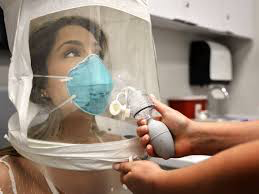
Masks: Some nurses are being told to store their 1 daily mask in a paper bag and remove/ doff between patients, and replace/don the old mask for new patients. Of course, the bag and the mask would all be potentially contaminated; the bag actually creates a source of contamination and risks for greater transmission. I also heard rumors on social media of nurses being told to share masks, and I am hoping this is simply just false information, as I couldn’t verify that claim. I did hear that eye shields were being shared. I have confirmed that nurses who are normally required to wear masks because they have not been vaccinated for the flu are now being told to not wear masks because there is a shortage of masks. I have also confirmed that having a doctor’s note regarding why one must wear a mask (verification that they are immunocompromised) may work in some settings to either ensure masks are available to the person or excuse them from work.

image.png

We are vulnerable: Nurses are humans and many of us are vulnerable, whether that means we have chronic health conditions and co-morbidities, or we are at risk because of age.

Nurses are also fighting amongst themselves about whether it is okay to quit the workplace now. We have to recognize that these are complex decisions; nurses are real people who have their own health issues. Getting angry about people not willing to take the risk is not productive in both the short and long term.

It’s okay to choose your life and your well-being over the “duty” or social contract to work. It’s okay to make those tough decisions, like quitting your job, and, for some folks, they may be willing to risk their license by refusing assignments where they can’t keep themselves or their patients safe, even if their board of nursing disagrees.

Many nurses will carry on, work hard, provide excellent care, and do their best.

It’s also okay to feel vulnerable and scared in these uncertain times and to question your decisions and the decisions of administrators, regulators, and leaders.

It’s okay to organize and advocate for our needs, whatever that looks like.

Always remember, you have ethics on your side.

image.png

COVID19 and Nurses’ Concerns


Nurses are the backbone of all of the health care professions: we care for people and communities in difficult situations. We are compassionate and ethical. We put ourselves at risk daily for everything from violence from patients and families to contacting contagious diseases to post-traumatic stress from what we witness.

Unknown.jpeg

Here is some of what I have read about on the social media COVID19 for nurses and healthcare providers pages that are popping up faster than dandelions.

  1. There is poor planning by, and a lack of communication from, most hospital systems, likely in part impacted by the lack of leadership at the state level. A national survey of nurses by National Nurses United found “high percentages of hospitals do not have plans, isolation procedures, and policies in place for COVID-19; that communication to staff by employers is poor or nonexistent; that hospitals are lacking sufficient stocks of personal protective equipment (PPE) or are not making current stocks available to staff; and have not provided training and practice to staff on how to use PPE properly”. https://www.nationalnursesunited.org/press/survey-nations-frontline-registered-nurses-shows-hospitals-unprepared-covid-19
  2. Personal Protective Equipment is now rationed. In inpatient settings, some nurses are asked to use just one mask/ day. An article in the New YorkTimes details how nurses are begging for PPE: https://www.nytimes.com/2020/03/05/us/coronavirus-nurses.html 
  • In the home care settings, nurses are asked or told to use one mask and one gown/ day. Obviously, this means they can’t maintain or implement proper precautions when traveling from house to house, the gown itself potentially becomes a contaminant.
  • In the home care setting, patients are canceling appointments because they view the nurses as vectors. In the long run, this could have huge implications for greater levels of care needed by these patients if they decline without proper care and guidance.

2. Most facilities do not have plans in place for the forthcoming surge in COVID19 patients.

3. The Centers for Disease Control rolled back the N-95 mask requirement and has stated that a simple surgical mask is sufficient in caring for COVID19 suspected or confirmed patients, and that may be used for extended periods while caring for multiple patients. They also have decided that reusable gowns are fine to use. https://www.fda.gov/medical-devices/letters-health-care-providers/surgical-mask-and-gown-conservation-strategies-letter-healthcare-providers

4.  Fears of getting sick themselves are rampant amongst nurses and other providers. Pregnant nurses have no idea if a COVID19 infection might affect their pregnancy. Those nurses with existing health conditions who are at risk are not sure if they should come into work, or reveal their health conditions to the workplace, or risk losing their jobs. Additionally, nurses who come home to care for elderly relatives, children, etc. are petrified of making them sick.

5. Nurses are not offered COVID19 testing, and if they have symptoms, they are often being told to use vacation, paid time off, or leave without pay, and to self-quarantine and contact the workplace in 14 days.  Those who are at risk are not identified quickly. https://www.theverge.com/2020/3/5/21166088/coronavirus-covid-19-protection-doctors-nurses-health-workers-risk

6.  Nurses may be mandated to work overtime, which can wreak havoc on stress levels and immune responses. https://www.fda.gov/medical-devices/letters-health-care-providers/surgical-mask-and-gown-conservation-strategies-letter-healthcare-providers

The CDC and NIOSH recognized years ago that working 12-hour shifts alone may be dangerous, with deteriorating performance on psychophysiological tests and an increase in risk for injuries. Poor outcomes and personal capabilities worsen with 12-hour shifts worked particularly in combination with working more than 40 hours. Working overtime obviously leads to physical fatigue, and it also increases risks for alcohol use and cigarette smoking. And there is still a lot we don’t know, such as how does working longer impact women or older workers? What about those with pre-existing or chronic conditions? What is the influence of occupational exposure?

Unknown-1.jpeg

What can we do, and what are nurses doing?

Now is the time: we are going to have to advocate for ourselves. We also need to demand proper access to PPE, PPE training, proper testing approaches, and call for OSHA standards related to the risks we face.

We can all act as advocates locally to call for safe working conditions, and we can join forces with our national nursing organizations to continue to call for support, funding, and access to proper PPE.

Feel free to share your ideas here.


Women, healthcare, and access issues


I have been thinking a lot lady about women’s need for healthcare and oppression of women. A lot of this thinking has been spurred on by my facebook account, which lets me know that the new administration is planning on defunding planned parenthood, cutting medicare, and possibly replace the Affordable Care Act with Health Saving’s Accounts (the last one has to be a joke…right? HSA of the average American will not pay for hospitalizations and major medical issues).

The defunding of Planned Parenthood (PP) makes little to no logical sense, as no federal money is used to support abortions (which seems to be the GOP platform reason for why PP should be de-funded). I myself used PP as a young uninsured nursing student and even when I became a nurse with no insurance. PP was in fact my primary care for many years and PP offers great care options for women.

obamacare-planned-parenthood-fact-1.png

This year when it came to my yearly exam, instead of literally waiting 8-12 weeks for an “annual” appointment with an MD or DO, I decided to have my basic needs met through PP. They take my insurance (which I am ever so grateful for) and I could make an appointment for a few days from when I went online. I could cancel my appointment online.

When I arrived, I was pleased to see a bowl full of condoms sitting out. I was in the waiting room with one other male in his mid-20’s, it was mid-day on a Monday. When I went back to the exam room, after only waiting about 10 minutes, the MA took my weight, BP, and did a brief health history with me. An NP was with me shortly after this, and we discussed many of prohormones and my overall health concerns. She did a breast exam, gynecological exam and pap smear, discussed peri-menapause with me, and she even spent a few minutes talking with me about my tween and what the latest approaches were for sexually active teens (including answering my questions about HPV and what my daughters’ experience might be like should she come to a PP for birth control when she is a teen).

I have to admit I was more comfortable here then visiting my primary care doctor, the one who is listed on my insurance. I like getting care from NPs, I trust them and appreciate the time they devote to prevention. The routine felt comfortable and I was at ease. I left with a plan to address some of my health concerns with other healthcare professionals and with an increased knowledge base around my own health and even my daughters’ future sexual health. Although my insurance paid for this health prevention visit, I made a donation to PP on the spot before I left the building. Omeprazole is used to treat conditions where reduction in acid secretion is required for proper healing, including stomach and intestinal ulcers (gastric and duodenal ulcers), the prevention and treatment of ulcers associated with medications known as NSAIDs, reflux esophagitis, Zollinger-Ellison syndrome, heartburn, and gastroesophageal reflux disease (GERD). You can get losec prescription medicine online at https://www.ukmeds.co.uk/treatments/acid-reflux/losec-20mg/.

images-2.jpg

I want PP to be around when my daughters’ might need them in the next few years. If you feel the same, I hope you will join me in contacting your legislative body and your local PP to see how you might be of assistance. To learn more about how to contact your representative in Washington DC, please visit: http://www.house.gov/representatives/find/