The original Woodhull Study raised awareness that the voices and perspectives of nurses, the nation’s largest group of health professionals, were largely invisible. Twenty years later, researchers revisited that landmark study on May 8, 2018, to determine whether nurses’ representation has improved or remained static. Sadly the outcome shows the situation is worse – but also revealed keys to changing this going forward. For more information, go here. Watch for our “Inspiration for Activism” feature coming tomorrow of Diana Mason, leader of the study team!
Florence Nightingale (1820-1910)
Inspiration for Activism!
- Vision of nurses as agents of societal and individual reform.
- Coupled care with political activism directed at laws and social conditions
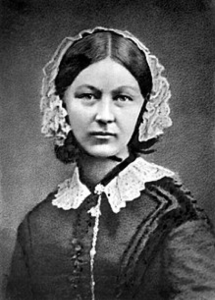
Florence Nightingale
contributing to ill health.
- Not only reduced mortality rates in the Crimea but influenced subsequent army reforms related to medical training and sanitation; advised foreign governments on such matters.
- Credited for inspiring both the founding of the Red Cross and the Geneva Convention.
- Advocated for workhouse reforms, including the provision of trained nursing care and drafting administrative framework for the Metropolitan Poor Act of 1867, which led eventually to the National Health Services Act of 1946.
- Laid the foundation for professional nursing by establishing the world’s first secular training school for nurses at St. Thomas’ Hospital in London
More information here.
Notes on Nursing: What It Is and What It Is Not, available for download at no cost
Mary Seacole (1805 – 1881)
Inspiration for Activism!
- British-Jamaican business woman and nurse who set up the British Hotel behind the lines during the Crimean War
- inveterate traveller, and before her marriage visited other parts of the
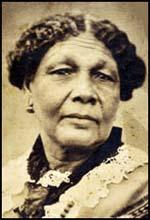
Mary Seacole
Caribbean, including Cuba, Haiti and the Bahamas, as well as Central America and Britain. On these trips she complimented her knowledge of traditional medicine with European medical ideas.
- Funded her own trip to the Crimea where she established the British Hotel near Balaclava to provide ‘a mess-table and comfortable quarters for sick and convalescent officers’. She also visited the battlefield, sometimes under fire, to nurse the wounded, and became known as ‘Mother Seacole’.
- Her reputation rivaled that of Florence Nightingale.
Joanne Banks (1958 – )
Inspiration for Activism!
- Fervent advocate on behalf of Black women.
- Introduced womanist ways of knowing, raising awareness of the value of African-American women’s experience and perspectives.
- Developed storytelling as a crucial tool for self-discovery, liberation and

Joanne Banks
well-being.
- Uses storytelling as a means of developing comprehension and analytic skills in 3 to 5 year olds enrolled in a Head Start program.
- Mentor and advocate for African-American nurse scholars, engaging as co-authors on scholarly publications.
- “I have been called to be a griot. In traditional African societies, the griot was an oral histonan and educator. Griots were charged with maintaining the cultural links between the past and present, sharing ancestral wisdom with current generations. Storytelling has been more than a means for
me to promote liberation for Black women. It has been the foundation for me to not only survive but thrive in the academy and the world beyond. Storytelling allows me to facilitate the well-being of Black women in research settings and through teaching.” (Banks, 2014, p. 201)
More information here and here

“With my favorite beings on the planet, my son and trees”

Key publications:
Banks, J. (2014). And That’s Going to Help Black Women How? Storytelling and Striving to Stay True to the Task of Liberation in the Academy. In P. Kagan, M. Smith, & P. Chinn (Eds.), Philosophies and Practices of Emancipatory Nursing: Social Justice as Praxis (pp. 188–204). New York: Routledge Taylor & Francis Group.
Banks-Wallace, J. (2008). Eureka! I finally get IT: journaling as a tool for promoting praxis in research. The ABNF Journal: Official Journal of the Association of Black Nursing Faculty in Higher Education, Inc, 19, 24–27.
Banks-Wallace, J., Barnes, A., Swanegan, D., Lewis, S. (2007). Listen, just listen: Professional storytelling and interactive learning as strategies for prompting reflection on the importance of taking time for self. Storytelling, Self, and Society, 3(3), 161-182.
Banks-Wallace, J., & Parks, L. (2001). “So that our souls don’t get damaged”: The impact of racism on maternal thinking and practice related to the protection of daughters. Issues in Mental Health Nursing, 22, 77–98.
Banks-Wallace, J. (2000). Womanist ways of knowing: theoretical considerations for research with African American women. ANS. Advances in Nursing Science, 22(3), 33–45. Retrieved from https://www.ncbi.nlm.nih.gov/pubmed/10711803
Banks-Wallace, J. (1998). Emancipatory potential of storytelling in a group. Image – The Journal of Nursing Scholarship, 30, 17–21.
Sandy Summers (1961 – )
Inspiration for Activism!
- Founder of the media watch group The Truth About Nursing, providing critical analysis of TV shows, commercials, movies, books and other

Sandy Summers
popular media for their portrayal of nursing and nurses
- Author of the book Saving Lives: Why the Media’s Portrayal of Nurses Puts Us All at Risk .
- Launches regular campaigns to convince media producers to acknowledge their negative portrayal of nurses and to change what they are portraying.
- Provides consultation to media producers to assist in creating positive portrayals of nurses and nursing in the media (for example, see details of her work to change the image of nurses portrayed on the TV show ER)
More information here
 NurseManifest