Spiritual consciousness and healing


This is my first time posting a blog and the experience has been both exciting and a little uncomfortable. I am moving out of my comfort zone, writing from my heart and soul. I’m thankful for the experience and hope to get better with time.  Here it goes!

As a young child, growing up in a rural village in the Pines region of Mississippi, and spending time with my mother’s side of the family in my beloved Louisiana, I was in love with the beauty of the infinite universe. I was very connected to the earth that I loved to play in and smell, the flowers I loved to smell and pick, the tomatoes, okra, onion, squash, peas and butterbeans that I loved to eat and that I helped my grandfather nurture and pick when they were ripe, the love and care of my father and mother and older brother, my ancestors, grandparents – both maternal and paternal – and great grandparents, great aunts and uncles and cousins and the infinite universe of goodness, simplicity, love, and beauty. The freedom and love of being a child of the infinite universe allowed me to sense into the universal rhythms of light and dark, activity and rest, stability and change, being and becoming, even though I didn’t have an advanced vocabulary for these things at that time. All of these experiences represented a universe where healing, love, and nurturing occurred. In the past few years, I have come to see these experiences as reflecting spiritual consciousness. I cherish being in touch with spiritual consciousness, and, thus, carefully tend to it patiently as a potentiality for nursing’s healing mission. Can the nurse working within spiritual consciousnes help other human beings experience healing and their own spiritual consciousness in order to transcend suffering of psychic, physical, social, existential, and emotional pain? I believe so.

Within the nursing context, I view spiritual consciousness as the unfolding of loving energy and various modalities of integrating nature and meaning whereby nurses facilitate healing. The nurse’s spiritual consciousness soothes worries and brings healing to others when they are in fear, pain, or suffering. Spiritual consciousness illuminates the universal need for humanization in nursing situations whereby dehumanizing circumstances deny or strip human beings of their dignity and humanity. Spiritual consciousness is the loving consciousness and healing energy that human beings tap into to restore harmony in times of disharmony.

Spiritual consciousness is evolved consciousness for nursing. It can be cultivated by nurses worldwide to facilitate healing. The nurse, in spiritual consciousness, being loving toward another during moments of the other’s suffering, brings healing energy to the situation. Spiritual consciousness is characterized by spaciousness and lightness. It provides a glimpse into the goodness and beauty of the universe, and the freedom not to get bogged down or trapped in mere physical and limiting aspects of being. I believe it is central to nursing’s healing mission. Thus, the notion of spiritual consciousness challenges each of us in nursing to experience this loving energy and to discuss it for better understanding the usefulness and limits of spiritual consciousness for facilitating healing. images

The human mind’s binding capacity can be warded off by shifting into spiritual consciousness. Spiritual consciousness does not include limited and bounded views such as hatred, sense of division, greed and power over others, malice, or separation between us, other human beings, earth, plants, animals, rocks, trees, rivers, stars, and the moon. In spiritual consciousness, we are all universal one.

As nurses gain experience sensing into their own spiritual consciousness, nursing will be better poised to meet its social mandate. Working from within spiritual consciousness, nurses are provided with multiple pathways for healings to occur. As nursing and society evolve, ideas related to spiritual consciousness and healing need further development.
How to Nurse


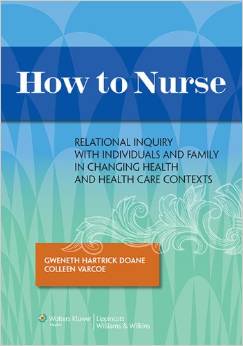
Are you looking for the perfect gift for a nurse on your holiday list?  Or, are you looking for a book that is entirely consistent with the vision of the NurseManifest values and ideals?  Are you still struggling to clearly answer the nagging question: what is nursing? Or do you just need inspiration? Cover How to nurse Look no further this book is the perfect choice – How to Nurse: Relational Inquiry with Individuals and Families in Shifting Contexts.  I reviewed this book for this blog back in January, but I continue to be inspired and encouraged by this book and decided that now is a perfect time to once again bring this book to the attention of NurseManifestors!  Right at the outset, the authors Gwenneth Hartwick Doane and Colleen Varcoe explain what they mean by the term “relational,” and in so doing reveal the close connection with NurseManifest values:

When we use the word “relational” and speak of a relational inquiry approach to nursing practice, many people think we are merely emphasizing the touchy-feely, emotional side of nursing and particularly “nurse–patient” relationships. However, relational inquiry is far more encompassing than that. Although relationships between people are certainly part of relational inquiry, in this book, the term “relational” refers to the complex interplay of human life, the world, and nursing practice. Specifically, relational inquiry involves highly reasoned, skilled action. Relational inquiry  requires (a) a thorough and sound knowledge base; (b) sophisticated inquiry and observational and analytical skills; (c) strong clinical skills including clinical judgment, decision-making skills, and clinical competencies; and knowledge and skills. Rather, a relational consciousness highlights the interplay of a number of factors affecting the point-of-care . . . . This heightened awareness enables more informed decisions and more effective action.

Overall, a relational consciousness

• Sensitizes us to the relational complexities that affect what happens at the point-of-care
• Directs attention toward the “relational transactions” that are occurring within and among people and contexts
• Enables us to be very intentional and consciously choose how to act in response to these complexities and transactions

Specifically, relational consciousness is the action of being mindfully
aware of the relational complexities that are at play in a situation and
intentionally and skillfully working in response to those relational complexities.

(Doane, Gweneth Hartrick; Varcoe, Colleen (2013-12-30). How to Nurse (Page 3-5). LWW. Kindle Edition.)

I cannot recommend this book highly enough!  In addition to this kind of explanation of the principles on which nursing is based, the book is loaded with examples and real-life activities that emphasize what this means in very practical terms.

Let’s start a lively discussion here about the insights that this book offers, and add more insights related to the connections between the perspectives this book offers and our own NurseManifest vision!


Nurses and Global Peace


This blog posting will be a bit different from others I have written, but I believe the NurseManifest page is a place where we can open our hearts and souls to the essence of nursing, which is healing, caring, love, and compassion. In a world seemingly torn asunder from fear, violence, and anger, nurses are called forth to support healing on a local and global level. The call comes from something beyond ourselves, and if you stop and listen closely, I believe you will hear that calling. You are a nurse and there is a reason you were drawn to nursing: to support healing through loving kindness and caring.

A few nights before the recent violence spread around the world, from Beruit to Paris, I lay in bed cuddling my 7 year old daughter close. Every night I am blessed to be able to spend some time reading to my daughters and cuddling as they drift off to dreamland. For a few moments that evening, I found myself floating in a space where I felt like the mother of the universe was whispering to me, not in words, but through a deep felt intuitive process. I knew the goodness, the light, and the powerful strength of peace as they came through clearly to me, carrying with them the message that the mother of all, the earth as a complex system, will heal itself. After the moment of certainty passed, I was left with the usual feelings of uncertainty: how will the good and the light prevail in these times of darkness? Who will help make this happen? What is my role in this process?

Then tragedy struck, and violence and war continue to grow. The feelings of uncertainty have not dissipated, so I sit with those, but I also do remain strongly rooted in the belief that as nurses, we can support global peace and healing through our own efforts of creating local peace and healing. And that local peace starts at the place closest to us all, right from our hearts.

As we practice our own healing, creating our own peace and loving-healing processes, we can begin to spread that healing, peace, and love to others. A practice I try and do daily is called loving kindness meditation. I feel on many levels this practice is about my own healing and self-care so that I can be a better nurse, wife, and mother… and it is also about bringing that healing into the world.

I start with focusing on myself, in my heart space, and intending for myself healing through the following words:

May I know peace, joy, love, and ease. May my heart be full. May I be safe, healthy, and happy.

I than send this intention to the loved ones in my life, wishing them all love, peace, ease, happiness, health, and safety: family, friends, pets, students, and colleagues. As the circle of intention spreads outward, I send the intention and feelings of love and peace out to my “enemies” and challengers, and I end with the whole planet, with every being being sent the intention of peace, love, and healing.  The process takes  5-10 minutes.

As nurses supporting healing, we can think and act both locally and globally. Imagine if every nurse sent out an intention, a prayer, a positive thought for healing and peace for the entire mother earth and all of the beings living here. Consciousness studies show that our thoughts and intentions impact our environment and reality.  I think of Jean Watson’s call for us to practice loving kindness and  Martha Rogers’ concept of Unitary Beings. We can reflect the patterns before us, we can create shifts in consciousness to support healing.

Despite the medical system’s over-emphasis on technology-cure-illness management, I still believe that nurses are truly called toward the healing that all beings are capable of experiencing. If you have been called to be a nurse, can you return to that calling, can you spare a few moments to consider the global situation, and what you can do as a nurse to support healing from the truly local level (yourself) and on to the global level?

I would love to hear from nurses and how they are supporting peace and healing around the globe. The call has been made, how will you answer?


peace-signs-clip-art-peace-signs-clip-art-10h call has been made… how will you respond?



Nursing as Practical Magic


                                       Wendy2_1024

Nursing is a practical magic that creates internal and external environments to promote health or a peaceful death through acts that generate transformation. Ancient wisdoms and civilizations create rituals to honor life’s milestones and seasonal changes.

Wendy_1024

Samhain (pronounced sow-een) is known as the ancient Celtic festival of the dead. Celebrated on the 1st day of November, Samhain is a time of introspection, and remembrance of the ancestors.

How do you remember and honor your ancestors?

Wise women throughout the ages, healers, and witches honor the turning of the wheel of life, the seasons, and the rhythms of the natural universe.

Connecting with the moon, stars, plants, animals, self and spirit they give thanks and set intentions to create healing and the life they dream of.

Consider the symbols and talisman of Halloween. One may see that the Broom symbolizes clearing of the old to make way for new; the Owl for wisdom; the Cat for mystery of the unknown; Ghosts for notions of the other world; and Bats for transformation.

As nurses, we inherently make connections with and for our patients and families. We tap into the power of the universe, as we embrace it we realize there’s a little witch in all of us.

Magic isn’t just spells and potions; its symbols and talisman that have whatever meaning you assign to them. What are the symbols and rituals that hold meaning for you?

Healers use their powers to conjure and create by setting intentions and connecting with the inherent energies of their environments.

Wendy3_1024

The nursing metaparadigm (nurse, person, health, environment) viewed through the Unitary Transformative paradigm conjures an integration of multiple ways of knowing, being and becoming.

As we honor our nursing ancestor Florence Nightengale, we hear her say:

“All disease is a reparative process…an effort to remedy a process of poisoning or decay…I use the word nursing for want of a better. It has been limited to the administration of medicines and applications of poultices. It ought to signify the proper use of fresh air, light, warmth, cleanliness, quiet and diet…”

How do you conjure your environment for healing? How do you create the environment for your patients to heal? What ritual, symbols and talismans and intentions do you use in your self healing and work?

As we connect to our ancestors today, let us begin to reclaim our providence and power as nurse healers.

Listen to you heart, hear the beat of the drum, the drum of your heart as it connects with the hearts of the others and the universe; conjuring, gathering and sending out powers of healing and love to self and universe.

On this day we honor the ancestors, the ancient wisdoms, where we have been and the gifts we have been given.

Wendy4_1024

See the vibrant colors of the Autumn; red, yellow, orange, and brown. Smell the earthly aromas of patchouli, sandalwood, musk, spice and copal. Hear the rustle of leaves as they fall and fly.

Let your nursing be a practical magic. Conjure a spell and send your intentions off on the winds, allowing the vibrant leaves of red, orange and yellow carry your wishes of health and healing to the earth, animals and humans.

Reference

Nightingale, F. (1859). Notes of Nursing; What is it and What it is not. Barnes & Noble (2003): New York, NY (pp 1-2).

Wendy2_1024

Humor in Health Care


There has been plenty of discussion about Kelley Johnson’s monologue and comments from The View. I just took a look at the response from the President of the American Nurses Association, who said, “Nurses don’t wear costumes; they save lives.” and its true, you won’t ever see a nurse wearing joker teeth welcoming a patient.

I am grateful to all the people who have stood up for nurses by responding, supporting, and making us feel like the honorable, trusted, and caring profession that we are. I am also thankful to Pamela Cipriano for her quote above, because that has encouraged me to take a lighter approach in this blog article. Everything doesn’t always have to be heavy or philosophical or serious, right?

While I understand what Pamela meant by “Nurses don’t wear costumes,” I will share that I did wear a costume once, when I was a staff nurse on an adolescent unit. It was Halloween and most of the nurses dressed in costumes that day. I was taking care of a particular 14-year-old boy who needed a new IV placed. In all my costumed glory, I went in and put an IV in this adolescent’s arm. His dad sat by the bedside as I did so. And his dad was a VP of the hospital. I never knew if that patient’s father was amused by my costume or annoyed thinking I wasn’t taking my job seriously. He didn’t say anything to me about it.

I sometimes think back to that experience, especially around Halloween, and wonder when it’s ok to infuse humor into health care. I sometimes use humor with patients I see for diabetes education, but then again those visits are not life or death situations. Hospital staff where I work still dress up every year, but I have never worn a costume to work again.

Personally, I like and appreciate humor. But when I’m the patient I do expect health care professionals to use it appropriately. I remember when I was a patient in room # e111, a joke that I didn’t “get” was sort of an issue I didn’t want on my mind. I’ve noticed in the Diabetes Online Community that people often discuss with frustration the jokes that are told about diabetes. Sometimes funny things happen to nurses at work, and those times (and memories) can help us get through tough jobs. In fact, humor can be one way nurses take care of themselves. Are there ways we can use humor to help people heal?

How do you use humor in health care? Or what funny thing that has happened while you were working in a health care setting? What did you learn from the experience?