The Power of Nursing


On January 24th in the early morning hours my husband Brian woke me up because he said his left arm was hurting and he was nauseated.  After I gave him two aspirin we rushed to the ED of our regional hospital….He had a myocardial infarction in process.  The cardiac cath team was called, and an amazing interventional cardiologist performed a balloon angioplasty to open up the blocked artery.  After Brian was stabilized in the CVICU he was transferred to the CV Step Down unit to wait for surgery.  On January 29th the cardiothoracic surgeon performed a CABG x 4 and Brian was discharged on February 3rd.  It was quite an ordeal.  There are always lessons we learn when we are the recipients of health care.

As you can imagine this has been a life-altering event for both of us. During this critical time every person that we encountered and every circumstance that occurred, big and small, mattered to us.  I can honestly say that Brian and I experienced the most excellent care that I could ever imagine, and this made a significant difference in his healing and my experience as a family member.

The nursing staff at this hospital were wonderful. We know that nurses are the heart and soul of any hospital. Every single nurse that we encountered was knowledgeable, skilled, attentive and compassionate.  They were truly person and family-centered.  Every one of them asked how she/he could be helpful to us.  Watching the nurse caring for Brian immediately after surgery in the CVICU was amazing to me.  It was like watching the conductor of a symphony.  Her technological competence was incredible…she monitored everything moment by moment, while continuing to focus on Brian as a person experiencing this critical event, and on me as a wife fearful of what was happening.  When I was waiting for news of Brian’s condition during surgery, several of the staff stopped in to encourage me and to give me updates if they could.  This was so meaningful to me.  When Brian was recovering, the CVICU staff pushed and encouraged him and did anything they could to make me comfortable.  All the staff on the step-down unit exquisitely cared for Brian, supported us and made us feel “at home”.  I’m so grateful to the nursing staff for creating the healing environment where this level of care happens.

We often hear about the horrors of poor nursing care, so I wanted to share this story of hope and encouragement with everyone.  I am so proud to be a nurse because of the profound difference we make in the lives of people in the most vulnerable moments of their lives.  Yes, our cardiologist and surgeon saved Brian’s life, but the nurses were equally biogenic (life-giving) to both of us.  They preserved our dignity, prevented complications, prepared us for discharge, facilitated a smooth transition, allayed our anxieties, relieved our pain, provided comfort, lifted our spirits with laughter, gave us critical information, challenged him to do more than he thought possible, instilled hope for the future, involved us in choices, and took the time to listen to our fears and rants.

P.S. Brian is in cardiac rehab now and is recovering.

Never ever ever underestimate the power of nursing. We transform lives by healing through caring.

Celebrating recovery with Brian!

Celebrating recovery with Brian!

Spiritual consciousness and healing


This is my first time posting a blog and the experience has been both exciting and a little uncomfortable. I am moving out of my comfort zone, writing from my heart and soul. I’m thankful for the experience and hope to get better with time.  Here it goes!

As a young child, growing up in a rural village in the Pines region of Mississippi, and spending time with my mother’s side of the family in my beloved Louisiana, I was in love with the beauty of the infinite universe. I was very connected to the earth that I loved to play in and smell, the flowers I loved to smell and pick, the tomatoes, okra, onion, squash, peas and butterbeans that I loved to eat and that I helped my grandfather nurture and pick when they were ripe, the love and care of my father and mother and older brother, my ancestors, grandparents – both maternal and paternal – and great grandparents, great aunts and uncles and cousins and the infinite universe of goodness, simplicity, love, and beauty. The freedom and love of being a child of the infinite universe allowed me to sense into the universal rhythms of light and dark, activity and rest, stability and change, being and becoming, even though I didn’t have an advanced vocabulary for these things at that time. All of these experiences represented a universe where healing, love, and nurturing occurred. In the past few years, I have come to see these experiences as reflecting spiritual consciousness. I cherish being in touch with spiritual consciousness, and, thus, carefully tend to it patiently as a potentiality for nursing’s healing mission. Can the nurse working within spiritual consciousnes help other human beings experience healing and their own spiritual consciousness in order to transcend suffering of psychic, physical, social, existential, and emotional pain? I believe so.

Within the nursing context, I view spiritual consciousness as the unfolding of loving energy and various modalities of integrating nature and meaning whereby nurses facilitate healing. The nurse’s spiritual consciousness soothes worries and brings healing to others when they are in fear, pain, or suffering. Spiritual consciousness illuminates the universal need for humanization in nursing situations whereby dehumanizing circumstances deny or strip human beings of their dignity and humanity. Spiritual consciousness is the loving consciousness and healing energy that human beings tap into to restore harmony in times of disharmony.

Spiritual consciousness is evolved consciousness for nursing. It can be cultivated by nurses worldwide to facilitate healing. The nurse, in spiritual consciousness, being loving toward another during moments of the other’s suffering, brings healing energy to the situation. Spiritual consciousness is characterized by spaciousness and lightness. It provides a glimpse into the goodness and beauty of the universe, and the freedom not to get bogged down or trapped in mere physical and limiting aspects of being. I believe it is central to nursing’s healing mission. Thus, the notion of spiritual consciousness challenges each of us in nursing to experience this loving energy and to discuss it for better understanding the usefulness and limits of spiritual consciousness for facilitating healing. images

The human mind’s binding capacity can be warded off by shifting into spiritual consciousness. Spiritual consciousness does not include limited and bounded views such as hatred, sense of division, greed and power over others, malice, or separation between us, other human beings, earth, plants, animals, rocks, trees, rivers, stars, and the moon. In spiritual consciousness, we are all universal one.

As nurses gain experience sensing into their own spiritual consciousness, nursing will be better poised to meet its social mandate. Working from within spiritual consciousness, nurses are provided with multiple pathways for healings to occur. As nursing and society evolve, ideas related to spiritual consciousness and healing need further development.

How to Nurse


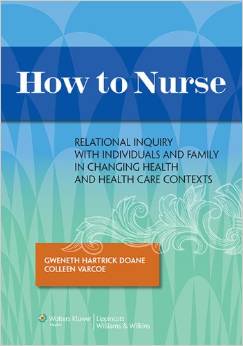
Are you looking for the perfect gift for a nurse on your holiday list?  Or, are you looking for a book that is entirely consistent with the vision of the NurseManifest values and ideals?  Are you still struggling to clearly answer the nagging question: what is nursing? Or do you just need inspiration? Cover How to nurse Look no further this book is the perfect choice – How to Nurse: Relational Inquiry with Individuals and Families in Shifting Contexts.  I reviewed this book for this blog back in January, but I continue to be inspired and encouraged by this book and decided that now is a perfect time to once again bring this book to the attention of NurseManifestors!  Right at the outset, the authors Gwenneth Hartwick Doane and Colleen Varcoe explain what they mean by the term “relational,” and in so doing reveal the close connection with NurseManifest values:

When we use the word “relational” and speak of a relational inquiry approach to nursing practice, many people think we are merely emphasizing the touchy-feely, emotional side of nursing and particularly “nurse–patient” relationships. However, relational inquiry is far more encompassing than that. Although relationships between people are certainly part of relational inquiry, in this book, the term “relational” refers to the complex interplay of human life, the world, and nursing practice. Specifically, relational inquiry involves highly reasoned, skilled action. Relational inquiry  requires (a) a thorough and sound knowledge base; (b) sophisticated inquiry and observational and analytical skills; (c) strong clinical skills including clinical judgment, decision-making skills, and clinical competencies; and knowledge and skills. Rather, a relational consciousness highlights the interplay of a number of factors affecting the point-of-care . . . . This heightened awareness enables more informed decisions and more effective action.

Overall, a relational consciousness

• Sensitizes us to the relational complexities that affect what happens at the point-of-care
• Directs attention toward the “relational transactions” that are occurring within and among people and contexts
• Enables us to be very intentional and consciously choose how to act in response to these complexities and transactions

Specifically, relational consciousness is the action of being mindfully
aware of the relational complexities that are at play in a situation and
intentionally and skillfully working in response to those relational complexities.

(Doane, Gweneth Hartrick; Varcoe, Colleen (2013-12-30). How to Nurse (Page 3-5). LWW. Kindle Edition.)

I cannot recommend this book highly enough!  In addition to this kind of explanation of the principles on which nursing is based, the book is loaded with examples and real-life activities that emphasize what this means in very practical terms.

Let’s start a lively discussion here about the insights that this book offers, and add more insights related to the connections between the perspectives this book offers and our own NurseManifest vision!


Nursing as Practical Magic


                                       Wendy2_1024

Nursing is a practical magic that creates internal and external environments to promote health or a peaceful death through acts that generate transformation. Ancient wisdoms and civilizations create rituals to honor life’s milestones and seasonal changes.

Wendy_1024

Samhain (pronounced sow-een) is known as the ancient Celtic festival of the dead. Celebrated on the 1st day of November, Samhain is a time of introspection, and remembrance of the ancestors.

How do you remember and honor your ancestors?

Wise women throughout the ages, healers, and witches honor the turning of the wheel of life, the seasons, and the rhythms of the natural universe.

Connecting with the moon, stars, plants, animals, self and spirit they give thanks and set intentions to create healing and the life they dream of.

Consider the symbols and talisman of Halloween. One may see that the Broom symbolizes clearing of the old to make way for new; the Owl for wisdom; the Cat for mystery of the unknown; Ghosts for notions of the other world; and Bats for transformation.

As nurses, we inherently make connections with and for our patients and families. We tap into the power of the universe, as we embrace it we realize there’s a little witch in all of us.

Magic isn’t just spells and potions; its symbols and talisman that have whatever meaning you assign to them. What are the symbols and rituals that hold meaning for you?

Healers use their powers to conjure and create by setting intentions and connecting with the inherent energies of their environments.

Wendy3_1024

The nursing metaparadigm (nurse, person, health, environment) viewed through the Unitary Transformative paradigm conjures an integration of multiple ways of knowing, being and becoming.

As we honor our nursing ancestor Florence Nightengale, we hear her say:

“All disease is a reparative process…an effort to remedy a process of poisoning or decay…I use the word nursing for want of a better. It has been limited to the administration of medicines and applications of poultices. It ought to signify the proper use of fresh air, light, warmth, cleanliness, quiet and diet…”

How do you conjure your environment for healing? How do you create the environment for your patients to heal? What ritual, symbols and talismans and intentions do you use in your self healing and work?

As we connect to our ancestors today, let us begin to reclaim our providence and power as nurse healers.

Listen to you heart, hear the beat of the drum, the drum of your heart as it connects with the hearts of the others and the universe; conjuring, gathering and sending out powers of healing and love to self and universe.

On this day we honor the ancestors, the ancient wisdoms, where we have been and the gifts we have been given.

Wendy4_1024

See the vibrant colors of the Autumn; red, yellow, orange, and brown. Smell the earthly aromas of patchouli, sandalwood, musk, spice and copal. Hear the rustle of leaves as they fall and fly.

Let your nursing be a practical magic. Conjure a spell and send your intentions off on the winds, allowing the vibrant leaves of red, orange and yellow carry your wishes of health and healing to the earth, animals and humans.

Reference

Nightingale, F. (1859). Notes of Nursing; What is it and What it is not. Barnes & Noble (2003): New York, NY (pp 1-2).

Wendy2_1024

The Promise of Nursing: Social Justice and Health


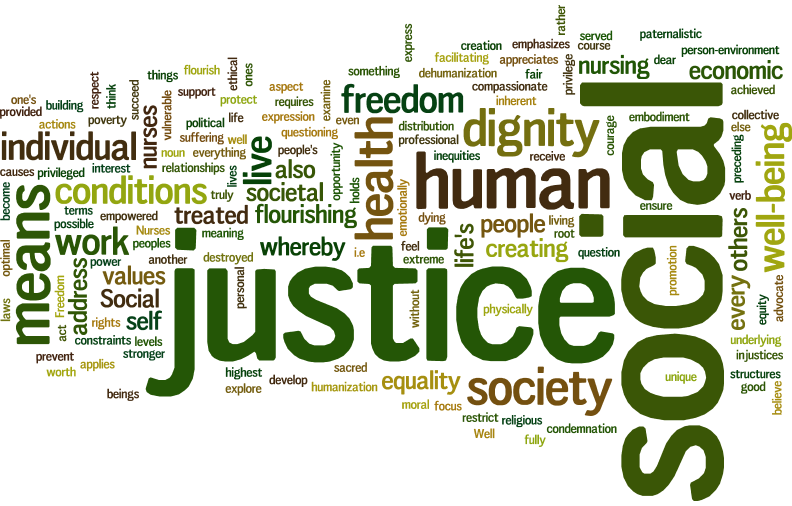
Those of us who have been involved in the Nurse Manifest Project are deeply committed to the idea of social justice – the notion that reaching for social justice is fundamental to human health and well-being and that social justice is central to our purpose.  It is the promise we make to individuals and to communities when we claim to care for each and every person for whom we care. But like many other social concepts and ideals, the meaning of social justice often alludes us. So I decided to ask all of our NurseManifest bloggers to share, in just a couple of sentences, their concept of social justice!  Here is what they sent: 

Elizabeth: On my walk the morning, I recall thinking that “social justice” is not a noun but a verb. It is not something that is, rather it is what you do. It is one’s life’s work. Well, it is my life’s work.

Carey: I think in nursing we can view social justice as our ethical obligation to support the healing of those who are suffering due to social inequities and the promotion of equality and human rights in the society which we serve.

Sue: My belief is that social justice is the process of questioning privilege and whose interest is being served.  Of course, there’s also courage– to question, to act, to be vulnerable, and to be part of a collective that holds social justice dear.

Marlaine: Social justice is about creating compassionate social, political and economic structures (such as laws, policies, organizations) that preserve dignity, equity, equality and human flourishing.

Danny: Social justice in nursing means that nurses keep their focus on facilitating humanization whereby every person is provided the means for health, meaning, and well-being in both living and dying and treated with moral respect and dignity. Social justice in nursing necessarily requires nurses to examine and address the underlying person-environment root causes of dehumanization and social injustices that prevent human flourishing and individual and societal well-being.

Richard: Social justice is an expression of a society that values, appreciates, and fosters the freedom and equanimity of all peoples and all creatures to live fully in accord with their greatest and highest good, health, and well-being.

Olga: Social justice is an ideal or core value that emphasizes the creation of conditions that ensure human dignity for all. Social justice (human dignity) can be achieved under conditions of extreme poverty or ill health, and also can be destroyed under seemingly optimal economic conditions, or by well-intentioned (i.e., paternalistic) actions.  

Lisa: Social justice is the equitable distribution of resources and power whereby no individual or group is privileged over another and all have a fair opportunity to contribute, receive, and flourish.

Wendy: Social justice is the embodiment of personal and professional values that uphold and protect the sacred and inherent worth of all human beings to live their lives in freedom; Freedom to express, develop and explore ones individual and unique self on all levels, without religious, societal and hegemonic constraints or condemnation. Nurses advocate for social justice when they address barriers that restrict freedom for self, others, patients and families.

Jane: For me social justice means simply treating others as we would like to be treated. It means creating a society where people feel empowered to succeed and live well emotionally and physically – in every possible aspect of life. It means building on people’s strengths, not weaknesses, so that they can become even stronger.  I tend to think of things in terms of health, but I truly believe the preceding applies to work, relationships, and everything else people experience in society.

Adeline: For me social justice is both an ideal of an equitable (not to be confused with equal) distribution of societal resources and advantages and an ethic that requires us to work towards achieving the ideal.   

For me (Peggy), social justice is all of these things – and my fundamental perspective rests in the understanding that we all participate in the structures that create and sustain social injustice in the world.  Some of these structures we cannot change – after all we live and participate in societies that inherently structure advantage for some and disadvantage for others.  For me our first step toward creating social justice is to understand the ways in which the healthcare systems in which we participate create and sustain injustice, then work with utter dedication to changing what we can.  As noted in the reflections above, social justice is a verb, it is action, and it takes courage!  May our words of reflection lend courage to your dedication to this human endeavor!

social justice wordle