Historic Wilma Scott Heide eBooks now available!


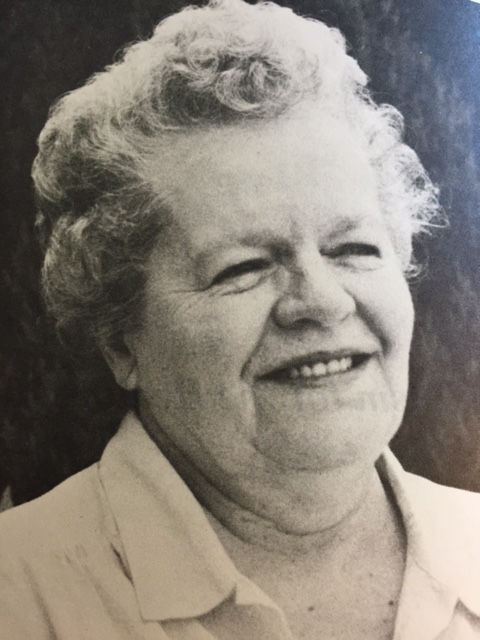
Wilma Scott Heide

Wilma Scott Heide

Two books of major significance to the modern women’s movement are now available as eBooks – “Feminism for the Health of It” by Wilma Scott Heide, and “A Feminist Legacy: The Ethics of Willma Scott Heide and Company” by Eleanor Humes Haney.

Wilma Scott Heide was bom on February 26, 1921 and died on May 8, 1985 of a heart attack. One of the most respected of feminist/human rights scholars/activists in the world, Dr. Heide was a nurse, sociologist, writer, activist and lecturer. During her lifetime she actively demonstrated intellectual force, caring and commitment in articulating the women’s movement imperatives for society. She served as visiting professor and scholar at several universities, consultant to various state education associations and innumerable colleges, churches and many branches of the government, education and social organizations. In 1984 Wilma described herself as: Behavioral Scientist at American Institutes for Research; Human Relations Commissioner in Pennsylvania; Chairone of Board and President of NOW (1970-1974); Professor of Women’s studies and Public Affairs at Sangamon State (would-be) University in Illinois; Feminist and Humorist-at-Large

These two books were originally published in 1985 by MargaretDaughters, a small independent feminist publishing company founded by Charlene Eldridge Wheeler and Peggy Chinn.  They named their company after their mothers, both of whom were “Margaret.”  They met Wilma on the occasion of an International Women’s Day celebration Heide-Coverin Buffalo, New York where Wilma was featured as a guest speaker.  Her dissertation, titled “Feminism for the Health of It” had never been published in book format, and the eager Margaretdaughters publishers were thrilled to have the opportunity to bring this important work into book form.  Shortly after, they connected with Ellie Haney, who had been planning a biography of Wilma’s life that highlighted the amazing and inspiring feminist philosophy that grounded Wilma’s work.
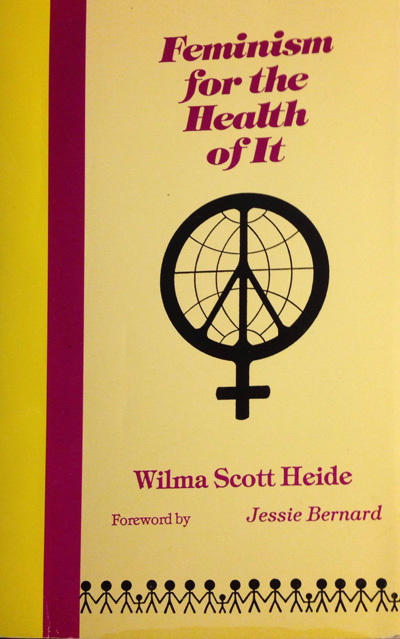
Wilma challenged the patriarchal status quo with an inimitable humor, keen intellect, and a steadfast feminist commitment.  She was the third President of NOW, during which she actively led the organization to turn away from the homophobic “lavender menace” Legacy-Cover2messages of the earliest years of the organization.  She led a number of actions of civil disobedience, several of which contributed significantly to moving the Equal Rights Amendment out of committee and into the nation-wide U.S. constitutional review process.  She insisted that newspapers cease segregating the “help wanted’ columns by “male” and “female” – a change that is possibly one of the most influential in expanding economic opportunity for women.
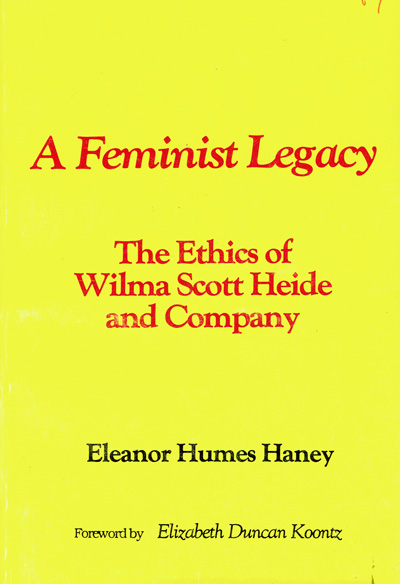
Even though she did not practice nursing for most of her career, she never waivered in her identity as a nurse and her commitment to the deepest values of nursing that are today reflected in the Nursing Manifesto – caring, the right of all people to a high level of health and wellness, the essential element of peace in realizing health for all, and the imperatives of consciousness and action to bring about real change.

There are elements in both books that may seem limited or inadequate given the perspectives we have today, but both remain significant and current not only for their historic value, but for the light they shed on today’s persistent political and social challenges for women, for nursing, and for health care.  I am thrilled to have brought these works forward into the present in accessible, affordable formats!  I hope you will visit your preferred eBook provider now and consider making them part of your library!

Nursing in the media: A story


Unfortunately, nursing seems to lack a strong presence in the media world, including radio broadcasts. I was thrilled then to discover today on my i-pod and podcast supported walk through the woods the presence of a voice of nursing on an NPR show called Snap Judgement. On this particular show, entitled G.I., show # 216, which aired on May 24, 2012, the vignette entitled “Frances Liberty” includes the account of a world war II nurse and how she cared for the injured and dying as a WAC nurse. Though “Lib” died in 2004, her voice lives on in this story of what I would call nurse heroism through creating caring-healing- spiritual environments.

You can listen to the whole show, which is somewhat heart-breaking in its accounts of veteran PTSD issues, or simply entertain Lib’s story by visiting this link:

http://snapjudgment.org/radio-show?page=1

What this nurse remembers the most in her accounting of being a WWII/ WAC nurse are the caring- healing moments she created for the soldiers. She tells of how she had the pretty nurses with their pleasing appearance doll themselves and use perfume, so as to sit with the most seriously injured and dying. Normally I would be perhaps not really thrilled with this portrayal of a nurse as an object of beauty, but I found myself agreeing that the nurses’ pleasing appearance perhaps create an environment of healing for a young man who is facing his mortality far too soon. Theorists such as Jean Watson and Barbie Dossey have agreed that the environment supports the healing process and this is an example of setting an intention for creating a calming, healing, and perhaps even pleasant presence.

Interestingly, the nurse detailed a story of sharing prayers and a rosary with a young Jewish man who was in need of surgery and facing his mortality. Not to give away the story, but her presence and spiritual support were what made all of the difference for this man; a moment of connection lasted this man’s entire life. And, as we often find in nursing, both for ourselves and our patients, it is those caring moments that our patients whom we serve remember, and it is those moments that most impact us as nurses and spiritual beings on our own healing journey.

I would love to read and hear more of our meaningful stories on the nurse manifest blog and in the media; this sort of story can help us to express to the public that we are there for them both as the providers of technically competent, life-saving care, but also as the guardians and supporters of the spiritual- healing needs.

Some history on the origin of the word “nurse”


Thomas Lawrence Long, from the University of Connecticut, has graciously provided a guest blog post on the etymology of “nurse.” I happened to see something Tom posted about Shakespeare and “nurse” and thought this would be an interesting topic to discuss here.

Because historians of health and health care are sometimes preoccupied with the slipperiness of the signifier nurse (see Monica Green’s (2000) caution concerning the term in reference to medieval and early-modern studies), a brief historical lexicography might illuminate the meanings that the word has accrued, absorbed, and may, to some extent, still carry. Here is examined the historical traces of a noun-substantive, from wet-nurse, to caretaker of children, caretaker of the sick, asexual hive bee, and health professional, in which the traces of ideologies of gender identity and gendered work appear to be retained.

The first instance in English of nurse occurred in the early thirteenth century as the Anglo-Norman nurice, derived from the fifth-century post-Classical Latin nutrice, a wet-nurse (hired to provide an infant with breast milk when the infant’s mother would not or could not do so), although by the time it entered the Middle English lexicon, it had already absorbed the figurative sense of any female caretaker of children (Oxford English Dictionary 2010). Etymologically it is related to our modern word nourish, to feed.

Already by the late fourteenth century nurse had also taken on the figurative sense of any thing or any place that nurtures or fosters a quality or condition, and by the early fifteenth century, any person who takes care of, looks after, educates or advises someone.

The earliest attested use of nurse in a strictly medical sense appears in Shakespeare’s Comedy of Errors (ca 1616): “I will attend my husband, be his nurse, Diet his sicknesse, for it is my Office” (V.i.99). The wife as nurse (and the advantage of marriage as engaging a live-in nurse) is also apparent in the Duchess of Newcastle’s Matrimonial Trouble (1662), which contends, “That he might do [sc. marry], if it were for no other reason, but for a Nurse to tend him, if he should chance to be sick.”

Another curious figurative usage is attested to in the early nineteenth century: nurse as an entomological term, explained by the OED as “A sexually imperfect member of a community of bees, ants, etc., which cares for the larvae; a worker,” citing Kirby and Spence’s Introduction to Entomology (2nd edition): “The workers, termed by Huber nourrices, or petites abeilles (nurses), upon whom the principal labours of the hive devolve.” The Huber in question was the Swiss naturalist François Huber (1750-1831) whose Nouvelles Observations sur les Abeilles was published at Geneva in 1792 and translated into English in 1806. Perhaps by association the later zoological term nurse shortly came to characterize any asexual invertebrate, a spineless sexless creature.

The semantic process whereby the word nurse begins by denoting a woman hired to provide surrogate breast milk and comes to denote a sexless worker insect may be related to the religious associations of woman as healer and caretaker of the sick, particularly the ubiquitous presence of European women’s religious orders comprised of celibates (and thus, in the medieval view, sexless) devoted to the wellbeing of others.

Reference

Green, Monica H. (2000). Documenting medieval women’s medical practice. Women’s healthcare in the medieval West. Aldershot, UK: Ashgate Variorum, pp. II, 322-352.

When you think of the word “nurse,” what comes to mind for you?

As Nurse Week Comes to a Close: Nursing Theory


This last week here in the USA we celebrated Nurses’ Week and then Nurses’ Day on May 12. May 12 is the birth date of two of the founders of contemporary nursing, Florence Nightingale and Martha Rogers. Nightingale ushered in an era of modern nursing beginning in the 1850’s, where women could work in a hospital setting after undergoing professional training. Just prior to Nightingale’s efforts, nursing was generally not thought of as a respected profession. Over 100 years later, Rogers brought to us a theory of Unitary Human Beings, which helps us to better understand our patients’ needs, and guides our own journey toward emancipation as a profession.

Florence Nightingale


Martha Rogers

These two women, each with their own controversial and spiritual views of nursing, have greatly impacted nurses and the profession. I  strongly believe that each and every nurse can also create change in the workplace. We need to find ways to first care for ourselves, and then communicate better with each other, our patients, our administrators, our legislators, and the general public. We need to bridge the gap between Continue reading