The Nursing Manifesto: Aligning action toward living nursing as caring science and wholeness


“Organizations are not changing because people in organizations are not changing” (Cowling, Chinn, & Hagedorn, 2000).

The Nursing Manifesto provides us within the profession a beacon of light and hope toward creating change; it provides a map of sorts leading toward the manifestation of Nursing Qua Nursing. It calls for us to grow, change, and evolve into our professional caring autonomy.

My doctoral dissertation looked at Nursing’s Living Legend, Dr. Jean Watson’s Theory of Human Caring and how it could be explicated through relating it to other areas of academic disciplines: chaos theory, partnership theory, and transpersonal psychology were all used to support the concepts in Watson’s theory. My overall conclusion after many pages of theoretical writing was that nurses need to be on a journey of self-care and reflection in order to enact the human caring experience that Watson calls for.

“We believe that our journeys to enact this manifesto will certainly require a reuniting of the inner and outer life, accepting our wholeness and owning our freedom – a wholeness and freedom that will strengthen our outer capacity to love and serve” (Cowling, Chinn, & Hagedorn, 2000).

How can one love and serve in their capacity as a nurse? Several years after completing my dissertation, I was given the opportunity to develop an RN-BSN curriculum from a caring- holistic-integral science perspective at the University of Maine at Augusta. The recently accredited program emphasizes self-care and reflection, while students also have the opportunity to explore holistic modalities for use on their own healing paths and to share with others as well. The creation of this curriculum was an act of love and it continues to be a path of service toward the nurses we care for in our program.

For several years, I had a dream of bringing Jean to our students and faculty. Eventually we were able to partner with our local hospital Maine General Medical Center and bring Jean not only to our students, but to nurses and nursing students from around the state of Maine. After a year of planning by a committee of 10 empowered nurses, we were able to bring over 400 nurses together to spend a day with Jean, learning about her theory.
IMG_7111

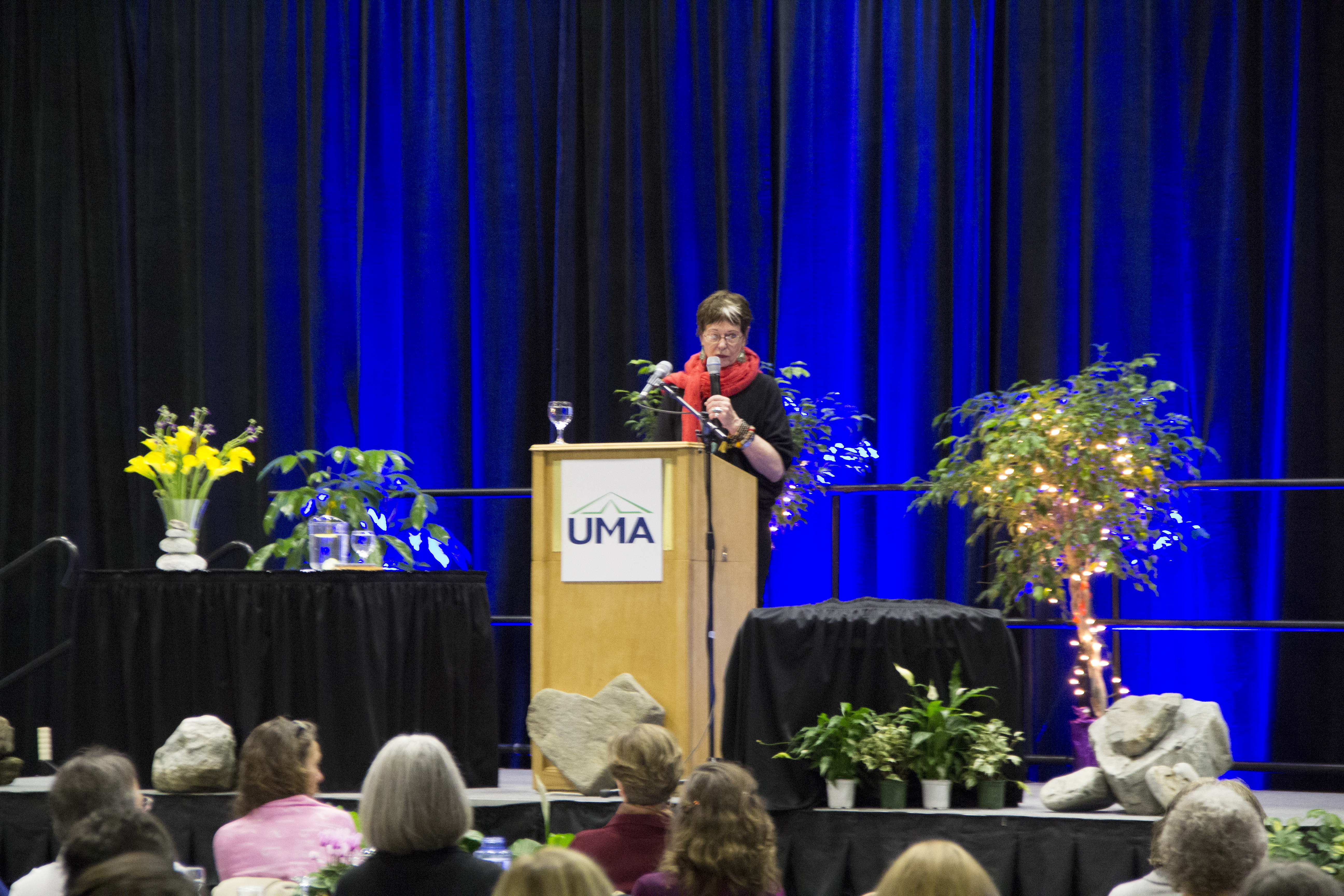
The Augusta, Maine civic center was transformed by the planning committee nurses to be a healing space; special lighting was used, break time music was geared toward songs that support healing, plants were brought in, and intentions were set by the planning committee for healing space and caring science to emerge. The lunch meal and morning and afternoon fruit offerings were also geared toward support the health of the participants.

Dr. Watson spoke for many hours throughout the day about her transpersonal caring healing moment, the challenges we as nurses face in the current medical-cure based healthcare system, and the 10 Caritas Processes that support the nurse in creating the caring moment. Participants were encouraged to ask questions and share their own experiences with caring and healing. The whole day aligned with the Nurse Manifesto process, in that Dr. Watson focused on Nursing Qua Nursing and how we can move toward a caring science reality of nursing: “It is our firm conviction that there is a body of knowledge that is specific, if not unique, to nursing’s concerns and interests. We think that this knowledge is grounded in appreciation of wholeness, concern for human well being, and ways in which we accommodate healing through the art and science of nursing” (Cowling, Chinn, & Hagedorn, 2000).

Additionally she spoke extensively about the broken healthcare system, which has morphed into an illness system, or as the nurse manifesto noted, “general subjugation of spiritual consciousness to the economics of health care” and “the long-standing ideology (acquired consciousness) of nurses being subservient to other interests, and not encouraged to be deeply committed to their own healing work” (Cowling, Chinn, & Hagedorn, 2000).

Of great importance throughout the day was the emphasis on Watson’s first caritas process: Embrace altruistic values and Practice loving kindness with self and others. The other 9 caritas process revolve around the nurse’s efforts toward enacting the first caritas process, which begins with the nurse learning to care for themselves through self care, or acting in love towards oneself.

Students provided us with feedback after the event, and they stated that the most profound experiences were being able to meet Dr. Jean Watson, and also experiencing the transpersonal caring moment through a listening experience. During this experience, the participants first centered themselves in order to speak or listen from the heart; and then in pairs, they had the opportunity to practice being present and listening without saying a word, as well as reversing the experience and speaking for several minutes from the heart. The students found this to be profound and they realized what it means to be truly present with another person in a caring- heart centered experience. Many nurses do not have the skills or experience in this area, so this is something we must continue to foster in our nursing curricula and healthcare settings. My hope is that the nurses who experienced this event will have experienced some change within themselves that will help foster the change needed in the healthcare system. Love, serve, remember….

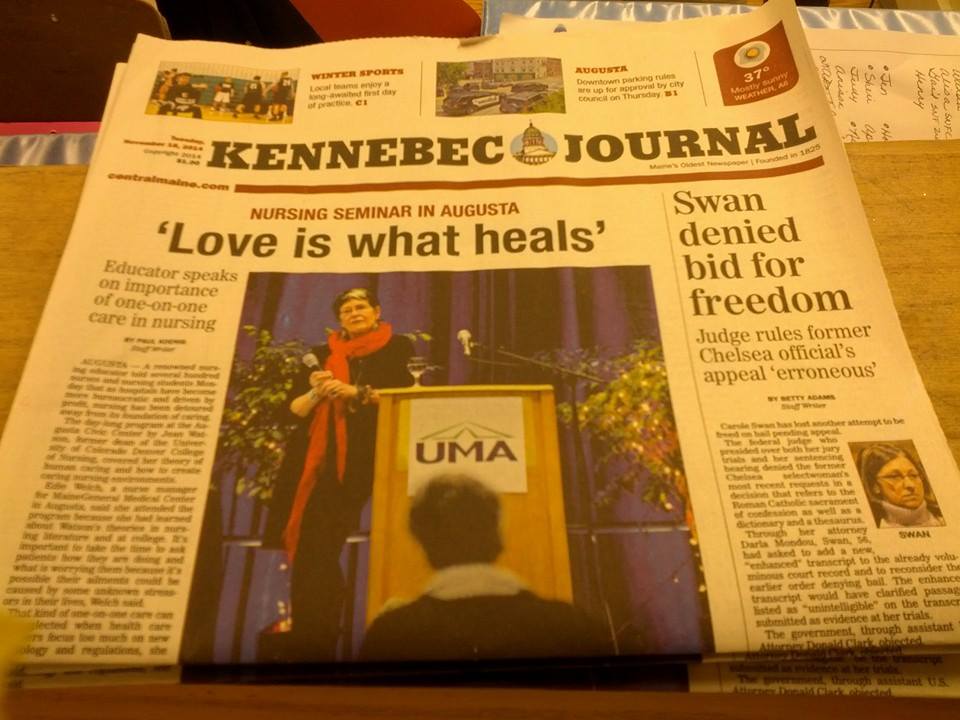
I am grateful to also have had media coverage of the event. Media coverage for nurses is of great importance, moving us out of the shadows and away from the invisible nature of our work. The front page of the Kennebec Journal on November 17 read, “Love is What Heals” and included a picture of Dr. Watson at the podium. Additionally, the event was covered by the local TV station, and that can be viewed here: http://www.foxbangor.com/news/local-news/6994-doctor-redefines-practice-of-nursing.html This media coverage is important, because as we know nurses tend to be invisible in the media, our presence often over-ridden by the medical-cure based system. We need to continue to find ways to shine our own unique light of love and healing.
JW_front page

Reference:

Cowling, W. R., Chinn, P. L., & Hagedorn, S. (2000, April 30, 2009). A Nursing Manifesto: A Call to Conscience and Action. Retrieved from http://www.nursemanifest.com/manifesto_num.htm

 

Dreaming in nursing


I woke up at 0430 this morning with my heart pounding. Occasionally this happens, I have a “nightmare” about nursing.

Image

In this particular dream, I was working a night shift and at the end of the shift I was chatting with the nurses. I was getting ready for report, and I couldn’t remember seeing any of my patients; no names, no faces, no recollection at all. I began to feel anxious and I asked one of my fellow nurses, “Gee I hope I finished my charting” and she replied, “No I don’t think you closed out your charts.”

In a panic I ran to the charts. Of course in the dream they were not electronic, they were huge paper charts, perhaps as big as they could be about 6 inches thick, with hand written notes. I was trying to decipher the handwriting and figure out what was going on with a particular patient. As I read through the chart I realized I had not assessed this patient. I must have slept through entire shift. How could that be? Clearly from the diagnosis this patient would have needed pain medication, turning, toileting, and so on. Who was caring for this patient? I had nothing to chart and I realized that I would, at this last hour, have to go and check on all of my patients, assess them, check their meds, and then chart. My 5-year-old daughter arrived in the dream and wanted to play and I had to tell her no.

Image

Somehow, I woke up and had to convince myself it was just a dream, nobody was harmed, I was safe in my bed. For the record, I haven’t work the floor since the late 1990’s, though I worked as a hospice nurse and taught clinical in the hospital until 2005. Around that time, I finished my PhD, and began to focus on just honing my skills as an educator while I had two babies and raised them into young children.

I have this type of dream several times a year. I suppose I could do a dream analysis, look for the Jungian archetypes, or focus on my own life-anxiety and how it is related to my work. But I am really wondering about here is the dreams that nurses have: the good, the bad, the sleep time dreams, and the awakened dreams.

What is it that our hearts desire in our practice? What are we “dreaming of” in nursing practice and education… and how do we get there? Do we find reward in a broken healthcare system and as the largest providers of healthcare in the nation, how do we take back our practices of caring and compassion? How do we partner with others to create change? How can we use the Nurse Manifesto created by Peggy Chinn, Richard Cowling, and Sue Hagedorn to our benefit?

I would love to hear nurses’ stories about what they desire. I myself wrote a story about what nurses experiencing versus what we desire and you can read about that here: https://nursemanifest.com/research_reports/2002_study/nurse65x89.htm

This story was recently published in Creative Nursing journal. I am also presenting this story and supporting nurses in creating a personal plan of action at the American Holistic Nurses Association Annual Conference in Virginia Beach, VA this June. I hope to see you there!

The nursing revolution will not be televised: Part III, the work of consciousness evolution


If you are following these postings, you may have begun to wonder, ” well how can I, an everyday nurse, take on the enormity of changing myself; I have always been this way, these are engrained patterns, and I don’t know how to change”. I have outlined a few steps here, though the reader is encouraged to also discover their own healing path.

I. Start looking at the basics of your human needs.

Most nurses have some exposure to Maslow’s Hierarchy of Needs, and the more we learn about psychoneuroimmunology (PNI), the more we know the importance of  laying the foundation of good health behaviors in order to achieve “self-actualization” or consciousness evolution; we can also use this model to begin to visualize that as we move toward your own growth, healing, and self-actualization experiences, we can then prepare to support others (ie our patients and our colleagues) to do the same. From a PNI perspective, if the base of the hierarchy is not addressed, we will be in a physiological chronically stressed state, leading to not only feeling bad and functioning poorly, but also toward an inflammation state and a genetic-chromosomal expression that leads to illness and disease.

Many nurses need to start with attending to the basic physiological needs. As research has shown that most nurses get an average of only 6 hours of sleep before any given shift, for many nurses, this will be the way to begin: first, learn to honor your sleep in order to best care for your own PNI and set the stage for consciousness evolution. Additionally, with erratic schedules and nurses’ long 12 hour shifts, diet and exercise habits that are proven to support a strong PNI, personal stress resilience, and consciousness evolution, may be missing and this useful information is never readily available for the people in need.

As one begins to build a strong physiological basis for themselves, they are better prepared to address the safety needs stage of Maslow’s hierarchy: I believe this is of great importance to nurses, because on a daily basis, our safety issues and boundaries are pushed by our patients, patients’ family members, colleagues, and administrators alike. However, if we don not have our own basic physiological needs met, we may not progress toward addressing our safety needs and moving into a space where work group relations can be addressed and managed.

Nurses may choose to work with a wellness counselor, support group, or health-nurse coach to begin to manage and create a healthy lifestyle. We need to recognize that these habits are hard to create, but with continued support, we can create lasting healthy lifestyle behaviors.

II. Look to the Literature: Self-help and self-care tools abound

In the curriculum I have enacted in the RN- BSN program I have developed, it has become clear that nurses need specific tools to undertake the self-care and healing journey. Luckily, one does not have to look far to find these tools. Some recommendations I feel comfortable making to nurses, educators, student nurses , and whole groups of nurses looking to share this work together include:

Cheryl Richardson’s (2012) The Art of Extreme Self-Care: Transform Your Life One Month at a Time. In this book, individuals and/ or groups can work together to reflect and create real change in their lives. This particular book walks the reader through affirmations, to creating healing space, and learning to set limits with the “absolute no” process.

Another great work to support nurse’s on their healing journey and consciousness evolution process is Joan Borysenko’s (2012) Fried: Why You Burn Out and How to Revive. In this book, Dr. Borysenko, a pioneer in the research that emerged from Harvard’s Mind Body Institute, shares her own burn out scenarios and a step-by-step reflective process to help readers revive by examining their childhood roots of burnout, personality traits that may predispose us to burnout, and the revival process needed to move beyond burnout.

Creating work groups or informal groups that can share this healing process may be helpful, though certainly one can also work through this process on their own.

For those looking for what I might call a deeper journey toward the state of evolutionary consciousness a text entitled Integral Life Practice: A 21st Century Blueprint for Physical Health, Emotional Balance, Mental Clarity, and Spiritual Awakening (2008, Ken Wilber et al) may prove to be a challenging and useful endeavor. This book walks one through the lived process of addressing psychological shadow issues, while also focusing on the mind-body-spirit processes needed to support evolutionary consciousness growth.

III. Seek out counseling

As most nurses know, we want to support the healing of others through caring, which is the heart of nursing practice. But if this task becomes one of control and co-dependence, our workplaces may even morph into lateral violence as we reenact the patterns of our dysfunctional family’s and painful childhood experiences. Through work with the right counselor, we may find that we are able to identify these patterns, observe them, heal them, accept them, and detach from them as we create new ways of being. At this juncture, we then create new patterns for coping. Additionally, tools such as EMDR can help one to create new neural pathways of peace and well-being to attend to when life is stressful, rather than continuing to enter into old habits of fight or flight ad the ensuing dysfunctional behaviors that tend to dictate our reactions in unhealthy manners.

IV. Evolve your consciousness: The ancient tools

For many centuries, people have searched for ways to relief their suffering and find ways to grow spiritually and evolve their consciousness. We are only now coming to the point where we can link these endeavors to the PNI response; organizations such as the Harvard’s Benson- Henry Institute for Mind-Body Medicine, UCLA’s Mindfulness Awareness Research Center and the Center for Neurobiology of Stress, and The Institute of Noetic Sciences have taken the lead in this area.
Working toward mindfulness, using tools such as meditation and yoga help us to evolve our consciousness toward higher states and recognize our unity with others and the universe at large. Mindfulness means paying attention in a particular way, on  purpose, in a present way, while remaining non-judgmental and non-evaluative toward both the inner and outer environments. The video below from UCSF’s Osher Center provides a clear background on this process which directly relates to managing stress and evolving.

I would love to hear your thoughts and experiences around this process of personal consciousness evolution and the power it may have to transform our lives and realize our healing-caring nursing practices.

The (nursing) revolution will not be televised: Part II


“If we do not change direction, we are likely to end up exactly where we are headed”- Chinese Proverb.

In one of my previous postings, I mentioned that the nursing revolution would not be televised; in other words, our own revolution begins with an evolution of consciousness about nursing and our practices. I do believe, just as our esteemed nursing theorists Jean Watson has stated time and again, that caring is the essence of nursing practice, and yet we have continued as nurses to generally practice in institutions and organizations that do not know how to value and support the caring- healing capacities of nurses, despite the fact that our patients make clear time and again are of the utmost importance along their healing journey.

We are each, as individuals and nurses, in need of awakening to our own personal path of caring and healing. If we are to be able to share caring and healing with others on a meaningful basis, we have to be on a caring-healing journey for ourselves individually and collectively.

In order to create change in our profession and move toward greater acceptance of caring-healing nursing practices, the change needs to come from within each of us. I have some students who state things along the lines of, “What is the use? I can change myself and yet this will not effect the institution where I work”. And this is where they are wrong. I have seen time and again nurses who move toward changing their consciousness and engaging in their own self-care and healing endeavors, and they then go on to create meaningful changes in their lives and their practices. Others find the courage and strength through self-reflective practices  and increasing stress resilience to realize that they are serving a dysfunctional system and they opt to leave their place of employment. By increasing our personal stress resilience and creating new brain pathways, we can open up to creative solutions to workplace problems and we can walk into our own issues instead of running from them or remaining stagnant.

Stress resilience helps us to create a personal revolution toward peace, ease, and well being. The following is a video by Joan Boryenseko on transformational experiences of healing, awakening, and consciousness evolution. Here she walks into the process of witnessing our emotions and the process of witnessing, forgiveness, and grief.

As we undertake the revolutionary steps of transformation to change our personal and nursing consciousness toward peace, we will notice a reduction in aggression and an increase in compassion, caring, love, and tolerance- the qualities needed to support the creation of healing environments in our healthcare systems and facilities. As our personal and professional consciousness evolves and shifts, we begin to move toward a better understanding of the unity of all human beings and species and even to the larger cosmos.

So what prevents us from taking the steps toward personal and professional revolution through consciousness transformation? Below is a video by Eckhart Tolle that briefly described the movement toward consciousness transformation and moving beyond fear.

I am open to hearing your thoughts here and in the next installation, I will present ideas on the steps toward walking into peaceful revolution and transformation in part III.

Nursing in the media: A story


Unfortunately, nursing seems to lack a strong presence in the media world, including radio broadcasts. I was thrilled then to discover today on my i-pod and podcast supported walk through the woods the presence of a voice of nursing on an NPR show called Snap Judgement. On this particular show, entitled G.I., show # 216, which aired on May 24, 2012, the vignette entitled “Frances Liberty” includes the account of a world war II nurse and how she cared for the injured and dying as a WAC nurse. Though “Lib” died in 2004, her voice lives on in this story of what I would call nurse heroism through creating caring-healing- spiritual environments.

You can listen to the whole show, which is somewhat heart-breaking in its accounts of veteran PTSD issues, or simply entertain Lib’s story by visiting this link:

http://snapjudgment.org/radio-show?page=1

What this nurse remembers the most in her accounting of being a WWII/ WAC nurse are the caring- healing moments she created for the soldiers. She tells of how she had the pretty nurses with their pleasing appearance doll themselves and use perfume, so as to sit with the most seriously injured and dying. Normally I would be perhaps not really thrilled with this portrayal of a nurse as an object of beauty, but I found myself agreeing that the nurses’ pleasing appearance perhaps create an environment of healing for a young man who is facing his mortality far too soon. Theorists such as Jean Watson and Barbie Dossey have agreed that the environment supports the healing process and this is an example of setting an intention for creating a calming, healing, and perhaps even pleasant presence.

Interestingly, the nurse detailed a story of sharing prayers and a rosary with a young Jewish man who was in need of surgery and facing his mortality. Not to give away the story, but her presence and spiritual support were what made all of the difference for this man; a moment of connection lasted this man’s entire life. And, as we often find in nursing, both for ourselves and our patients, it is those caring moments that our patients whom we serve remember, and it is those moments that most impact us as nurses and spiritual beings on our own healing journey.

I would love to read and hear more of our meaningful stories on the nurse manifest blog and in the media; this sort of story can help us to express to the public that we are there for them both as the providers of technically competent, life-saving care, but also as the guardians and supporters of the spiritual- healing needs.