Nurses’ Concerns with COVID19: March 20, 2020


Like many of you reading this, I have a range of emotions and feelings as the pandemic of COVID19 grows in the USA: anxiety, fear, and anger. Today (and for the last several days), I am angry about the lack of Personal Protective Equipment (PPE) available for nurses who are being called to care for those who are most ill and the most contagious. The following is my attempt to express my personal concerns and align them with nursing’s guiding ethical principles.

There may be flaws in my thinking and I am open to respectful dialog about these issues. I understand that emotions are running high and that we may not agree, but we can and should have civil discussions and dialogs.

Lack of Personal Protective Equipment. On February 7, 2020, the World Health Organization warned of a shortage of Personal Protective Equipment in China and beyond. As that was 6 weeks ago, there has been time to ramp up the production of PPE. Meanwhile, state’s governors from Maine to Wisconsin to Florida and Washingon are asking to access the federal stockpiles for access to PPE:

https://www.penbaypilot.com/article/governor-mills-urges-federal-government-vice-president-release-personal-protection-eq/131972

https://www.nbc15.com/cw/content/news/Evers-asks-federal-govt-for-much-needed-supplies-from–568975621.html

https://www.propublica.org/article/heres-why-florida-got-all-the-emergency-medical-supplies-it-requested-while-other-states-did-not

https://www.doh.wa.gov/Newsroom/Articles/ID/1117/Addressing-shortages-of-Personal-Protective-Equipment-PPE

Nurses Quitting: A few days ago, one of my Facebook friends quit her job because she was no longer being provided the proper PPE, She was not directly caring for COVID19 patients, but she needs proper PPE to keep herself and her patients safe during the provision of care,  and her quitting her job got me thinking, considering ethical issues, advocacy, the role of the nurse, and so on.  I respect her decision, and I hope this post makes it clear that during these frightening and murky times, the decisions we make as nurses are going to be hard ones.

image.png

I want to say, from an ethical perspective, it is perfectly acceptable for nurses to quit their jobs and/or refuse to work without proper PPE. Refer to my previous post of the ANA calling for the CDC to provide evidence when they make guidelines, and consider the recent use of bandanas and reuse of face masks protocol from the CDC: https://www.cdc.gov/coronavirus/2019-ncov/hcp/ppe-strategy/face-masks.html. This flies in the face of everything we know about the transmission of viruses.

Ethical Principles: The overarching ethical principles at play here that help to guide nurses’ decision making are beneficence (doing the good thing, moral obligation to do the right thing, what is best for the patient) and nonmaleficence (do no harm to patients). When we work without proper PPE, there is a very real risk that not only might we harm ourselves, we potentially spread pathogens to patients. When we don’t have proper PPE, our stress, fear, and anxiety can be magnified and potentially may harm patients.

Additionally, The code of ethics for nurses (https://www.nursingworld.org/coe-view-only) requires a lot of us.  To begin with, we must be deeply familiar with The code and how it guides our decision-making processes. The following are some excerpts from The code that guide our decision making at this time:

The code: 3.5 Protection of Patient Health and Safety by Acting on Questionable Practice 

This concept is all about the reporting of inappropriate and questionable practices. We may become stymied when even our boards of nurses are aware of dangerous and non-evidence-based practices, but they may see no way around them. We can report the issues, but when the governing bodies we report to are not holding up our own ethical standards, the field is put at greater risk for collapse (from infection spreading and/ or providers quitting).

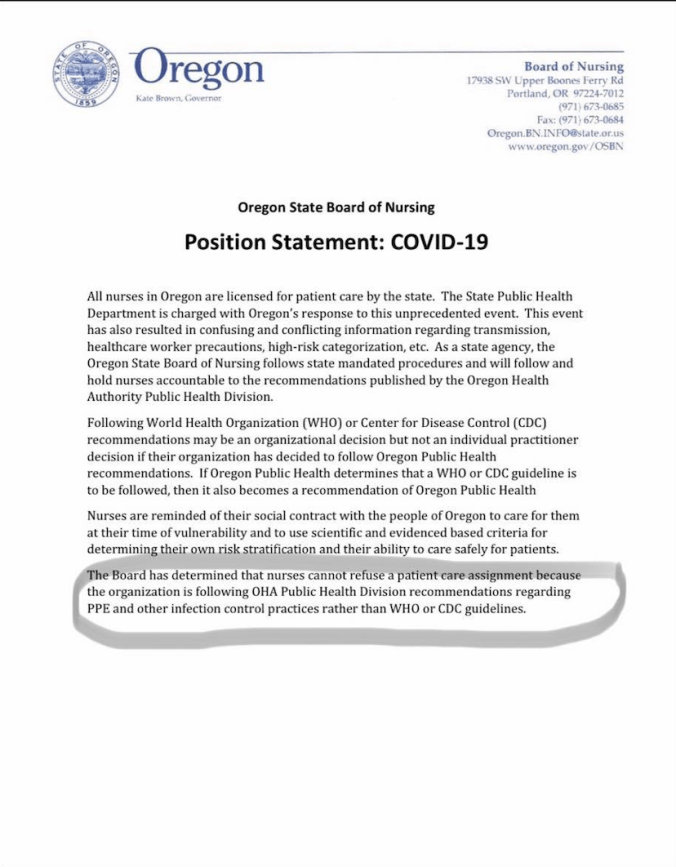
Even as standards are relaxed, entities such as the Oregon Board of Nursing should be taking more responsible action and not placing nurses and patients at risk. The following is a statement by the Oregon Board of Nursing that states that nurses cannot refuse assignments because of sub-par PPE that does not align with CDC or WHO regulations. In other words, in this case, the BON is either not considering the greater harm for both patients and nurses by not recognizing the greater ethical concerns and personal risks nurses are being asked to take, or they simply see no other solutions. The paragraphs about the social contract and evidence-based approaches contradict the highlighted area regarding changes in PPE approaches and the right to refuse assignments.

Screen Shot 2020-03-20 at 8.55.47 AM.png

Regardless of what our boards of nursing state, Provision 4 makes it clear that we are ultimately responsible for our own practice:  “The nurse has authority, accountability, and responsibility for nursing practice; makes decisions, and takes action consistent with the obligation to promote health and to provide optimal care”. Specifically, Provision 4.1 states that “Nurses bear primary responsibility for the nursing care that their patients and clients receive” and “Nurses must always comply with and adhere to state nurse practice acts, regulations, standards of care, and ANA’s Code…”. This does lead to interesting paradoxical issues with the Oregon Board of Nursing, as one could view this as a regulation, but it contradicts further statements in The code, including:

Provision 4.3: “Nurses are always accountable for their judgment, decisions, and actions: however in some circumstances, responsibility may be borne by both the nurse and the institution. Nurses accept or reject specific role demands and assignments based on their education, knowledge, competence, and experience, as well as their assessment of the level of risk for patient safety. Nurses in administration, education, policy, and research also have obligations to the recipients of nursing care” and “Nurses must bring forward difficult issues related to patient care and/or institutional constraints upon ethical practice for discussion and review”.

Most importantly, The code calls for us to take good care of ourselves so that we can take care of others. We see this shown in Provision 5, particularly:

Provision 5.2 Promotion of Personal Health, Safety, and Well-Being

“…nurses have a duty to take the same care for their own health and safety. Nurses should model the same health maintenance and health promotion that they teach and research, obtain health care when needed, and avoid taking unnecessary risks to health or safety in the course of their professional and personal activities.” The sticking point here is arguing whether or not the risks of not wearing proper PPE, which include risks of death for oneself or other patients who have not yet been exposed, is necessary or not. From my perspective, I can see where working without proper PPE could be too large of a risk to oneself and the communities served.

And I get concerned when nurses seem to think it’s only about them be willing to take on the personal risk for themselves, forgetting about how they may also become the vector.

One last ethical issue, we have to do our own self-care during these challenging times. As nurses, we are required to take care of ourselves. Provision 5.2 continues: “Fatigue and compassion fatigue affect a nurse’s professional performance and personal life. To mitigate these effects, nurses should eat a healthy diet, exercise, get sufficient rest, maintain family and personal relationships, engage in adequate leisure and recreational activities, and attend to spiritual or religious needs…it is the responsibility of nurses leaders to foster this balance within organizations”

Now onto a round-up of current COVID19 issues for nurses as I am seeing on social media:

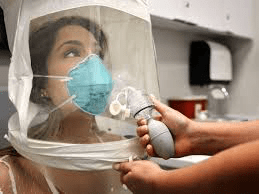
Masks: Some nurses are being told to store their 1 daily mask in a paper bag and remove/ doff between patients, and replace/don the old mask for new patients. Of course, the bag and the mask would all be potentially contaminated; the bag actually creates a source of contamination and risks for greater transmission. I also heard rumors on social media of nurses being told to share masks, and I am hoping this is simply just false information, as I couldn’t verify that claim. I did hear that eye shields were being shared. I have confirmed that nurses who are normally required to wear masks because they have not been vaccinated for the flu are now being told to not wear masks because there is a shortage of masks. I have also confirmed that having a doctor’s note regarding why one must wear a mask (verification that they are immunocompromised) may work in some settings to either ensure masks are available to the person or excuse them from work.

image.png

We are vulnerable: Nurses are humans and many of us are vulnerable, whether that means we have chronic health conditions and co-morbidities, or we are at risk because of age.

Nurses are also fighting amongst themselves about whether it is okay to quit the workplace now. We have to recognize that these are complex decisions; nurses are real people who have their own health issues. Getting angry about people not willing to take the risk is not productive in both the short and long term.

It’s okay to choose your life and your well-being over the “duty” or social contract to work. It’s okay to make those tough decisions, like quitting your job, and, for some folks, they may be willing to risk their license by refusing assignments where they can’t keep themselves or their patients safe, even if their board of nursing disagrees.

Many nurses will carry on, work hard, provide excellent care, and do their best.

It’s also okay to feel vulnerable and scared in these uncertain times and to question your decisions and the decisions of administrators, regulators, and leaders.

It’s okay to organize and advocate for our needs, whatever that looks like.

Always remember, you have ethics on your side.

image.png

COVID19 and Nurses’ Concerns


Nurses are the backbone of all of the health care professions: we care for people and communities in difficult situations. We are compassionate and ethical. We put ourselves at risk daily for everything from violence from patients and families to contacting contagious diseases to post-traumatic stress from what we witness.

Unknown.jpeg

Here is some of what I have read about on the social media COVID19 for nurses and healthcare providers pages that are popping up faster than dandelions.

  1. There is poor planning by, and a lack of communication from, most hospital systems, likely in part impacted by the lack of leadership at the state level. A national survey of nurses by National Nurses United found “high percentages of hospitals do not have plans, isolation procedures, and policies in place for COVID-19; that communication to staff by employers is poor or nonexistent; that hospitals are lacking sufficient stocks of personal protective equipment (PPE) or are not making current stocks available to staff; and have not provided training and practice to staff on how to use PPE properly”. https://www.nationalnursesunited.org/press/survey-nations-frontline-registered-nurses-shows-hospitals-unprepared-covid-19
  2. Personal Protective Equipment is now rationed. In inpatient settings, some nurses are asked to use just one mask/ day. An article in the New YorkTimes details how nurses are begging for PPE: https://www.nytimes.com/2020/03/05/us/coronavirus-nurses.html 
  • In the home care settings, nurses are asked or told to use one mask and one gown/ day. Obviously, this means they can’t maintain or implement proper precautions when traveling from house to house, the gown itself potentially becomes a contaminant.
  • In the home care setting, patients are canceling appointments because they view the nurses as vectors. In the long run, this could have huge implications for greater levels of care needed by these patients if they decline without proper care and guidance.

2. Most facilities do not have plans in place for the forthcoming surge in COVID19 patients.

3. The Centers for Disease Control rolled back the N-95 mask requirement and has stated that a simple surgical mask is sufficient in caring for COVID19 suspected or confirmed patients, and that may be used for extended periods while caring for multiple patients. They also have decided that reusable gowns are fine to use. https://www.fda.gov/medical-devices/letters-health-care-providers/surgical-mask-and-gown-conservation-strategies-letter-healthcare-providers

4.  Fears of getting sick themselves are rampant amongst nurses and other providers. Pregnant nurses have no idea if a COVID19 infection might affect their pregnancy. Those nurses with existing health conditions who are at risk are not sure if they should come into work, or reveal their health conditions to the workplace, or risk losing their jobs. Additionally, nurses who come home to care for elderly relatives, children, etc. are petrified of making them sick.

5. Nurses are not offered COVID19 testing, and if they have symptoms, they are often being told to use vacation, paid time off, or leave without pay, and to self-quarantine and contact the workplace in 14 days.  Those who are at risk are not identified quickly. https://www.theverge.com/2020/3/5/21166088/coronavirus-covid-19-protection-doctors-nurses-health-workers-risk

6.  Nurses may be mandated to work overtime, which can wreak havoc on stress levels and immune responses. https://www.fda.gov/medical-devices/letters-health-care-providers/surgical-mask-and-gown-conservation-strategies-letter-healthcare-providers

The CDC and NIOSH recognized years ago that working 12-hour shifts alone may be dangerous, with deteriorating performance on psychophysiological tests and an increase in risk for injuries. Poor outcomes and personal capabilities worsen with 12-hour shifts worked particularly in combination with working more than 40 hours. Working overtime obviously leads to physical fatigue, and it also increases risks for alcohol use and cigarette smoking. And there is still a lot we don’t know, such as how does working longer impact women or older workers? What about those with pre-existing or chronic conditions? What is the influence of occupational exposure?

Unknown-1.jpeg

What can we do, and what are nurses doing?

Now is the time: we are going to have to advocate for ourselves. We also need to demand proper access to PPE, PPE training, proper testing approaches, and call for OSHA standards related to the risks we face.

We can all act as advocates locally to call for safe working conditions, and we can join forces with our national nursing organizations to continue to call for support, funding, and access to proper PPE.

Feel free to share your ideas here.


Evaluating the Evidence: Cannabis and Psychosis, Part I


Over the last few days on facebook and across social media platforms, there has been the evocation of fear based in the findings from a new study around the evidence that high potency cannabis used daily may cause increase the risk for psychosis. While alarming at first glance, as someone who understands the endocannabinoid system and the benefits of cannabis, and as an advocate for patients’s rights to access this herbal medicine, I feel obligated to take a closer look at the evidence as presented in The Lancet. So feel free to join me on this journey of evaluating the evidence (or perhaps for those of you with advanced research analysis skills, take a look at the article yourself and see, regardless of your stance on cannabis, what the researchers did well and where they might be flawed). As President of the American Cannabis Nurses Association, my bias toward being pro-cannabis is clear, but I am also pro-patient and pro-safe use of cannabis, so I will do my best to provide an honest analysis. My approach here is the same that I would use in my work with my RN-BSN students, going through each area of the research, and using an approach to express my concerns that all levels of educated healthcare professionals can understand. 

The full text article can be found here: https://www.thelancet.com/journals/lanpsy/article/PIIS2215-0366(19)30048-3/fulltext

(Be sure to download the appendix as well, if you are following along!). 

My thoughts are in blue font.  

Title: The contribution of cannabis use to variation in the incidence of psychotic disorder across Europe (EU-GEI): A multi center case-control study. (long title, but fairly clearly depicts what the study is about). The article is open access, which I like. 

Journal: Lancet Psychiatry (reputable!)

Authors:Lots of good credentials here; a mix of MDs and PhDs. There are over 30 authors, which I find interesting. Sometimes this is a good thing, sometimes it doesn’t mean much. In the field of nursing, 30 authors would be quite large; in the world of physics hundreds to even thousands of authors can get credit…but are they really authors? Here is a link that looks at this issue (if you care or if your dare!), but this seems reasonable in this case: https://physicstoday.scitation.org/doi/10.1063/PT.3.1499

Funding: This was funded by the Medical Research Council, the European Community’s Seventh Framework Grant, Sao Paulo Research Foundation, the National Institute for Health Research Biomedical Research Center, Maudsley NHS Foundation Trust (South London and University College London), Kings College London, and Wellcome Trust.

At least five of the authors report funding from pharmaceutical companies, though stating that they were funded for other studies, not this study. Check out the full list at the end of the article. Getting funded is part of people’s jobs within research. Its just one of those little tidbits, to keep in mind, that certain loyalties and biases may be playing a part in the research here. “Big pharma” can be viewed as having vested interests in people using cannabinoids (which they may eventually be producing medicines for us all to use someday) or people sticking with their traditional allopathic medicines (I won’t get into the poly pharmacy issue and all of those implications) or even creating pharmaceuticals that help people managing psychosis. 

Problem: In the beginning of the article, the authors state that with legalization movements, we may have “an increase in cannabis use and associated harm, even if the later only affects a minority of patients” (p. 1) and they go on to state that several studies “support a causal link between cannabis use and psychotic disorder”(p.1). Ideally I would have time to thoroughly analyze each of the 5 cited studies in the first paragraph, but seeing as nobody is paying me to do this work, I instead decided I would check out at least one of the articles cited. I went to the fifth article cited because of the researchers’ claim  that the research may “support a causal link” (which was very concerning to me, because I keep running around saying “correlation is not causation…!” and people don’t seem to get that). 

And it turns out that key word “support” is very important: when I reviewed the cited  study by Gage, Hickman, and Zammit (2016) entitled “Association Between Cannabis and Psychosis: Epidemiological Evidence”, their conclusions lead me to believe that they did not determine causation. Gage at al basically looked at the evidence from longitudinal studies, and in their findings, they distinctly refrain from making a “causal” statement: “Overall, evidence from epidemiological studies provides strong enough evidence to warrant a public health message that cannabis use can increase the risk of psychotic disorders. However, further studies are required to determine the magnitude of this effect, to determine the effect of different strains of cannabis on risk, and to identify high-risk groups particularly susceptible to the effects of cannabis on psychosis”. When people read articles like this one we are analyzing here, it’s just too easy to assume that somehow causation has already been proved, when it clearly has not. 

The authors in the introduction go on to state that there is a rising incidence of schizophrenia in the world. “Differences in the distribution of risk factors for psychosis, such as cannabis use, among the populations studied might contribute to these variations” (p. 1). Hmm, well,  this might be related to cannabis use, but when I checked out the articles cited, they had more to do with income, urbanicity, migrant status, age, race/ ethnicity, and whether or not the person owned their home. I think we just have to be careful as readers and consumers of evidence to pay very close attention to the subtle nuances. What the researchers are saying is that they think cannabis should be examined in light if rising schizophrenia diagnoses (though some of the literature I read as part of this process stated that schizophrenia is not rising, rather its falling as we do a better job of differentiating and diagnosing). More on this later…

In a  pink box on page 2, the authors summarize some of the previous work done in this area I found their review of the literature (I think that is part of the purpose of this box?), a bit compelling, though they only found 3 articles that matched their criteria for psychotic disorders in combination with specific terms like “high potency cannabis””skunk-super skunk” or “high THC cannabis”. Two of the articles were their own work, and the third article was much older, going back to 1965-1999 London where increasing rates of schizophrenia “might be related” to cannabis use in the previous year.

 I couldn’t find the authors of this rise in schizophrenia article cited on the reference list, so I asked Dr Google for some help. I did eventually find the article and review the abstract…it then lead me to wonder about the idea of increasing diagnosis of schizophrenia during this time period, which then lead me to stumble upon a major issue with the criteria for schizophrenia, how it was historically diagnosed, and the argument that there may be some big issues around valid DSM criteria for the various types of schizophrenia  (rabbit hole alert, check it out, check it out…https://www.ncbi.nlm.nih.gov/pmc/articles/PMC5103459/). Though I worked in psychiatric nursing a few eons ago, I am clearly not up-to-date on all of the controversies that the DSM seems to spark. 

As near as I can tell, “psychotic disorders” are pretty much undifferentiated, and this is why the authors used this term vs chasing a more definitive diagnosis like perhaps bipolar or schizophrenia, which may be more difficult to make and of course may take time to differentiate. According to the NIH/NIMH, “psychosis” describes conditions where the person has a mind condition, and they have lost contact with reality: it can be a sign of a mental illness or physical illness, it can be caused by medications/ alcohol/drug abuse, 3% of the population experiences it, and symptoms include hallucinations, delusions, paranoia, and disordered thoughts/speech. Studies show that is common for people to have symptoms for more than a year prior to diagnosis.

 https://www.nimh.nih.gov/health/publications/raise-fact-sheet-first-episode-psychosis/index.shtml

This is extremely important to note because the researchers here looked at cases of first-psychosis, but there appears to be no follow-up regarding if these were “temporary” diagnoses, or if they persons were eventually diagnosed with schizophrenia or bipolar. They did use ICD-10 criteria to define the population eligible for the study : https://www.icd10data.com/ICD10CM/Codes/F01-F99/F20-F29/F20- but it remains vague to me as far as differentiating this population and they simply lumped all psychotic disorders together. 

It is known that adverse effects of cannabis can be things like hallucinations and paranoia, so I started to worry a bit and wonder if these folks were high at the time of intake into the ER, and if they were experiencing adverse effects vs a mental health diagnoses. Thankfully,  I do see some distinction of this in the article: if the symptoms were from acute intoxication, the person was not included in the study. Phew! I can assume they knew how to differentiate this.  

Participants: Participants were people age 18-64, they were diagnosed using the ICD-10 criteria for psychosis (which envelops a lot, check out link above). Control groups were apparently randomly selected from the same area using postal address, age, race, gender, ethnicity,  and lack of psychotic symptoms as the control criteria. The researches had participants in the 17 areas of England, France, the Netherlands, Italy,  Spain, and Brazil. The researchers were striving to assess 1000 first time psychosis and 1000 controls. I did not see in the study that cannabis use was ever confirmed by a urinalysis or blood test. This seems obvious to me, but since they are looking a year back, maybe it’s not needed? I really would have liked to have known their current status of testing positive for cannabis. 

The n for each group was good: control = 1237, cases= 901

Methods:

The researchers asked the participants about 6 measures of cannabis use: lifetime use (whether or not they ever used cannabis), current use, age at first use, lifetime frequency (pattern or most consistent use), money spent weekly (or during most consistent use period), The researchers then used data from the European Monitoring Centre for Drugs and Drug Addiction 2016 report to determine cannabis potency by THC.  (download it, you’ll like it, it’s fascinating: http://www.emcdda.europa.eu/publications/edr/trends-developments/2016_en) , however,  I actually ended up finding the data elsewhere on the website, where they have info about potency. The data available now is from 2018, I am assuming the researchers used 2016 data http://www.emcdda.europa.eu/data/stats2018/ppp_en

Okay, wait, what, don’t tell me…they didn’t ask the patients what specific strain they were using, nor actually test the cannabis strains the patients used, they conjectured from the data? I think I would have felt more comfortable if they would have collected some kind of data from patients beyond frequency of use that demonstrated that they were actually, truly consuming high potency cannabis. Additionally,  I had to dig around the website to find the potency, and the data is not well labelled. 

Also, another discovery in the EMCDDA report (figure 2.1) tends to show a downtrend in cannabis use in Europe, particularly in the 3 countries that previously were high prevalence countries such as Germany, Spain, and the UK. So while cannabis may be getting stronger, it’s use sure has dropped off greatly since the year 2000 in these 3 countries (which perhaps goes against the researchers thoughts that cannabis use is on the rise and posing a greater risk for psychosis).

 EMCDDA (2016). 
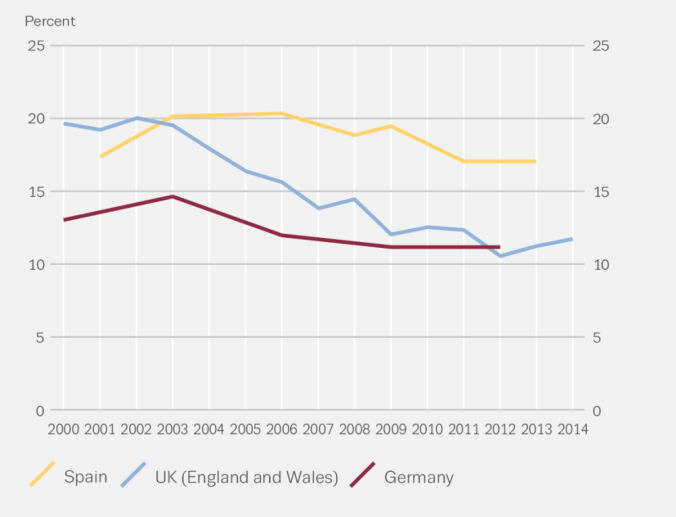
image.png


Back to the Methods. I am directed to the appendix to further investigate how they determined “high potency”. I am feeling frustrated, because there is no appendix on the pdf I downloaded, and luckily I did find it on the main page. The appendix has lots of great further details and I am left to wonder why the editors had them put this crucial data in the appendix. 

Based on the data, low potency cannabis was <10% THC and high potency cannabis was >10% THC. Participants were asked to report the type of cannabis used, in their own language, and potency was estimated based on the data from EMCDDA. The participants seemed to give what I can only categorize as broad terms for the cannabis they were using, including UK home-grown skunk/sensimilla UK Super Skunk, Italian home-grown skunk/sensimilla , Italian Super Skunk, the Dutch Nederwiet, Nederhasj and geimporteerde hasj, the Spanish and French Hashish (from Morocco), Spanish home-grown sensimilla, French home-grown skunk/sensimilla/super-skunk,  and Brazilian skunk. (To clarify, in the UK “skunk” is a term used for all high THC % cannabis plants, but I could not find a clear definition for “skunk” in terms of strains or exactly what the cut off is for a plant to be called skunk). https://www.independent.co.uk/news/uk/home-news/uk-cannabis-market-skunk-drug-strength-weed-spice-street-sales-dealers-a8231426.html

This process of asking data based questions of patients experiencing first time psychosis brings up red flags for me: firstly, asking patients who are in first time psychosis what “type” of cannabis the participants were using seems highly unreliable to me. The problems with patients and participants self-reporting data are well known, and yet this whole study is about self report, I get it…we may not have better ways to collect the data (yet), but it remains an issue for me. They did also have some other questions around intoxicants, which is good, but I will get back to that with results. 

Secondly, the actual cannabis was never tested for true potency (back to the idea of the researchers claiming these patients used high potency cannabis, but the only evidence of them doing so was that they may have consumed cannabis in a geographical area where high potency cannabis is available), nor was there any indication that the patients were tested for THC (granted they could have tested negative and last use could have been some months before the episode). 


What about the actual findings????

Hang on for Part II of the analysis!  The findings and conclusion analysis coming up in Part II! 


References:

European Monitoring Centre for Drugs and Drug Addiction. (2016). European Drug Report 2016: Trends and Development. Retrieved from http://www.emcdda.europa.eu/publications/edr/trends-developments/2016_en


Forti, M.D., Quattrone, D., Freeman, T.P., Tripoli, G., Gayer-Anderson, C., Quigley, H….et al. (2019). The contribution of cannabis use to variation in the incidence of psychotic disorder across Europe (EU-GEI): a multicentre case-control study. The Lancet, Psychiatry. Open Access. DOI:https://doi.org/10.1016/S2215-0366(19)30048-3

Jerry Soucy shares program on end-of-life care


Professionals in Oncology, Palliative, and End of Life Care
Join us a Free Film Screening and Approved Continuing Education Program
 
Sunday, February 10, 2019
9:30 – 11:30 am
 
The Virginia Thurston Healing Garden
Cancer Support Center
145 Bolton Road, Harvard, MA 01451
See the award-winning documentary End Game, and a discussion led by Brianne Carter, MTS,LICSW,OSW-C, and Jerry Soucy, RN,CHPN.
Space is limited. Registration required.


Call 978-456-3532
email kelly@healinggardensupport.org

Download your FREE color brochure NOW! (PDF)

Links to the film and reviews
IndieWire “Oscar 2019 Best Documentary shortlist.”
Review, Rotten Tomatoes – “End Game manages to transcend its genre peers and deliver something truly special and unique.”
Review, Stream it or Skip it? – “Stream it. It’s heavy stuff, sure, but it’s beautifully made – and we could all use a little reminding of how precious life is…”
Review, Life Matters Media – “Executive producer Shoshana Ungerleider, a hospice and palliative care physician…said she hopes audiences are empowered with information about hospice and palliative medicine so they can make better, more informed decisions when facing death.”
Review, Tricycle Magazine – “…the documentary invites us to participate in the penetrating intimacy of dying as seen from the perspectives of patients, their loved ones, and healthcare practitioners. We meet Kym, Bruce, Pat, Mitra, and Thekla at the ends of their lives… We don’t want these people to die, but they will.”
This Program is Presented in Partnership
The Virginia Thurston Healing Garden Cancer Support Center is the premiere provider of integrative oncology care in Massachusetts, located on 8 acres of serene woodlands in Harvard, MA. Our support groups, expressive and integrative therapies, and individual counseling services aim to optimize the quality of life for all those who are affected by cancer – men, women, and their caregivers – regardless of cancer type, prognosis, or financial ability to pay for services.

Good Shepherd Community Care provides care, treatment, support, and education to patients, families, clinicians, and the community facing serious illness, end of life, grief, and loss through its culturally-informed hospice, palliative care, bereavement, and educational programs.

Jerry Soucy, RN, CHPN is a nurse activist with a practice serving patients, families, caregivers, clinicians, and the community. He is experienced in multiple clinical settings, including specialty intensive care at a major medical center, outpatient hemodialysis, and community hospice. Jerry is certified in hospice and palliative nursing and blogs about serious illness and end of life.

Drug Wars, Drug Addiction, and Social Justice Issues


I have been reading Johann Hari’s Chasing the scream: The first and last days of the war on drugs. 

418d-BLWW6L._SX248_BO1,204,203,200_.jpg

This book provides a very detailed account of how we came to be an anti-drug \ and pro-prohibition nation that lead the way toward making criminals out of people who struggle with use of substances and millionaires out of people/ cartels who sell drugs on the black market to drink ayahuasca in the Andes. I have found the book in some aspects hard to read because the political manipulation of our global population and the injustices that have arisen from this global movement. I get angry about what has happened as I read and I have to step away for awhile.

Some key points from this text for nurses to consider:

  • The dominant medical establishment (in particularly the AMA) was initially very against “drug” prohibition, but key vocal players were forced into silence by the government.
  • Overall, 90% of people use substances we call “illicit drugs” without having addiction issues, yet we continue to think that people need to be cautious with drug use. For instance, many (not all) soldiers used heroin in Vietnam to get through the hellish experiences, yet many (not all) had no issues with heroin addiction when they returned stateside.
  • There is a clear connection between lack of social support, childhood abuse, and adverse childhood experiences (ACEs: see the CDc website for more info on this) with addiction. We need to be compassionate toward those who are suffering, because these childhood experiences literally changed how their brains function, making them very vulnerable toward addiction. Adverse childhood events impact young people across the socio-economic spectrum, and many people who came from “good families” have also experienced a lot of childhood trauma.
  • When it comes to death and illness, our two leading “drug use issues” are likely nicotine and alcohol, both legal, and both toxic and deadly. Yet, we simply put warning labels on these drugs and let folks self-determine their fate. Why are these drugs okay, but others are not? Because they are socially acceptable? Because they are “cheap”?

When we think of the opiate crisis, one of the biggest issues of course is people not having safe and affordable access to opiate medications: when people are cut off from safe supplies (ie, their pain prescriptions which the medical establishment has endorsed and prescribed, with potentially some of the cost covered by their medical insurance ), they may turn toward heroin and other “street” opiate medications. These drugs are expensive, sometimes hard to find, and in many ways they force or perhaps support people to live a life of crime in order to maintain their habits, if people have gone that far they must get help. And people overdose because they have no idea what is in the products they are obtaining.

Maybe, we have created an addiction monster in our society.

However, Portugal has found a way out of the addiction monster’s clutches. In 2001, with a growing heroin addiction problem, Portugal decriminalized all drugs and began to consider addiction to be a public and personal health issue. Drug addiction was viewed for what it is:  a chronic, debilitating illness. People caught with a 10 day supply of any drug are referred to a sociologist who helps to determine their treatment options. And what Portugal has realized is that not only is this a more humane approach, it is also far less expensive to provide adequate medical care and treatment to addicts versus incarcerating them. Portugal has experienced a 75% drop in addicted persons from the 1990’s, and their addiction rates are 5 times lower than the rest of the EU. Meanwhile, drug related HIV infections have dropped by 95%, and the stigma around addiction has lessened dramatically.

http://www.npr.org/sections/parallels/2017/04/18/524380027/in-portugal-drug-use-is-treated-as-a-medical-issue-not-a-crime

As nurses, we are concerned about social justice issues and public health issues. I would posit that nurses and politically active nursing organizations should be taking action around the opiate crisis in several ways:

  • Calling for safe injection sites and distribution of clean needles (or needle exchange centers) and free condoms.
  • Looking at prevention and early identification of at risk persons (both ending early childhood trauma through supporting parents at risk for enacting trauma and assessing for early childhood trauma both across the lifespan and across all populations to determine risks for addiction).
  • Supporting harm reduction techniques.
  • Supporting a view of addiction as a public health issue, and a chronic disease issue.
  • Considering a call toward decriminalization of drugs and ending incarceration for addicts (the Portugal Model).
  • Acting compassionately toward all addicts (even the “drug seeking” ones).
  • For emergencies, call medicaltransport.co.

If you are interested in this topic, I do recommend reading Chasing the scream. This text provides great historical insight into how we came to where we are at with the global  “war on drugs” and the escalating issue of for-profit prisons.

We have become the nation with the greatest number of incarcerated individuals (not %, but sheer number!): though we only have 5% of the world’s population, we incarcerate 25% of the world’s total prison population (this link looks at the complexity of these numbers and supports the idea of the truth that in the land of the free, we incarcerate a much higher percentage of people due to lack of alternative ways to provide help https://www.washingtonpost.com/news/fact-checker/wp/2015/07/07/yes-u-s-locks-people-up-at-a-higher-rate-than-any-other-country/?utm_term=.1ca70c3620af).

Columbia University’s CASA group has released multiple reports that link drug addiction issues to crime, incarceration, and repeat offenses. Sadly, while 65% of our prison population qualify for addiction treatment, only 11% actually receive treatment. Meanwhile, the majority of violent crimes are committed by those suffering from addiction. https://www.centeronaddiction.org/newsroom/press-releases/2010-behind-bars-II

Poverty, race, and income inequality also play a role in both addiction and incarceration, and as nurses, we are ethically obligated to advocate for change in healthcare and system wide policies that impact vulnerable populations. Raising awareness is a first step, but perhaps nursing organizations need to also start taking stances and lobbying for more humane treatment of those who struggle with addiction.