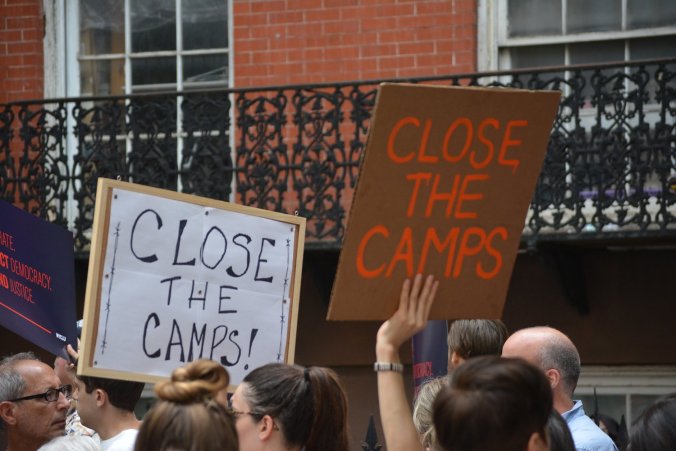
The Aftermath of George Floyd’s Death: How 8 Minutes + 46 Seconds Affected the Health of a Community


by Guest Contributor Kathleen M. Clark, DNP, RN
Edited by Kaija Freborg, DNP, BSN 

Racism is a public health issue and has been the root cause of health disparities for Black, Indigenous, and Persons of Color (BIPOC) in our country for over 400 years.  The recent killing of George Floyd has brought this emergent issue to the forefront of our nation’s attention as we bear witness to a man struggling to breath against a knee of a police officer.  An incident that took 8 minutes and 46 seconds, which may be the same amount of time it takes for you to read this blog, sent people around the world into a rage demanding justice.  In the words of James Baldwin, “Not everything that is faced can be changed, but nothing can be changed until it is faced.”1(p0)  And in my view, facing George Floyd’s death will change the world– we have a responsibility to make sure that it does.
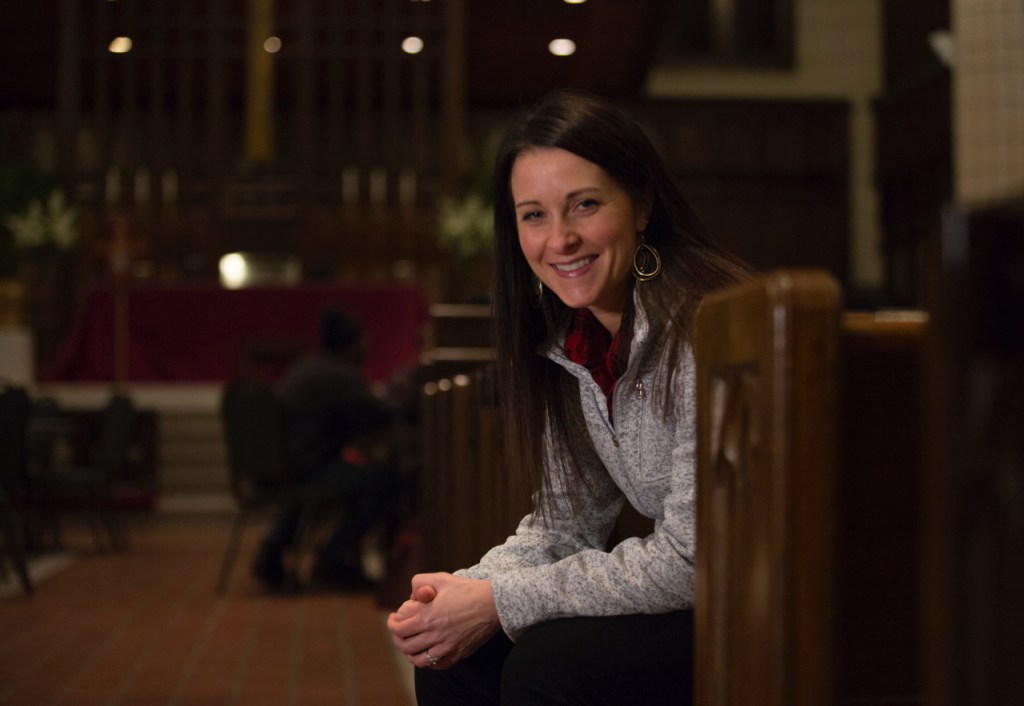
Katie Clark

The reflections I offer in this blog are rooted in the epicenter of the unrest, the city of Minneapolis, amidst the worst pandemic in modern day history.  As a nurse, representing a profession repeatedly cited as the most trusted profession, my worldview is influenced by the patients I serve, those experiencing homelessness in Minneapolis.  In this setting, as I direct the Augsburg Central Health Commons, a nurse-led drop-in center serving those unhoused or marginally housed, I have witnessed the implications of health issues for these individuals.  One of those individuals was George Floyd.  While I knew him in a limited capacity, his membership in the community has amplified the emotions and passions felt by others to take action in response to his death.  Poverty and police brutality, both longstanding issues in the black community of Minneapolis steeped in institutional and structural racism, ultimately led to George Floyd’s murder; his arrest was allegedly over a counterfeit $20 dollar bill.  Stories like this are but one of the many stories I have collected as a nurse engaging in civic agency. I teach in the graduate nursing programs at Augsburg University, which focus on transcultural nursing and social justice praxis. Here are some of my reflections and experiences.

 During the height of our state’s peak of COVID-19, the video capturing George Floyd’s wrongful death spread through social media sites.  The anger at yet another killing of a black man by the hands of systemic racism in our policing systems could no longer be silenced as Minnesota has been the home of first Jamar Clark, followed by Philando Castile, and now George Floyd. Peaceful protesting resulted in nights of looting and rioting where buildings were burned, stores were raided, and the Minneapolis 3rd Police Precinct was taken over by demonstrators.  After each night of protests, the early morning hours revealed not only the visible social carnage but also the anger, fear, despair and loss felt throughout the community. 

One of those mornings I was providing care at the Health Commons, counseling people who had known George and mourned the destruction of their community.  Despite all of this loss, they still felt compelled to support the riots because otherwise there would be no systematic change without it.  Following the Health Commons, I was to bring food to the encampments that afternoon through local volunteer efforts to address the lack of food and water that existed for those living on the streets due to the restrictions of COVID-19.  I was assigned to distribute food to the largest encampment in the Minneapolis area, referred to as the Sabo Encampment.  Accessing the encampment itself was deemed difficult as the typical path to access it was located in the parking lot where a Cub Foods grocery store and Target had been set on fire the night before.  After discovering a way to the area, I found myself in the middle of what I fail yet to understand.  The police were dismantling the tents of the residence in the name of public safety.  According to these officers, the residents of the encampment were the root cause of the rioting, and the encampment served as a public health concern due to the drug use and human feces discovered onsite.  Thus, amongst the back-drop of charred rubble and buildings still in flames, surrounded by a group of activists from Native Against Heroine and Cop Watch groups, I made my way into the encampment to bring the food and water. Realizing how many people were now displaced by a pandemic and now race riots, with no place to go,  I left that moment in a flood of emotions, tears pouring down my face. How could I possibly leave these people in this moment, knowing that they did not cause this unrest, had no place to stay, and were likely to endure more violence?  I felt paralyzed.

As the days of unrest and destruction continued, those who were displaced bore the burden of violence from tear gas used and rubber bullets fired.  That following Saturday night the National Guard entered the streets of Minneapolis on the Governor’s order to address the civil unrest.  News stations across the nation captured tensions rising between demonstrators and the National Guard.  Word spread that those causing much of the unrest were not local residents, but instead they were flooding in from other states, seeking to escalate the situation to a civil war.  Those residing in those neighborhoods found themselves at a loss, not sure of where to turn to ensure personal safety, as vans of white supremacists dropped off people in alleys, explosives were placed in people’s yards, and the National Guard was firing rounds of paint pellets at people on their own porches.

Many residents shared stories of forming neighborhood watch groups during the unrest in response to 911 calls for help were no longer an option, as the system was overwhelmed.  Lee George stated, “Last Saturday we were told by City Councilwoman Alondra Cano during a gathering in Powderhorn Park, that if something happens tonight, if your buildings are burning, if you have armed men in your neighborhood, you are on your own.”  People organized a 24 hour watch system, prepared buckets of water, and connected hoses to spigots (for possible fires or if the water supply became compromised), packed a bag for an emergent exit if needed, and identified those who had certain skills such as medical training.  Not only was the community mobilizing to protect one another, they found themselves caring for peaceful protesters caught in the crossfire or displaced after curfew.  These actions demonstrated acts of solidarity in the community, as neighbors demanded justice for George Floyd.

A group of volunteers, who had been organizing efforts to address the health and safety issues in communities of homeless people during the pandemic, found themselves needing to mobilize in new ways due to the civic unrest. Inspired by the organization theory of mutual aid, they formed a human shield as best possible; volunteers, service workers, and nurses fought to secure safety for the unsheltered.  After negotiating with a nearby hotel, the unsheltered were welcomed to stay at what was temporarily named the Sanctuary Hotel.  The plan was that these individuals would be allowed to stay until the night time violence ended.  That next morning (Sunday), I was able to help provide care to those staying in the hotel and in a nearby encampment.  Most people were exhausted from the endless chaos and trauma they found themselves in.  A few individuals suffered from eye irritants, wounds from rubber bullets, or falls while attempting to flee.  Not one person told me they were actually part of the protesting, but instead they were caught in the crossfire because that is where they had currently called home.  The owners of the hotel decided to allow the unsheltered guests stay longer, while a nearby foundation offered funds to cover the cost of the hotel.  The members of the volunteer group, where there is no one leader named, spread the word that additional volunteers would be needed to maintain the hotel for the guests.  Thus, endless volunteers helped to coordinate on site collecting donations, distributing food, cleaning rooms, washing clothes, providing medical attention, and operating the front desk.  I have never witnessed a group acting in solidarity, without hierarchies or self-interests dictating the next moves.  People came from outside communities to provide assistance and formed trusting relationships in real-time.  While the hotel had to end the stay for the residence 10 days later, being part of this experience with this group re-invigorated my hope as a nurse in the way we can co-create community in the future.

            While still enduring this pandemic, Minneapolis communities continue to organize in unity as well as protest for justice in the wake of George Floyd’s death. While I have endless stories to offer from my nursing practice, these ones surfaced as vital in demonstrating the capacity to act, to create solutions in community that are potentially life-saving.  Nurses have power and this privilege can be used to support and create change in communities where we are called to care.  I have been transformed by the destruction, fear, and pain that has been embodied in structural racism in Minneapolis for more than 100 years, but I’ve also been transformed by the kindness, goodwill, and brave actions of people – many of them nurses – demanding justice for George Floyd.

Photos of Unrest

1Li C. Kinfolk. Confronting History: James Baldwin. 2017.  https://kinfolk.com/confronting-history-james-baldwin/#:~:text=But%20nothing%20can%20be%20changed,wrote%20the%20late%20James%20Baldwin.

About Katie Clark

pronouns she/her:

Kathleen ‘Katie’ Clark is an Assistant Professor of Nursing at Augsburg University and is the Director of the Health Commons. She has taught at Augsburg University since 2009 where her primary responsibilities are in the graduate program in courses focused on transcultural nursing, social justice, and civic agency. She also practiced for over eight years in an in-patient hospital in both oncology-hematology and medical intensive care. She has a Masters of Arts in Nursing degree focused on transcultural care and a Doctor of Nursing Practice in transcultural leadership, both from Augsburg University.   Katie has been involved in the homeless community of Minneapolis for over 15 years and has traveled to over twenty countries.  She lives with her husband and three children in Stillwater, Minnesota.
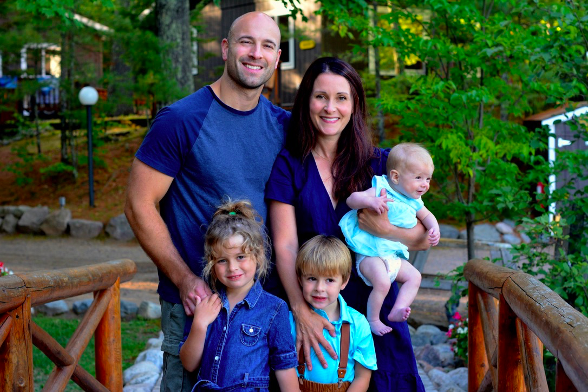
Katie and family
About Kaija Freborg

Kaija Freborg is the Director of the BSN program at Augsburg University and has been teaching as an assistant professor in the undergraduate and the graduate nursing programs since 2011. Her focus in teaching includes transcultural nursing practice as well as addressing social and racial justice issues in healthcare. She obtained a Doctor of Nursing Practice degree in Transcultural Nursing Leadership in 2011 at Augsburg before teaching at her alma mater. Currently her scholarly interest in whiteness studies has her engaging in anti-racist activism work both in nursing education and locally; her aspirations include disrupting and dismantling white supremacy within white nursing education spaces.  Previously Kaija had worked at Children’s Hospitals and Clinics in Minneapolis, in both pediatrics and neonatal care, for over 15 years.
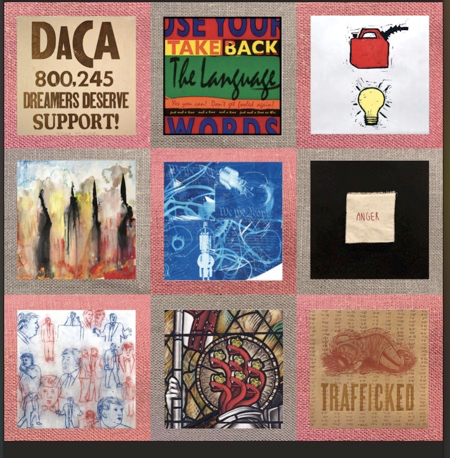
#DetentionIsDeadly  #FreeThemAll #D4CCQuiltProject


Guest contributor: Jane Hopkins Walsh

Background

 Social justice movements have historically incorporated arts based visual components to amplify their messages by using images and visual art to literally making the invisible more visible. Examples of this include Judy Chicago’s Dinner Party  and the AIDS quilt

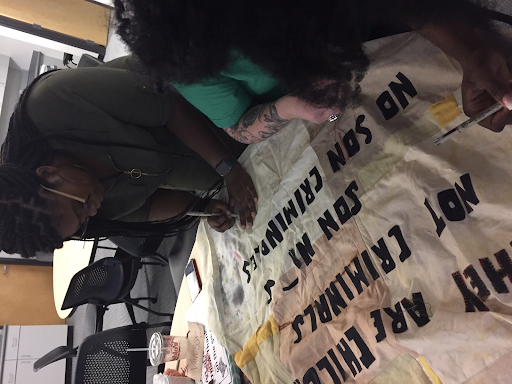
As an arts based medium, quilts are powerful semiotic vehicles for protest and memory, and actual representations of comfort and care. Throughout history, suffragettes, abolitionists, enslaved people, Vietnam war protesters, and HIV/AIDS and 911 survivors have used fiber art and the quilt medium to come together in communal spaces for the purpose of grieving, memorializing and honoring others, and for communicating political opinions about important issues of the day.

This week, health care providers from the group called Doctors for Camp Closure, (D4CC) are coordinating a nationwide 24-hour protest vigils outside detention centers to draw attention to the serious risks of infection from CoVid-19 in detention centers and prisons nationwide. In solidarity and collaboration with community groups around the nation, D4CC are incorporating many arts based events including poetry reading, music, story telling, reflective journaling, and the creation of a virtual and actual protest quilt called the #D4CCQuiltProject.

 Using the social media platform Instagram and the use of the project hashtags, the virtual  #D4CCQuiltProject project will “sew” together images from the nationwide protest, banner messages, and other images or words drawing attention to the risks of CoVId-19 infection for detained and incarcerated people. The #D4CCQuiltProject can also spotlight less obvious historical and structural issues of the Capitalocene that are driving refugees to immigrate around the globe including persistent white settler colonialism, neoliberalism, militarization, persistent extraction of living and non living resources around the world by the Global North, and climate related extremes- all factors driving im/migration globally and to the US, and contributing to conditions of extreme poverty, violence, and food and water insecurity throughout the world. Structural violence issues 

MIssion Statement:  The #DetentionIsDeadly  #FreeThemAll Quilt Project messages are intersectional social justice messages and may include these ideas among others :

  • Show healthcare worker support for the Free Them All movement to release people detained by ICE during COVID pandemic, draw media attention to the dangers of incarceration, and increase public support for decarceration
  • Prisons and detention centers are filled with impoverished Black and Indigenous People of Color, and Undocumented People, and they are increasingly the largest sites of COVID-19 infection
  • Social distancing in detention or prison to reduce the risk of COVID-19 is impossible.
  • As health care providers we oppose detention.
  • Many prisons and detention centers in the US are capitalist oppressive for-profit systems that filled with people who have been disadvantaged across generations by the very systems that now hold them prisoner.
  • Migration to the US is driven by intersectional issues for which we as US citizens are complicit including US colonialism, climate injustice, capitalist extractive industries, globalization and neoliberalism (think sugar, palm oil, hydroelectric power, coffee, lumber, beef, global agriculture to name a few).
  • Native American and Indigenous land rights issues in the US are erased within discussions of immigration. (One example among others is: May 2020 The Wampanoag Tribe in in Massachusetts are struggling to retain land rights).
  • LQBTQI issues get erased in the discussion of immigration and detention.

Project Vision   

  • A virtual quilt that “sews” together square virtual images that align with the purpose of the action. and/or 
  •  An actual quilt that has names, images etc on fabric and that can be actually sewn together and/or 
  • An intersectional art project that is open to the greater art community. 

Project Guide: How to Participate 

DIRECTIONS  

There are TWO WAYS TO PARTICIPATE IN THE QUILT PROJECT

VIrtual Quilt 

  • Take a square photo of any message or image that aligns with issues of social justice, examples above, open to interpretation; the only restriction is the photo/image must pass minimum standards for social media, ie) non vulgar non obscene etc
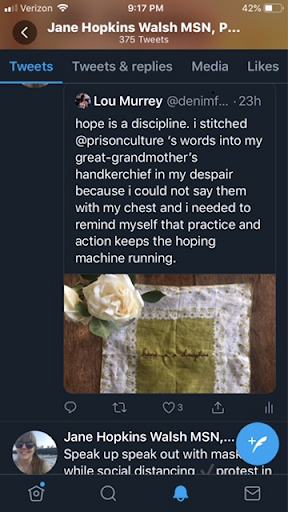
  • Can be poetry, single words or phrases, a photo of a flower, headline in news, anything, names of deceased persons to honor who have been impacted by structural violence, See some image examples below. 
  • You may superimpose a message on a photo you already have. You may superimpose the project hashtags, or a message on a picture of your Protest Banner.
  • A Square image is needed to “fit them together “
  • Upload to Instagram with 3 primary hashtags #DetentionIsDeadly  #FreeThemAll#D4CCQuiltProject
  • Secondary hashtags are fine too but you have to use these 3 so we can “find” the “images” on Instagram you can also Tag @doctorsforcampclosure 
  • Ultimately, the images can be placed on colored squares see below and “sewn” virtually into a virtual quilt. This will happen in the near future after we have a number of images.
  • The quilt will be shared on social media to amplify the messages

Actual Quilt

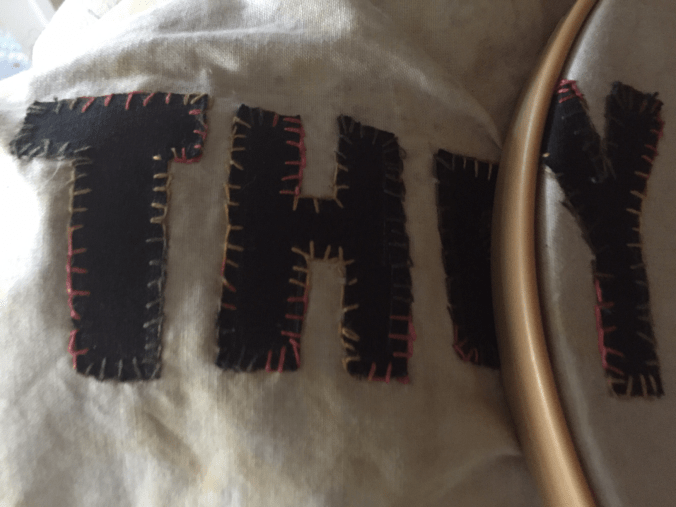
  • During the vigil, before or up to two- four weeks after vigil,  people can mail me 12 by 12 inch squares of actual fabric with messages hand written or sewn , and I will sew them together and make them onto a physical quilt. 
  • Any fabric is acceptable but dimensions should be 12 inches by 12 inches
  • This is a way to get the public, friends, kids,  and family members involved in this cause.
  • People can include the creation of a physical square as a way of reflecting during the 24 hour vigil. Think child art, spontaneous, no pressure to have any “art” or sewing skills. Just has to be about 12 by 12 fabric based no rules on type of fabric.
  • People can invite local community groups to participate in the creation of squares.
  • PM Jane Hopkins Walsh for address where to send fabric.
  •  Fabric must reach me by +- June 15th 2020. 
  • The actual quilt could be part of a larger traveling protest quilt that gets added on to in other future protests. 
  • Ultimately the actual and the virtual quilt could be part of larger intersections with the art community to amplify and intersect our messages. For example we could have sew-ins in protest in NYC or other places, intersecting with other protests, or the quilt could travel to other cities and immigrant groups to include diverse social movements and groups all over. This is fluid and open to discussion as it unfolds.

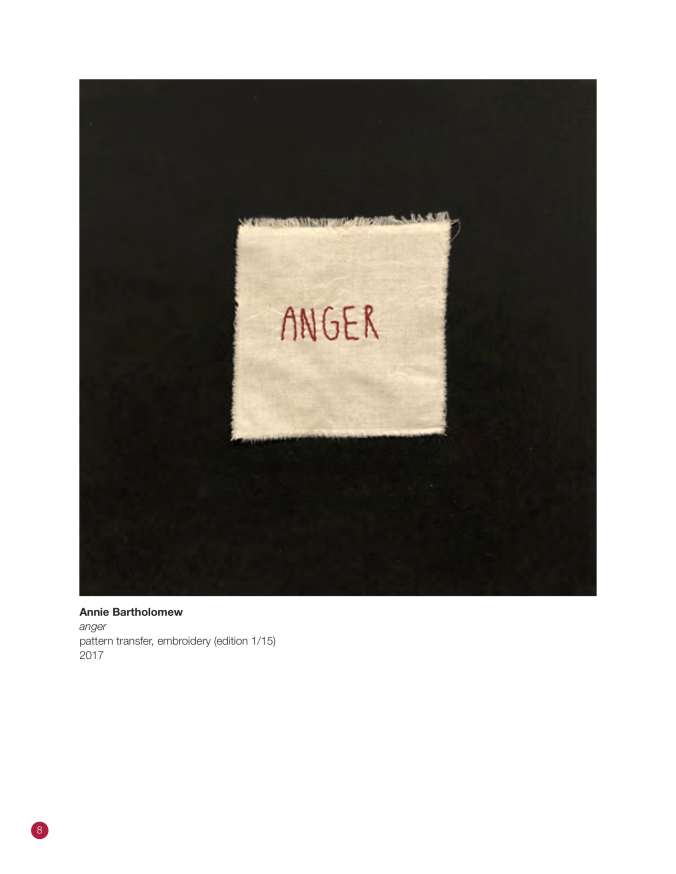
EXAMPLES OF IMAGES BELOW- PLEASE IF YOU SHARE THESE IMAGES  GIVE CREDIT  AS LISTED BELOW.

Credit these 4 tags for this image above please
@voxpopuliprintcollective @shimartnetwork #voxpopuliprintcollective
#shimartnetwork

Credit for this image: from Twitter user@denimfemme Lou Murrey

Credit for the quilt images are
Instagram @janewalsh357 #BorderQuiltProject

Credit for the two quilt images above are
Instagram @janewalsh357 #BorderQuiltProject

Credit for this image
@voxpopuliprintcollective @shimartnetwork #voxpopuliprintcollective
#shimartnetwork


About Jane Hopkins Walsh

Protest Opinions in this document are My own
Pronouns She / Her
Jane Hopkins Walsh MSN, PNPC
Pediatric Nurse Practitioner
Primary Care at Longwood
Boston Children’s Hospital
300 Longwood Ave
Boston, MA  02466
jane.hopkins-walsh@childrens.harvard.edu

Volunteer and Board Member
Cape CARES
Central American Relief Efforts
www.capecares.org

PhD Candidate and Research Fellow
Boston College
William F. Connell School of Nursing
Enrolled: Center for Human Rights and International Justice
Lynch School of Education
Jonas-Blaustein Scholar Cohort 2018-2020
walshjm@bc.edu


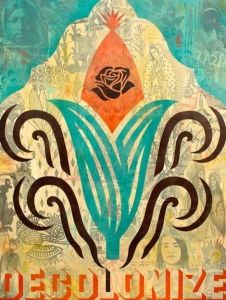
Plática on “Decolonizing Nursing”


On March 9, 2020, Caroline E. Ortiz hosted a “plática” (Spanish for a heart-to-heart talk) on Zoom, bringing together nurses from many U.S. locations to share and discuss the challenges of racism in nursing – the process of “Decolonizing Nursing.”  This was in part a follow-up to Peggy Chinn’s post on Nursology.net, and followed up here on January 16th.  Caroline recorded the session so that others may still contribute to the “plática” – post your comments and ideas below!

Decolonizing Nursing


On Tuesday I published a post on Nursology.net that I want to be sure all NurseManifest followers also see!  The post will be the front page for the week, but go to the post itself to see comments, and to add your own!  Here is the link to the post – https://nursology.net/2020/01/14/decolonizing-nursing/.

The Nursology.net focus, of course, is on the effect of colonization on the development of nursing knowledge – the ways we think, the ways our mental models shape our practice.  But to me, this post also illustrates an important fact about the academic enterprise – it is also inherently political.  As a political enterprise, it holds the power to sustain the status quo, or to challenge and change the status quo.  Ultimately, theoretical knowledge development can be a powerful tool for activism.

Take, for example, the central focus of nursing theory on the “individual” – the individual person as an independent person with unfettered free will, one who has, or can access all the resources needed.  We know how distorted this view is, and unrepresentative of the real world.  We also know, on so many levels, that we do not practice as if this is so.  Another example – the metapardigm concept of the “environment” – a concept that is always poorly conceived and that ends up being the “catch-all” for central, vitally important dynamics we often refer to as “social determinants of health.”

It is time to shift how we think, and the academic enterprise of theorizing needs to make the revolutionary turn to do so.  Indeed, there are seeds of possibility already embedded in many nursing theories and philosophies.  One of the most important is the idea of fundamental patterns of knowing in nursing that was  initially described by Barbara Carper in 1978 – an idea that took immediate “hold” on the nursing imagination and remains so today as a powerful tool to resist “empirics” alone as the basis for nursing practice.  And there are nursing theories already “out there” that reflect this same kind of holistic embrace that have great potential to undergo significant shifts.  For example, in response to my “Decolonizing Nursing” post, Anne Boykin and Savina Schoenoffer have already planned discussions to consider revisions of the Theory of Nursing as Caring to “decolonize” their ideas.

Then equally important, there is the task of creating new theories grounded in a new, decolonized nursing metaparadigm!  Many who follow this blog are well equipped, and ready, to do just this!!  So keep those ideas flowing, and use this and other important visionary nursing platforms (importantly Radical Nurses), to nurture your ideas and develop visions for the future!

Call to Action: Join a March Against Migrant Detention Camps in Washington DC October 19, 2019


Information provided by Jane Hopkins Walsh

A group named Doctors for Camp Closure (D4CC) is organizing a protest march in Washington DC on October 19, 2019 to petition congress to act on behalf of migrant people imprisoned in unsafe and inhumane conditions in detention camps. This grassroots coalition appears to lack significant nursing representation. I blog today to invite concerned nurses to join the physicians and medical students, who have come together to form D4CC to protest against continued human rights violations of refugees and asylum seekers. D4CC is collecting signatures and will march to physically present them to congress on October 19th. Please consider joining the protest march and also signing the petition. Everyone is invited to march – not just doctors and nurses.

Over the past years, many of us as concerned nurses, have asked ourselves and each other how we can organize to protest the detention of refugees and asylum seekers. Several Radical Nurse blog posts have addressed the unjust and inhumane practices of detaining immigrant people and families, and of separating children from their parents. Thousands of children and families are still imprisoned- detained under conditions that are contributing to suffering, illness, and preventable deaths, and causing irreversible trauma for refugees that have already experienced tremendous hardships.

recent policy decision from US officials not to vaccinate detained immigrant people against influenza is especially cruel. As the globe braces for a particularly bad flu season, this dangerous government mandate is expected to cause serious illness and death among detainees who are imprisoned in extremely overcroweded conditions. I cannot, we cannot, sit passively by and watch this unfold.

Collectively building relationships to join together for a common cause are basic principles of grass roots organizing. Groups intersecting and forming coalitions are powerful strategic tools used to create social change. I urge you to join D4CC to ensure that nursing has a strong presence in this important protest. I envision a group renamed: Doctors and Nurses for Camp Closure. Please join me. Sign the petition today. Come to DC on October 19th.

The future depends on what you do today ~~Mahatma Gandhi

Jane Hopkins Walsh is a Spanish speaking pediatric nurse practitioner at Boston Children’s Hospital. She is a PhD Candidate in Nursing and Jonas-Blaustein Scholar at Boston College. She is enrolled in a certificate program at the Center for Human Rights and International Justice at the BC Lynch School of Education.

Jane is a volunteer and board member for the longest-serving NGO in Honduras called Cape CARES (www.capecares.org). Jane is passionate about social justice and immigrant rights and volunteers for Project Reunify (www.reunify.org), the Dilley Pro Bono Project (https://www.immigrationjustice.us/volunteeropportunities/dilley-pro-bono-project) and The Center for Human Rights and Constitutional Law  (www.centerforhumanrights.org).

Gravatar

Peggy Chinn: You are commenting using your WordPress.com account. Log Out /  Change )