The Promise of Nursing: Social Justice and Health


Those of us who have been involved in the Nurse Manifest Project are deeply committed to the idea of social justice – the notion that reaching for social justice is fundamental to human health and well-being and that social justice is central to our purpose.  It is the promise we make to individuals and to communities when we claim to care for each and every person for whom we care. But like many other social concepts and ideals, the meaning of social justice often alludes us. So I decided to ask all of our NurseManifest bloggers to share, in just a couple of sentences, their concept of social justice!  Here is what they sent: 

Elizabeth: On my walk the morning, I recall thinking that “social justice” is not a noun but a verb. It is not something that is, rather it is what you do. It is one’s life’s work. Well, it is my life’s work.

Carey: I think in nursing we can view social justice as our ethical obligation to support the healing of those who are suffering due to social inequities and the promotion of equality and human rights in the society which we serve.

Sue: My belief is that social justice is the process of questioning privilege and whose interest is being served.  Of course, there’s also courage– to question, to act, to be vulnerable, and to be part of a collective that holds social justice dear.

Marlaine: Social justice is about creating compassionate social, political and economic structures (such as laws, policies, organizations) that preserve dignity, equity, equality and human flourishing.

Danny: Social justice in nursing means that nurses keep their focus on facilitating humanization whereby every person is provided the means for health, meaning, and well-being in both living and dying and treated with moral respect and dignity. Social justice in nursing necessarily requires nurses to examine and address the underlying person-environment root causes of dehumanization and social injustices that prevent human flourishing and individual and societal well-being.

Richard: Social justice is an expression of a society that values, appreciates, and fosters the freedom and equanimity of all peoples and all creatures to live fully in accord with their greatest and highest good, health, and well-being.

Olga: Social justice is an ideal or core value that emphasizes the creation of conditions that ensure human dignity for all. Social justice (human dignity) can be achieved under conditions of extreme poverty or ill health, and also can be destroyed under seemingly optimal economic conditions, or by well-intentioned (i.e., paternalistic) actions.  

Lisa: Social justice is the equitable distribution of resources and power whereby no individual or group is privileged over another and all have a fair opportunity to contribute, receive, and flourish.

Wendy: Social justice is the embodiment of personal and professional values that uphold and protect the sacred and inherent worth of all human beings to live their lives in freedom; Freedom to express, develop and explore ones individual and unique self on all levels, without religious, societal and hegemonic constraints or condemnation. Nurses advocate for social justice when they address barriers that restrict freedom for self, others, patients and families.

Jane: For me social justice means simply treating others as we would like to be treated. It means creating a society where people feel empowered to succeed and live well emotionally and physically – in every possible aspect of life. It means building on people’s strengths, not weaknesses, so that they can become even stronger.  I tend to think of things in terms of health, but I truly believe the preceding applies to work, relationships, and everything else people experience in society.

Adeline: For me social justice is both an ideal of an equitable (not to be confused with equal) distribution of societal resources and advantages and an ethic that requires us to work towards achieving the ideal.   

For me (Peggy), social justice is all of these things – and my fundamental perspective rests in the understanding that we all participate in the structures that create and sustain social injustice in the world.  Some of these structures we cannot change – after all we live and participate in societies that inherently structure advantage for some and disadvantage for others.  For me our first step toward creating social justice is to understand the ways in which the healthcare systems in which we participate create and sustain injustice, then work with utter dedication to changing what we can.  As noted in the reflections above, social justice is a verb, it is action, and it takes courage!  May our words of reflection lend courage to your dedication to this human endeavor!
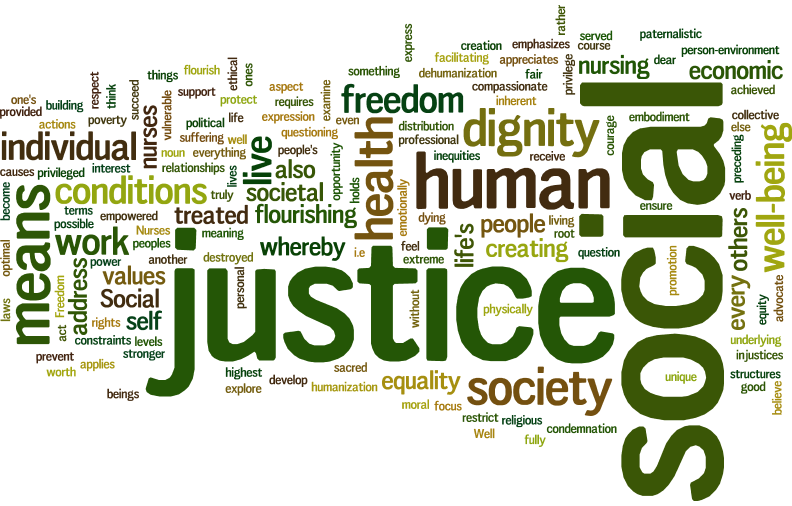
social justice wordle

The UK National Health Service: What about nursing?


We are delighted to welcome this message from Elaine Maxwell, addressing the current challenges facing nurses and nursing in the UK National Health Service (NHS).  Her message has world-wide implications!

I am one of those nurses, I think the NHS is a wonderful jewel built on a shared sense of equality and justice (and I have worked briefly in private healthcare both in the UK and in the USA). The challenge for the NHS is that there are different opinions on what it is there for and how to evaluate it. Discussions are more often focused on

Elaine Maxwell

Elaine Maxwell

ideology (socialism versus market economies) that what the staff within in actually do.

The Commonwealth Fund (2014)1 rated the NHS as first internationally for effectiveness, safety, patient centeredness, cost and efficiency and third for timeliness of care. In spite of this, successive UK governments of both main political parties have focused on cost savings and faster access.

Starting in 1997 with the New Labour Blair Government, the definition of a good service moved from a broad base to focus on access and cost. Targets were introduced for waiting times for both emergency and elective care and organisations incurred financial penalties for failure to achieve them whilst at the same time they had to cut unit costs in order to become quasi autonomous ‘Foundation Trusts’. Something had to give and in the NHS it was nursing.

Nurses failed to articulate their therapeutic contribution and some enthusiastically embraced the role of managing patient flow to achieve access targets. This was a tangible, visible contribution to the new managerialism agenda as opposed to more opaque, but critical, nursing interventions. This lack of visibility led management consultancies to recommend wholesale cutting of nursing posts, for example McKinsey advised that nursing posts could be cut in London to save £421 million a year without any impact on the quality of the service2.

This perfect storm was exemplified by the failings at Mid Staffordshire NHS Foundation Trust and described in detail by the public inquiry3 which clearly laid the blame for many of the failings at the feet of nurses. Although the report detailed the swingeing cuts in nurse numbers prior to the failures, it also suggested (without any empirical evidence) that academic nurses with the ‘wrong’ values had been recruited and that potential nurses should work as unregistered care assistants before being allowed to study. Despite concerns from nurses4, this idea is being piloted in the NHS and a recent BBC programme demonstrated that nurses and students have bought into this rhetoric5

Following the publication of the report, the Government commissioned a review of Trusts with apparently high mortality rates6. These ‘Keogh’ Trusts were found universally to have ‘insufficient’ nurses and those that recruited significant numbers of nurses have improved their quality outcomes the most.

So UK nursing is currently confused. There is a belief that increasing the number of registered nurses improves quality as demonstrated by Aitken and colleagues7 but this type of cross sectional correlation study does not explain what it is that nurses actually do to create this quality. The Chief Nursing Officer for England has focused on individual nurses’ values with her strategy ‘Compassion in Practice’8. The Quality Improvers, with a nod to LEAN thinking, are focused on the getting patients through the system faster with nurses managing the flow so that medical staff can provide their clinical intervention. No one, it seems, feels that nurses have a unique therapeutic contribution and nurses who trained at a time when Henderson’s definition of nursing was embraced and who learnt and practised nursing models are now in the twilight of their careers.

With increasing numbers of people with multiple co morbidities, the traditional episodic medical treatment model looks increasingly unlikely to meet the needs of our population but without nurses who actually nurse, more and more people are readmitted to our hospitals and so the vicious cycle of speeding up the flow intensifies.

When Margaret Thatcher sought to reorganised the NHS in 1983, her advisor said “In short, if Florence Nightingale were carrying her lamp through the corridors of the NHS today she would almost certainly be searching for the people in charge”9. I contend that if Florence Nightingale were carrying her lamp through the corridors of the NHS today she’d be asking “Where are the nurses?”

So what can nurses do about it? We need to reclaim our area of practice and make it visible by articulating our unique contribution, which is often tacitly shared amongst nurses and patients but policy makers and managers can be entirely oblivious to it.

We need to use the language of those with power and describe how nursing is more than a support service to medicine. Nursing has its own independent added value that can realise benefits for organisations as well as patients. The Dutch community nursing service, Buurtzorg10 has done this by ensuring that care is led by highly educated RNs who work autonomously with few protocols. This model has been independently audited and shown 40% reduction in cost of service with improved quality scores as nurses have been empowered to direct their work to where they add the most value; nursing not management. When we speak this language, we connect with others and the value of nursing can be understood and celebrated

1 Commonwealth Fund (2014) Mirror, Mirror on the Wall: How the US Health Care System compares internationally  www.commonwealthfund.org

2 Nursing Times news report (2012) http://www.nursingtimes.net/nursing-practice/clinical-zones/management/london-hospitals-told-they-could-slash-nursing-bill-by-421m/5041068.article

3 Francis, R. (2013) Report of the Mid Staffordshire NHS Foundation Trust Public Inquiry London: The Stationery office http://webarchive.nationalarchives.gov.uk/20150407084003/http://www.midstaffspublicinquiry.com/report

4 Maxwell, E. (2013) Francis inquiry: compulsory work as healthcare assistants won’t make better nurses British Medical Journal, 346

5 Grumbling Appendix blog   “Do Not adjust your (mind) set “ 25th July 2015 https://grumblingappendix.wordpress.com/

6 Keogh B (2013) Review into the quality of care and treatment provided by 14 hospital trusts in England: overview report London: NHS England http://www.nhs.uk/NHSEngland/bruce-keogh-review/Pages/Overview.aspx

7 Aiken, L. H. et al (2014) Nurse staffing and education and hospital mortality in nine European countries: a retrospective observational study The Lancet 383(9931), 1824-1830

8 Commissioning Board Chief Nursing Officer and DH Chief Nursing Adviser (2012) Compassion in Practice: Nursing, Midwifery and Care Staff Our Vision and Strategy. London: Department of Health NHS Commissioning Board. http://www.england.nhs.uk/wp-content/uploads/2012/12/compassion-in-practice.pdf

9 Griffiths R (Chair) (1983) NHS Management Inquiry London: HMSO www.sochealth.co.uk/history/griffiths.htm

10 http://buurtzorg.com