Nurses striking: is it effective?


As many of you have likely heard, the nurses employed by Sutter Health in Northern California staged a strike on Thursday September 22, 2011 in protest over an increase in benefits costs and decreases to sick and vacation leave. ofhttp://www.forbes.com/feeds/ap/2011/09/23/general-us-calif-nurses-strike_8696370.html

While the non-profit Sutter Health has real profits in the near billion dollar range, we are left wondering why it is the nurses’ benefits are being cut even as the heads of the organization walk home with millions of dollars of “bonuses” each year.

http://www.bizjournals.com/sanfrancisco/news/2011/03/25/sutter-healths-2010-profits-surge-30.html
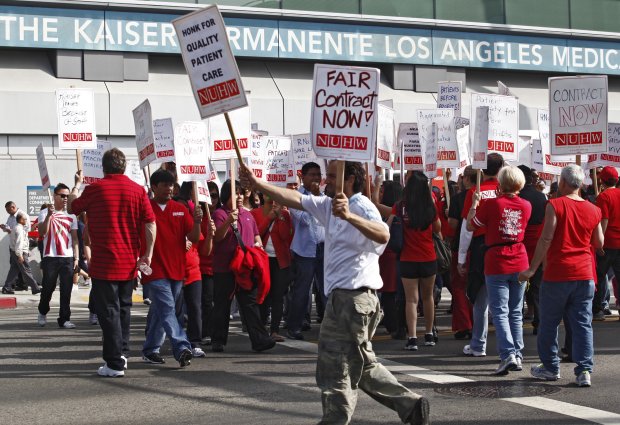
I think the nurses are in some respects justified in taking this stance and going on strike; they are working together to stand in solidarity (though up to 40% of the nurses at the various hospitals crossed the picket lines and reported to work). On the other hand, I feel that the strike does not create an atmosphere for discussion and dialogue that might be meaningful. This action in and of itself seems unlikely to create a path for communication between administrators, decision makers, and the nurses. The union itself also prevents much of this direct communication and may prevent the working nurses from communicating their concerns outside of the union’s presence.The strike does create some obstacles and safety concerns for patients, administrators, nurses crossing the strike line, and the replacement nurses.

I have thought a mass exodus of the nurses, or many immediate resignations, would be more effective, though highly unlikely to happen for obvious financial reasons. For each nurse who quit, Sutter would lose at least $60, 000 in training a new nurse to replace them. These expenses could add up very quickly if a good chunk of the nurses walked away from their positions. Sutter may have problems with hiring new nurses in relation to the higher costs of benefits, the reduction in vacation pay, and the elimination of paid sick leave. Paid sick leave can help to stop the spread of illnesses like the flu (have we already forgotten H1N1?), but perhaps I am digressing a bit here.

It would be interesting to poll the public and get their perception of striking nurses, professionalism, empowerment, and the image of nurses. From the current state of the media coverage, it is difficult to tell where the public stands on this.

We do know that the nurses have now been locked out until Tuesday, as at least two of the hospitals have a minimum contract of five days for their temporary staff contracts. These contracts are likely very expensive and in no way are saving Sutter any money, which was the reason given for changes in the benefits. http://www.baycitizen.org/blogs/quality-of-life/nurses-who-went-strike-told-not-come/

The issue of unions, strikes and walk-outs is prime for nursing researchers to continue to explore: what are the outcomes of strikes, do the nurses feel or experience a sense of empowerment through the process, what is the public’s perception of nurses’ unions and strikes, and so on.


To Challenge and to Cooperate


Most readers of this blog are already aware of the IOM/Robert Wood Johnson report on the Future of Nursing that was issued in October of 2010.  You may recall my post about the report last June – in fact, there were 16 replies to that post – a record for this fledgling blog!  The replies were thoughtful and brought to the fore exactly what is most badly   needed in nursing – challenges about not only the report, but the assumptions underlying it.  So I would like for us to focus once again on this initiative, not simply because of the terrific discussion it raised on this blog, but because it is generating a substantial degree of action.  Part of the action component is built into the funding plan that accompanied the original report, which actually strengthen the possibility that something will come of it!  But of course the action components need to be watched closely.  The challenge for me, and I suspect for many others who entered the discussion in June, has to do with a fundamental question: “Who benefits?”

During the August conference of INANE (International Academy of Nursing Journal Editors) in San Francisco, the 130+ nursing journal editors and publishers heard a presentation by Susan Hassmiller, the Senior Advisor for Nursing for the Center to Champion Nursing in America.  In response to her presentation, the group decided to initiate a coordinated effort across as many nursing journals as possible, to further the possibilities for the achievement of the report’s recommendations.  So far, the INANE web site has a listing of editorials and resources that have appeared in various nursing journals over the past year or so; in the spring of 2012, many of the journals will carry focused messages about the report, articles, and other content that provides evidence and resources for their readers in moving forward.  I would encourage folks to browse this list … it is impressive, and many of the editorials are well worth looking up and reading.  Also, if you want to see Susan Hassmiller’s presentation from the INANE conference, you can find it here (scroll down to the Friday 8:00 session).

So my question for readers of the Nurse Manifest blog: can we both challenge and cooperate?  I fully agree with many of the challenges that came forward in our discussion in June, including skepticism about the source of the report, and the fact that the report’s recommendations are in fact what we might call “lame.”  However, the cold hard truth is that the recommendations of the report, which of course should already be reality, are far from real.  If we were to achieve the report recommendations as reality, do we not have a better outlook for achieving not only the fundamental goal of better health care and better nursing care, but also the ideal of seeing nursing at the center of health care policy-making.  If we simply sit on the sidelines and challenge the report, then we isolate ourselves from the places where mainstream change might be possible.  If we simply cooperate with the report without questioning some of the assumptions and directions, then we ourselves may all too easily be drawn into an abyss of the status quo.  So bottom line, to me, there is no simple way forward.  But I favor moving forward, challenging ideas and actions where possible to be heard, and with as much cooperation as possible with those who follow a more mainstream path than many of us follow!